
Table of Contents
We talk about financial independence with clients almost every day. We rarely use the word ‘retirement’. Our clients have far too much energy and ambition to resonate with the old definition of retirement.
Financial independence is what most of them crave. The ability to work because you want to, not because you need to. It is a quieter, more flexible word than retirement, and it leaves room for the work, the travel, the family time and the contribution that most people still want in their 50s, 60s and 70s.
The harder question is what happens when you actually get there. What does FI feel like? For many it meets every expectation of freedom and liberation. For others, in the words we hear in client meetings: be careful what you wish for.
What financial independence actually means in Australia
Financial independence is a financial state and an emotional state at the same time.
Financially, it is the point at which your invested assets, owned property, business income, super and lifestyle structures can sustain your living standard without you needing to work for income. Practically, that often looks like a combination of:
- A mortgage paid down or fully offset.
- A diversified investment portfolio outside super, large enough to cover lifestyle for many years.
- Superannuation positioned for the next phase, with a clear strategy around contributions and access.
- Business or property income that is no longer reliant on your day-to-day attention.
- Insurance and estate structures designed for the family rather than for the wage.
Emotionally, FI is the point at which the wage stops being the centre of gravity. That sounds attractive in theory. In practice, it changes a lot of small daily anchors that most people had not realised they were leaning on.
Why hitting the number is often the easier half
Across the last two decades, we have walked many clients into financial independence. The pattern we see is consistent. The years of accumulation feel hard while you are in them, but they are deceptively clear. There is a number, a strategy, a structure, a cadence.
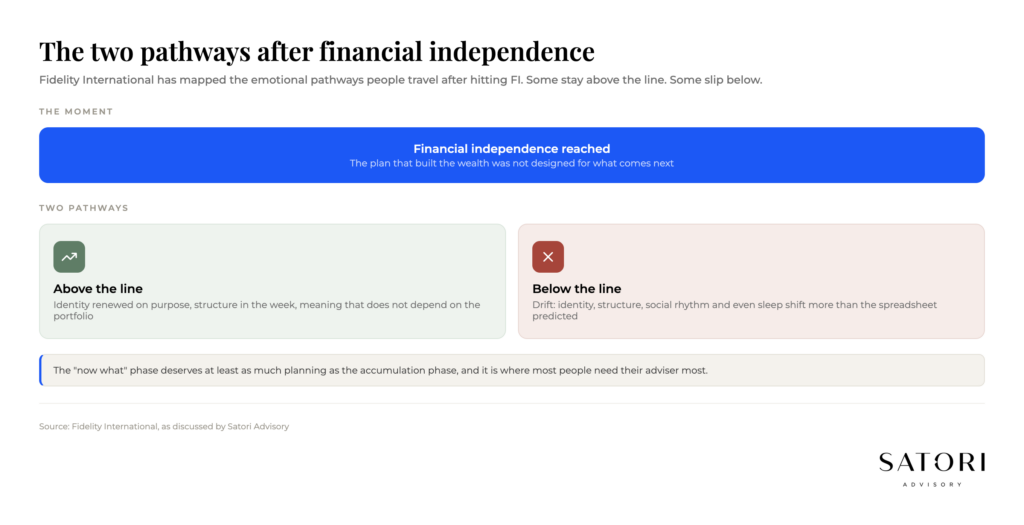
The first 12 to 24 months after hitting FI are often the most disorienting. The plan that worked to accumulate the wealth was not designed for what comes next. Identity, structure, social rhythm and even sleep can shift more than the spreadsheet predicted.
The most common things we hear in those first two years are not financial. They sound like this:
- “I am not sure what to say when people ask what I do.”
- “I have more time than I have ever had and somehow get less done.”
- “Markets move and I notice it more than I used to.”
- “My partner is still mid-career and our rhythms have come apart.”
- “I have started saying yes to things I do not really want to do, just to fill the calendar.”
None of those are financial planning problems in the strict sense. All of them shape financial decisions.
Above and below the line: the two paths after financial independence
We have watched this phase play out across many client families, and the emotional pathways that people travel after hitting financial independence. The simplified version is that everyone moves through a transition, and from there they tend to settle either above the line or below it.
Above the line is the chapter most people picture when they imagine financial independence. New projects, more time with family, deliberate health, travel that actually relaxes, mentoring or board work, a small business done for love, contribution work in the community. The portfolio is the platform, not the centre.
Below the line is quieter and harder to see from the outside. Restlessness. Boredom. A drift into over-monitoring the portfolio. Spending that grows to fill the calendar. Identity slowly leaking out of the diary. From the outside the numbers can still look great. From the inside the years feel thinner than they should.
The work after FI is to design the conditions that keep you above the line, and to recognise the early signals when you are slipping below it.
Strategies for staying above the line
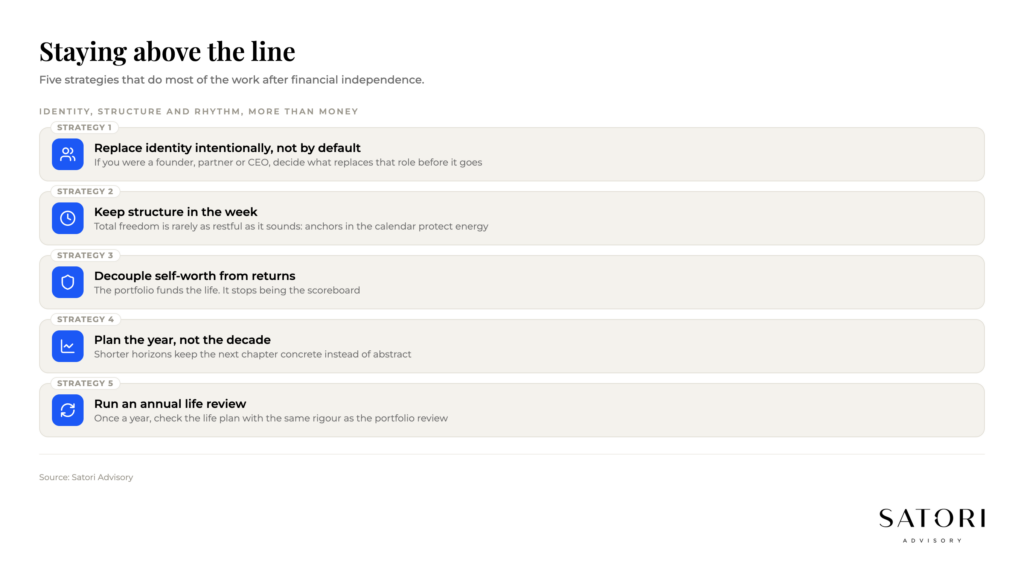
In our experience there are five strategies that do most of the work in the first three years after FI.
1. Replace identity intentionally, not by default
If you were a partner, a founder, a CEO or a senior leader, that identity does not exit gracefully on its own. Pick the next two or three labels you want to be able to say out loud at a dinner. Board director. Mentor. Cyclist. Writer. Active grandparent. The portfolio funds these. The labels do the heavier lifting.
2. Keep structure in the week
Total freedom is rarely as restful as it sounds. We see clients thrive when there is a real cadence in the week, even if every block is self-chosen. A morning ritual. A standing meeting. A sport. A community commitment. Structure is not the opposite of freedom. It is the container that lets freedom feel like freedom.
3. Decouple lifestyle from portfolio noise
Once the wage stops, the portfolio becomes the most visible income source, and small market moves can feel personal. The work is to set a clear drawdown strategy, build the cash buffer that supports it, and then trust the structure. Above-the-line clients tend to check their portfolio less, not more.
4. Plan the calendar for the next year, not the next decade
Most people over-plan the decade and under-plan the year. The year is where above-the-line living is actually built. A small number of meaningful trips, projects, learning blocks and family commitments in the diary will do more than any rebalance.
5. Run an annual life review, not just a portfolio review
We sit down with clients once a year to look at the portfolio. We also use that meeting to look at the rest of the life. What changed in the last twelve months. What is missing. What is being avoided. The financial plan is downstream of those answers.
How the conversation with your adviser should change
During accumulation, the adviser is mostly optimising returns, tax, structure and lending. After financial independence, the adviser is doing those things and protecting identity, time and meaning at the same time.
Practically, the conversation shifts in three ways.
- From contributions to drawdown. The question becomes how much, from where, in what order, with what tax outcome.
- From growth to sequencing risk. The early years of FI have outsized impact on the rest of the plan, so the cash buffer and asset mix design matters more.
- From single household to multi-generational. Estate, super death benefits, family loans and business transition all start to share the table with the lifestyle plan.
What to do next
If you are within five years of financial independence, or you have just crossed the line, the most useful next step is rarely a new investment idea.
It is a calmer conversation about three things:
- What does an above-the-line year actually look like for you?
- What in your current plan was designed for accumulation, not for this next chapter?
- Where, in the next twelve months, is the gap between your portfolio strategy and your life strategy?
Behind the scenes we continue to integrate the strategy, the numbers, the tax, the lending and the structures. Out the front, the conversation increasingly becomes about staying above the line. If anything in this piece raised a question for you, please reach out.
How Satori Advisory works
At Satori Advisory we energise every part of your financial world. We integrate your tax, business, wealth and lending as a prosperity engine, aligned with what matters most to you. With a clear roadmap, informed by data and backed by decades of strategic experience, we simplify the complex. We do not offer pre-packaged solutions. We deliver tailored, end-to-end advice that reflects your reality and ambitions. You work directly with senior advisers who listen deeply, think boldly and act with purpose, supported by our trusted team and curated network of financial and business specialists, so you can realise your potential, powered by numbers.
Frequently asked questions
What does financial independence mean in Australia?
Financial independence is the point at which your invested assets, property, business income, super and lifestyle structures can sustain your living standard without you needing to work for income. It is the ability to work because you want to, not because you need to.
Is financial independence the same as retirement?
No. Retirement implies stopping work. Financial independence implies optionality. Most of our clients continue to work in some form after reaching FI: board roles, mentoring, smaller businesses, advisory or community work. The wage stops being the centre of gravity, but contribution does not.
What is ‘above the line’ and ‘below the line’ after financial independence?
In our client work we see two broad pathways after hitting FI. Above the line is the chapter where the portfolio funds a deliberate life of meaning, structure and contribution. Below the line is restlessness, drift and over-monitoring of the portfolio. The plan after FI is designed to keep you above the line.
How long is the transition into financial independence?
In our experience, the first 12 to 24 months after hitting FI are often the most disorienting. Identity, structure and rhythm shift more than the spreadsheet predicts. After that, clients who have intentionally replaced their identity, kept structure in their week, and decoupled lifestyle from portfolio noise tend to settle above the line.
Should I draw down on super, investments or cash first?
There is no universal answer. The drawdown strategy depends on your age, super balance, marginal tax rate, the size and tax efficiency of your investment portfolio outside super, and the role of cash buffers. The goal is to fund the lifestyle, manage tax across the household, and reduce sequencing risk in the early years.
Ready to talk?
If you are approaching financial independence in Australia, or you have recently hit your number and are asking ‘now what’, we would be glad to set up a calm, no-pressure conversation.
Please feel free to get in touch on 1300 925 081 or send an email to [email protected] if you’d like to book in a chat on the above or on other matters.
Disclaimer
This article contains general information only and has been prepared without considering your objectives, financial situation or needs. It is not personal financial advice, taxation advice or legal advice and should not be relied upon when making financial decisions. Before acting on any information, consider its appropriateness to your circumstances and seek professional advice where appropriate.