
Table of Contents
In managing money for Australian families we keep a close eye on what is moving around the corner, not just what is moving on the screen today. Some of the most useful research in that conversation comes from Visual Capitalist, whose work on the future direction of financial markets pulls together signals that quietly reshape how capital behaves.
Two of their pieces sit on our reference shelf. One identifies six powerful signals revealing the future direction of financial markets. The other tracks big-picture trends accelerated by the events of 2020 and the years that followed. Below is how we read those signals through an Australian long-term investor lens.
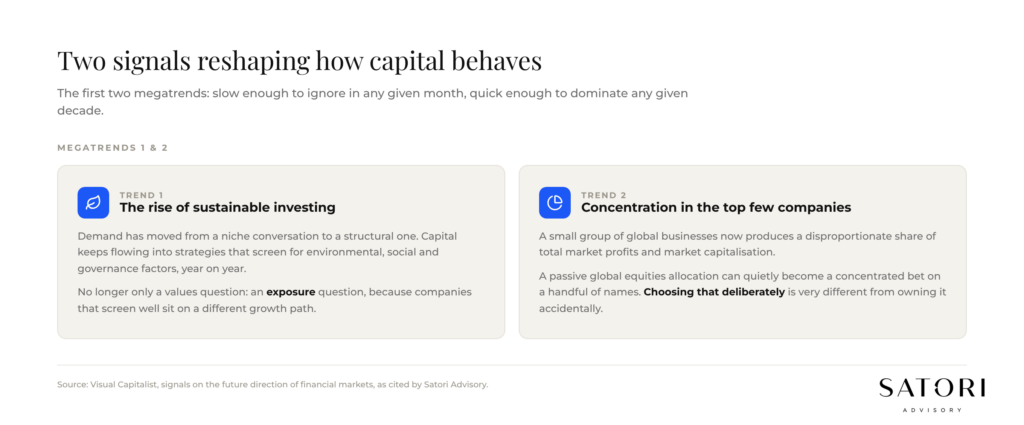
1. The rise of sustainable investing
The demand for sustainable investments has moved from a niche conversation to a structural one. Capital continues to flow into strategies that screen for environmental, social and governance factors, even if the pace of those flows has become uneven over recent years. The pool of ESG-screened capital is large enough to keep influencing where portfolio managers sit.
For long-term investors this matters in two ways. Sustainable investing is no longer only a values question, it is also an exposure question, because the underlying companies and sectors that screen well sit on a different growth path to those that do not.
2. The concentration of wealth in the top few companies
Visual Capitalist flags the growing concentration of wealth in the hands of the top few companies. A small group of global businesses now produces a disproportionate share of total market profits and market capitalisation.
This has practical implications. A passive ‘global equities’ allocation can quietly become a concentrated bet on a handful of names. Knowing that, and choosing it deliberately, is very different from owning it accidentally.
3. Digital transformation of the economy
The shift toward digital business models has been one of the clearest big-picture trends of the past decade. Sectors that were once defined by physical footprint, branches and inventory have been rebuilt around software, data and direct customer access.
For portfolios, this means the line between ‘tech’ and ‘every other sector’ is blurring. Many of the most resilient businesses inside traditional sectors now look more like software companies underneath.
4. The reshaping of work and consumption
How and where people work, and what they spend on, has shifted in ways that show no signs of fully reversing. Remote and hybrid work, online consumption and the redrawing of physical retail are now part of the long-term backdrop, not a temporary detour.
Long-term investors should ask which businesses sit on the right side of that change, and which ones have business models that depend on the world looking the way it did before.
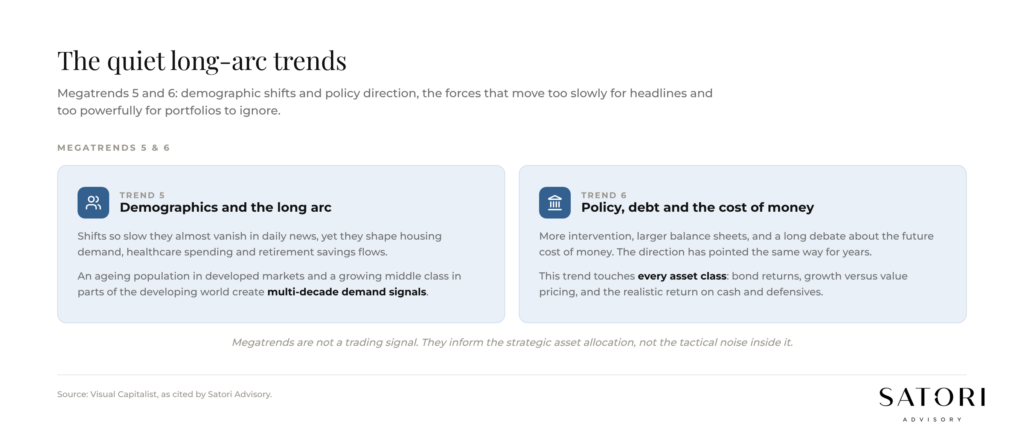
5. Demographics and the long arc
Demographic shifts move so slowly they almost vanish in daily news, yet they shape everything from housing demand to healthcare spending to retirement savings flows. An ageing population in developed markets and a growing middle class in parts of the developing world create persistent, multi-decade demand signals.
Whether you are building wealth, preparing for retirement, or already drawing income, demographic exposure inside your portfolio is worth a deliberate look.
6. Policy, debt and the cost of money
Interest rates, government debt and policy intervention have moved through a sharp adjustment over recent years. A pronounced hiking cycle, then an easing cycle, against a backdrop of elevated public debt and an open debate about where the cost of money settles next. The cost of money is back to being a live variable inside portfolio decisions.
This trend touches every asset class. It shapes bond returns, the relative pricing of growth versus value businesses, and the realistic expected return on cash and defensive holdings inside a balanced portfolio.
How we use megatrends inside a long-term plan
Megatrends are not a trading signal. They will not tell you what to buy on Monday or what to sell at the end of the quarter. They are slower and more useful than that.
- They inform the strategic asset allocation we choose for clients, not the tactical noise inside it.
- They influence which sub-sectors and themes we are happy to overweight inside growth assets.
- They feed into the regular review conversations we have about whether a portfolio is still positioned for the world it actually lives in.
The mistake we see most often is reading a megatrend headline and trying to trade it next week. The compounding power is in the opposite direction, owning the right exposures patiently, while the trend does its slow work.
What this means for you
If you have not looked at your portfolio through a megatrends lens in a while, three quiet questions are worth taking into your next review.
- Where is your portfolio quietly concentrated, and is that concentration intentional?
- How much of your growth exposure is positioned for the world ahead versus the world behind?
- Are your sustainable investing preferences expressed in your actual holdings, or only in your conversations?
How Satori Advisory works
At Satori Advisory we energise every part of your financial world. We integrate your tax, business, wealth and lending as a prosperity engine, aligned with what matters most to you. With a clear roadmap, informed by data and backed by decades of strategic experience, we simplify the complex. We do not offer pre-packaged solutions. We deliver tailored, end-to-end advice that reflects your reality and ambitions. You work directly with senior advisers who listen deeply, think boldly and act with purpose, supported by our trusted team and curated network of financial and business specialists, so you can realise your potential, powered by numbers.
Frequently asked questions
What are megatrends in financial markets?
Megatrends are slow-moving structural forces that reshape capital markets over years and decades rather than weeks. Visual Capitalist’s work highlights signals like the growing demand for sustainable investments and the concentration of wealth among the top few companies as examples worth tracking.
Why does wealth concentration among top companies matter for my portfolio?
A standard global equities allocation can quietly become a concentrated bet on a small group of names that drive most of the index. Knowing that, and choosing it deliberately, changes how you think about diversification and risk inside your plan.
Is sustainable investing actually a long-term trend?
Visual Capitalist identifies the growing demand for sustainable investments as one of the structural signals shaping market direction. The pool of capital flowing into ESG-screened strategies remains structurally significant, even if year-on-year flows have become uneven since 2023, and continues to influence sector exposures.
How should I use megatrends inside my investment plan?
Megatrends are best used to inform your strategic asset allocation and your conversations about which themes and sub-sectors to hold patiently, not as a short-term trading signal. The compounding is in owning the right exposures while the trend does its slow work.
Ready to talk?
If you would like to look at your portfolio through a megatrends lens, we would be glad to set up a quiet conversation.
Please feel free to get in touch on 1300 925 081 or send an email to [email protected] if you’d like to book in a chat on the above or on other matters.
Disclaimer
This article contains general information only and has been prepared without considering your objectives, financial situation or needs. It is not personal financial advice, taxation advice or legal advice and should not be relied upon when making financial decisions. Before acting on any information, consider its appropriateness to your circumstances and seek professional advice where appropriate.