
Table of Contents
Australian super has accumulated a lot of vocabulary over its 30-plus years of evolution. Most of the terms describe rules that move every year or two. The result is a vocabulary that feels intimidating even to people who have held super accounts for decades.
Below is a plain-English 2026 guide to the terms that actually matter for most Australians. The figures are current to 2026-27 and reflect changes recently legislated.
Super Guarantee (SG)
The compulsory amount your employer must contribute to your super on top of your wages.
Rate as of 1 July 2025: 12%. This is the final scheduled step in the long-running staircase of SG increases.
SG is calculated on ordinary time earnings (OTE), which generally excludes overtime and certain bonuses.
Employers must pay SG quarterly. The June quarter contribution must be received by the fund by 30 June if the employer wants to claim the deduction in the current financial year.
Maximum Contribution Base
The earnings cap on which SG is payable.
For 2026-27: $270,830 for the financial year (annual from 1 July 2026 under Payday Super).
If you earn above this cap, your employer is not required to pay SG on the part of your earnings above the cap.
This produced a maximum SG contribution per employee of $7,500 per quarter ($30,000 per year) for 2025-26. The maximum contribution base indexes each year, so confirm the 2026-27 figure at ato.gov.au.
Concessional contributions cap
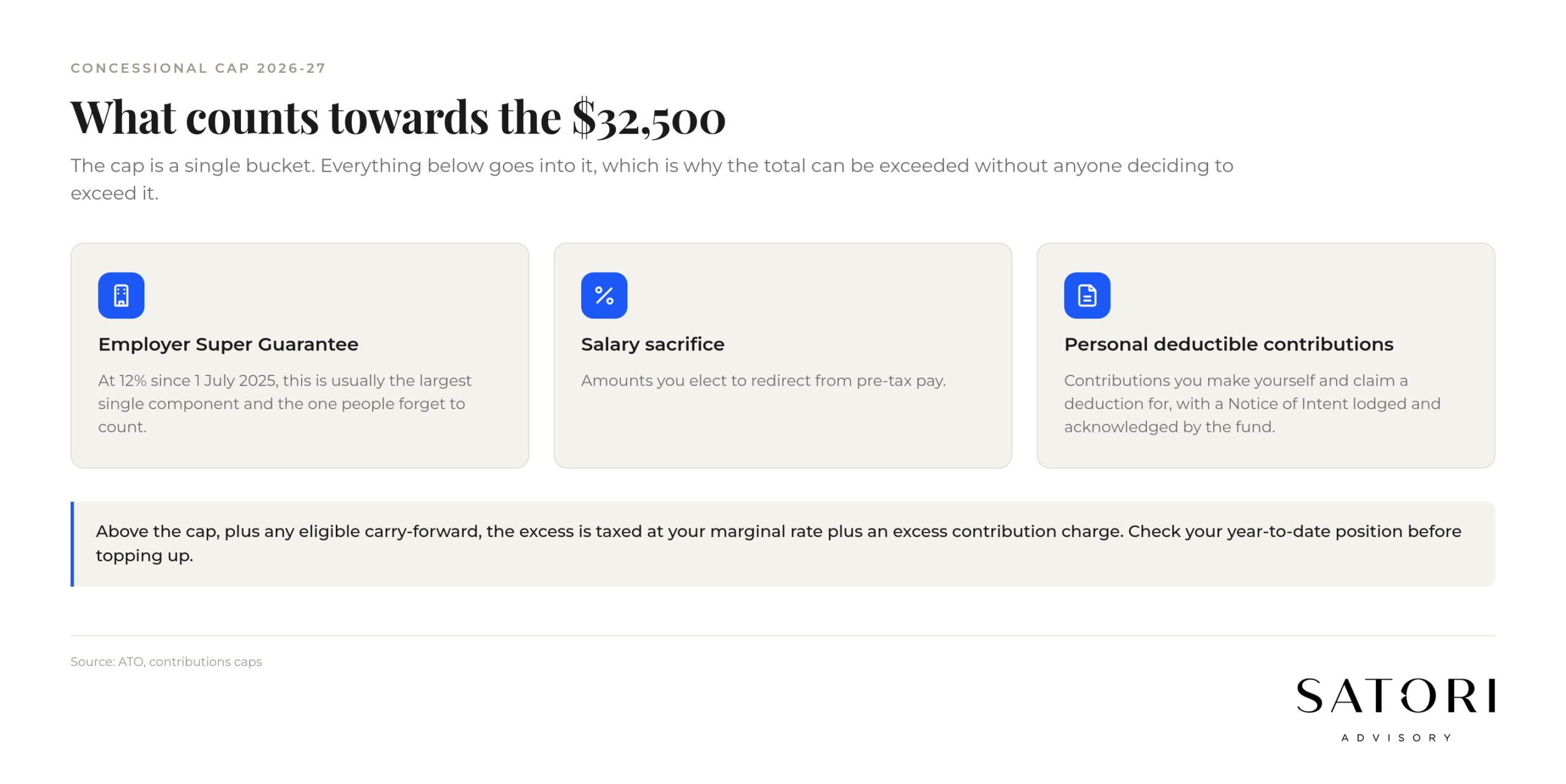
The annual cap on pre-tax contributions into super. Pre-tax contributions include the SG, salary sacrifice, and personal contributions you claim a deduction for.
Cap for 2026-27: $32,500 (up from $30,000 in 2025-26).
Contributions inside the cap are taxed at 15% in the fund. Contributions above the cap are taxed at your marginal rate plus an excess contributions charge.
Carry-forward concessional contributions
If your Total Super Balance (TSB) at 30 June of the previous financial year was under $500,000, you can use unused concessional cap from up to the previous five financial years.
30 June 2026 is the last opportunity to use unused 2020-21 cap before it expires permanently.
An individual who has not used any concessional cap across the previous five years and is eligible to carry forward may contribute up to $167,500 in 2026-27.
Non-concessional contributions cap
The annual cap on after-tax contributions into super (contributions for which you do not claim a deduction).
Cap for 2026-27: $130,000 per year.
Bring-forward rule: members under age 75 can sometimes contribute up to three years of cap in a single year (up to $390,000), depending on TSB.
If your TSB is at or above the transfer balance cap, your non-concessional cap may be zero. Check before making large non-concessional contributions.
Transfer Balance Cap (TBC)
The lifetime cap on the amount you can transfer from accumulation phase super into the tax-free retirement (pension) phase.
General Transfer Balance Cap: $2.1 million for 2026-27, up from $2.0 million for 2025-26 and $2.1 million from 1 July 2023 to 30 June 2025.
Amounts above the TBC must remain in accumulation phase (where earnings are taxed at up to 15%) or be withdrawn.
Preservation age
The age at which you can access your super if you have retired permanently.
Preservation age is 60 for everyone born on or after 1 July 1964 (i.e., for every Australian retiring in 2024 onwards).
You can access your super on or after preservation age if you have permanently retired. You can access it from age 65 regardless of work status.
Government co-contribution
A scheme where the government adds to your super if you make an eligible after-tax (non-concessional) contribution and your income is below specified thresholds.
2026-27 thresholds: maximum entitlement is $500 if you earn $47,488 or less and make a $1,000 after-tax contribution. The benefit phases out completely at $62,488.
At least 10% of your income must come from salary, wages or business activity to qualify.
Tax on super contributions, earnings, and withdrawals
Contributions: concessional contributions are taxed at 15% inside the fund. Non-concessional contributions are tax-free entering the fund (you already paid tax).
Earnings: investment earnings in accumulation phase are taxed at up to 15%. Earnings in retirement-phase pension accounts are tax-free (subject to the Transfer Balance Cap).
Withdrawals after age 60: generally tax-free.
Withdrawals before age 60: tax depends on the components of the account (tax-free component, taxable component).
Division 296 (the $3 million super tax)
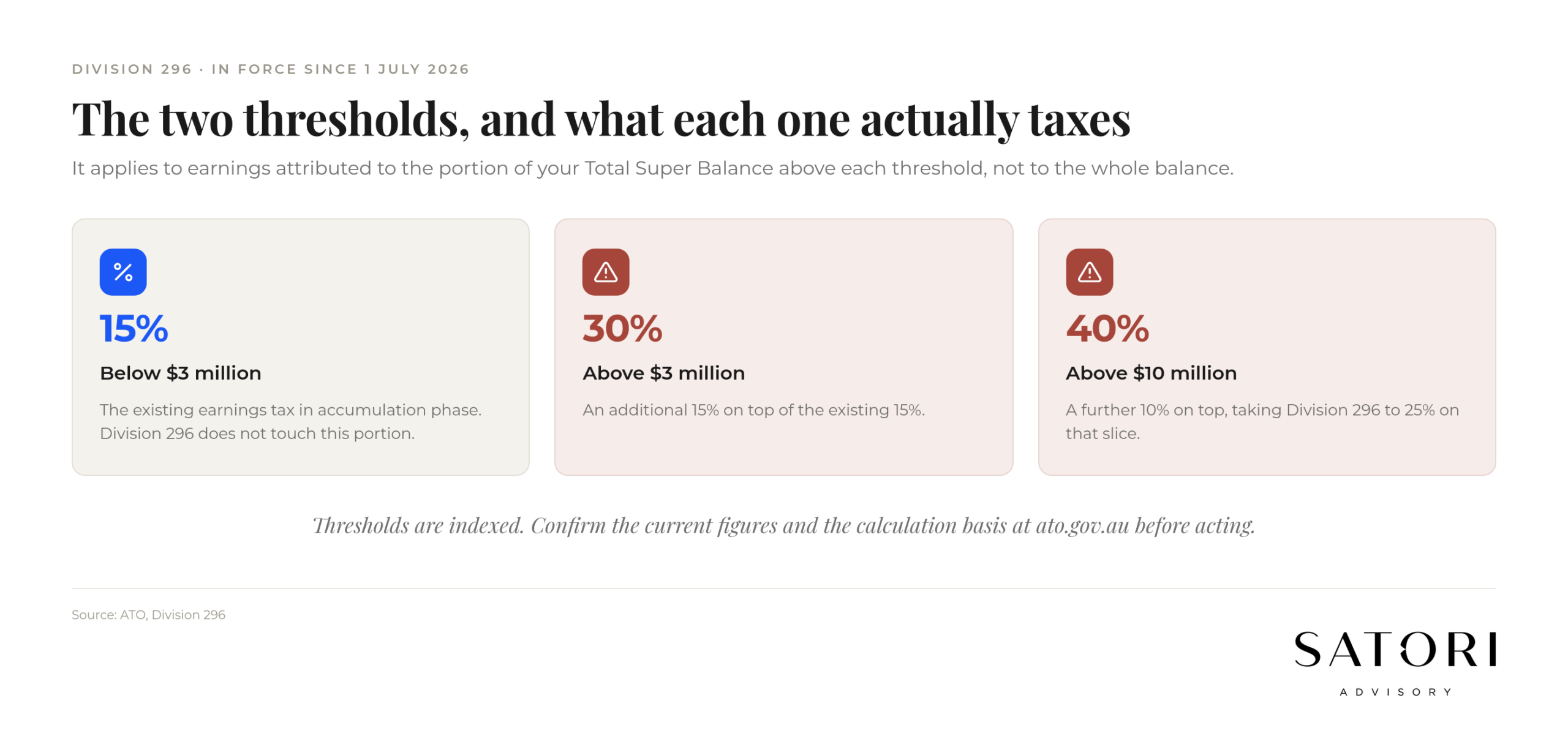
New tax on earnings attributed to super balances above $3 million. Legislated 10 March 2026 (Royal Assent 13 March 2026), has been in force since 1 July 2026.
Rate: an additional 15% (on top of the existing 15% on super earnings, so 30% total) on earnings attributed to the portion of your TSB above $3 million.
A further 10% applies on top of that for the portion of your TSB above $10 million (so total Division 296 of 25% on that portion, plus the underlying 15% = 40%).
Applies to TSB measured on 30 June. First assessment year is 2026-27. First liabilities fall due in 2027-28.
Practical implications
Once you know the vocabulary, the planning levers become clearer.
Use your concessional cap each year. If you have spare cap and the cashflow to top up, the 15% contribution tax rate beats your marginal rate in almost every situation.
Use carry-forward if you have unused historical cap and your TSB is under $500,000. The 2020-21 unused cap expires on 30 June 2026.
Test eligibility for the Government co-contribution every year if your household has a lower-earning spouse.
Plan around the Transfer Balance Cap if you are approaching retirement.
Get ahead of Division 296 if your TSB is approaching $3 million.
How Satori Advisory works
At Satori Advisory we integrate your tax, business, wealth and lending as a prosperity engine, aligned with what matters most to you. With a clear roadmap, informed by data and backed by decades of strategic experience, we simplify the complex. We don’t offer pre-packaged solutions. We deliver tailored, end-to-end advice that reflects your reality and ambitions. You’ll work directly with senior advisers who listen deeply, think boldly and act with purpose. Feel cared for by our trusted team and curated network of financial and business specialists, as we empower you to make smart decisions and realise your potential, powered by numbers.
Frequently asked questions
What is the Super Guarantee rate in Australia in 2026?
12% from 1 July 2025. The compulsory employer contribution on ordinary time earnings, paid into a super fund of the employee’s choice.
What is the concessional contributions cap for 2026-27?
$32,500 per year. Includes employer Super Guarantee, salary sacrifice, and personal deductible contributions. Contributions inside the cap are taxed at 15% in the fund; contributions above the cap are taxed at your marginal rate plus an excess contributions charge.
What is the non-concessional contributions cap for 2026-27?
$130,000 per year. After-tax contributions for which you do not claim a deduction. Some members can bring forward up to three years of cap to contribute up to $390,000 in a single year, depending on age and TSB.
What is the preservation age for Australian super?
60 for everyone born on or after 1 July 1964. You can access super on or after preservation age if permanently retired, or from age 65 regardless of work status.
What is the Transfer Balance Cap?
The lifetime cap on amounts you can transfer from accumulation phase super into the tax-free retirement pension phase. General cap is $2.1 million for 2026-27, indexed over time.
What is the Government co-contribution?
A scheme where the government contributes up to $500 to your super if you make a $1,000 after-tax contribution and your income is under $47,488 (phasing out at $62,488). At least 10% of income must come from salary, wages or business.
What is Division 296?
A new tax on earnings attributed to super balances above $3 million. Legislated March 2026, has been in force since 1 July 2026. Additional 15% on earnings attributed to the portion above $3M, with a further 10% on the portion above $10M.
Ready to talk?
If you would like a calm, no-pressure conversation about how this applies to your specific situation, we are here to help.
Please feel free to get in touch on 1300 925 081 or send an email to [email protected] if you’d like to book in a chat on the above or on other matters.
Disclaimer
This article contains general information only and has been prepared without considering your objectives, financial situation or needs. It is not personal financial advice, taxation advice or legal advice and should not be relied upon when making financial decisions. Before acting on any information, consider its appropriateness to your circumstances and seek professional advice where appropriate.