
Table of Contents
Successful people use their budget like a fuel gauge. It is the one dial that tells you whether you are going to make it to your next destination. Likewise, your budget should be able to tell you whether you are on track to reach your next goal.
Spending spare time entering and editing budget data manually is a thing of the past. The Satori myVAULT client portal categorises bank transactions automatically, with you setting the rules and the platform doing the work.
Below is the structure myVAULT uses: seven categories, designed to make Australian household cashflow legible at a glance.
Fixed core expenses
Fixed core expenses are the regular, predictable costs that keep the household running. They include groceries, utilities, automotive expenses (registration, insurance, maintenance), healthcare and medical, home maintenance, insurances, personal care, online services, petrol and fuel, pet and pet care, and transport.
These costs tend to recur monthly or quarterly with relatively stable amounts. They form the floor under the household’s monthly cashflow.
Variable core expenses
Variable core expenses are costs you may not incur every week, but that are still important to track. A special dinner, a gift to friends or family, an irregular medical expense, a one-off home improvement.
These expenses have a considerable impact on your overall financials even though they do not appear every month. Capturing them in a dedicated category makes the impact visible rather than absorbed into the discretionary bucket.
Kids
If you have children, expenses relating to them deserve their own category. Childcare fees, school fees, after-school activities, sport, hobby-related costs, clothing, uniforms, and the constant stream of small expenses that come with kids.
Allocating child-related expenses into a single core bucket might be your first instinct, but the structure of these expenses changes meaningfully as children get older. Childcare fees cease when school starts. Private schooling fees can change each year. Sport or hobby expenses can be one-off or ongoing. Tracking them separately surfaces the trajectory.
Roof over your head
Like the kids category, the ‘roof over your head’ expense is often a core expense but is best isolated. Rent or mortgage repayments, rates, body corporate fees, and home insurance.
Understanding this expense ensures accurate forward planning. For example, if you are currently renting and hope to purchase a home, what impact will the mortgage have on your excess cashflow? Isolating the housing cost makes the comparison cleaner.
Transfers
Most Australian households have multiple bank accounts. Internal transfers between your own accounts can unbalance even the most comprehensive budgets if they are treated as expenses.
myVAULT isolates internal transfers in a dedicated category so they do not double-count as spending. This keeps the balance sheet view accurate and the cashflow analysis honest.
Investments and savings
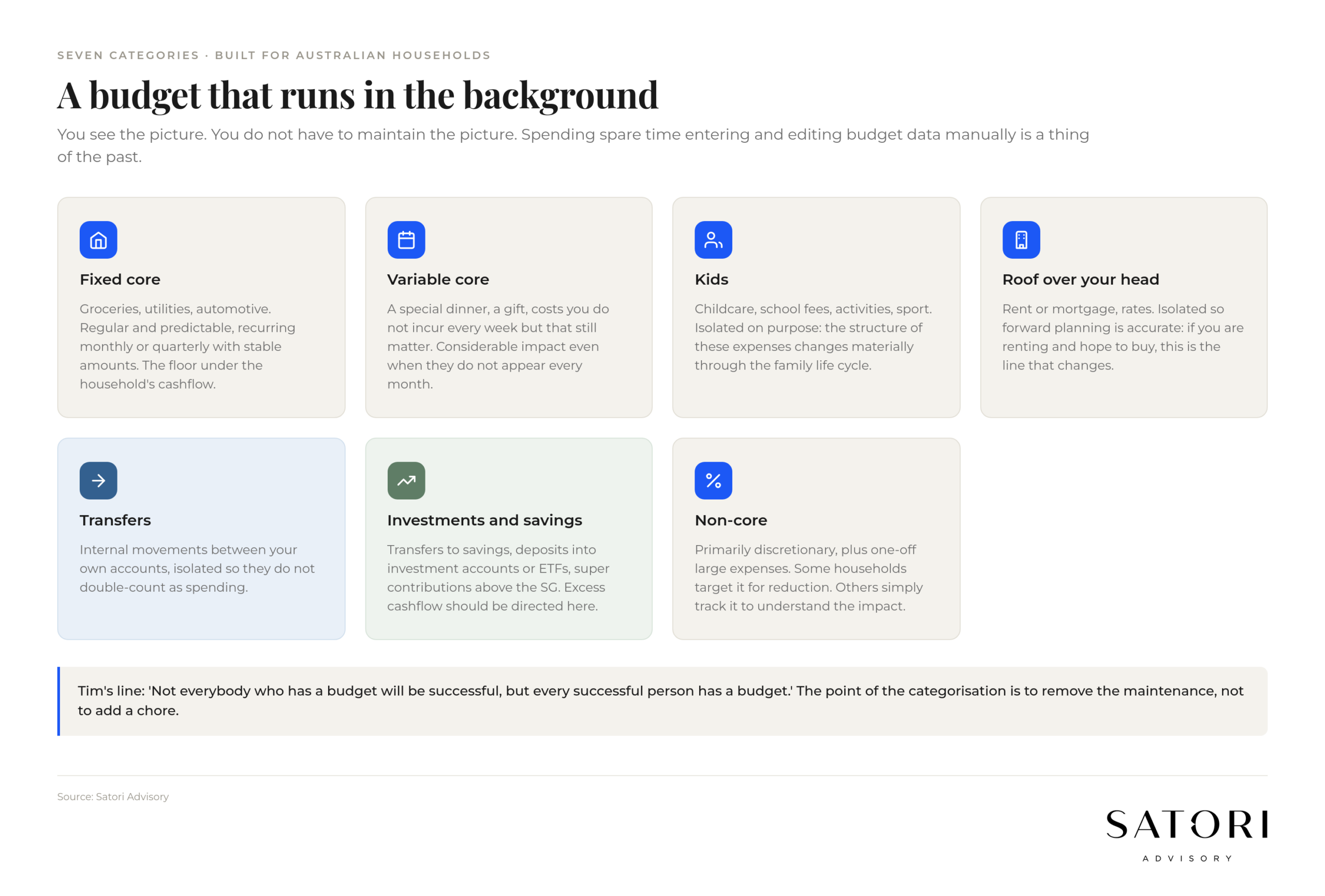
The fun stuff. These categories identify activity relating to savings and investing. Excess cashflow should be directed toward these areas.
Examples: transfers to savings accounts, deposits into investment accounts or ETFs, super contributions above the SG (salary sacrifice, personal deductible contributions), payments into offset accounts above the minimum mortgage repayment.
Tracking these transactions is key to supercharging your financial future. Combined with the goals functionality in myVAULT, this category becomes the engine room of the household’s wealth building.
Non-core expenses
Non-core expenses are primarily discretionary spending. The category captures one-off large expenses, work-related expenses (where the household is paying out of pocket), postage, printing, business costs, outgoing wages, and similar.
Some households use this category as a target for reduction. Others simply track it to understand the impact on the future. Either approach works; the discipline is to look at the number.
How the categorisation actually runs
myVAULT connects to your bank accounts through secure read-only data feeds, pulls the last 12 months of transactions, and applies the seven-category structure automatically.
Where the platform’s default categorisation does not match your preference, you can override any single transaction. The platform remembers the rule and applies it consistently going forward. By the second or third month, most households need very little manual input.
The result is a budget that runs in the background. You see the picture; you do not have to maintain the picture.
How Satori uses myVAULT in client advice
For our clients, myVAULT is the shared picture between you and your adviser. When we are running an annual review or weighing a major financial decision, we are looking at the same numbers you are.
The integration matters. When the adviser recommends increasing concessional super contributions, the recommendation references the actual excess cashflow visible in myVAULT, not a guessed figure. When the recommendation is to redirect spending from non-core to investments, the magnitude of the move is anchored in real data.
Tim Hobart often says: ‘Not everybody who has a budget will be successful, but every successful person has a budget.’ myVAULT removes the friction so the habit can stick.
What to do next
If you are an existing Satori client and have not yet set up myVAULT, ask your adviser at your next meeting. Setup takes about ten minutes.
If you are considering working with Satori, the integrated advice conversation includes myVAULT as part of the ongoing engagement.
How Satori Advisory works
At Satori Advisory we integrate your tax, business, wealth and lending as a prosperity engine, aligned with what matters most to you. With a clear roadmap, informed by data and backed by decades of strategic experience, we simplify the complex. We don’t offer pre-packaged solutions. We deliver tailored, end-to-end advice that reflects your reality and ambitions. You’ll work directly with senior advisers who listen deeply, think boldly and act with purpose. Feel cared for by our trusted team and curated network of financial and business specialists, as we empower you to make smart decisions and realise your potential, powered by numbers.
Frequently asked questions
What categories does myVAULT use for budgeting?
Seven categories: fixed core expenses (groceries, utilities, vehicle, healthcare), variable core (special dinners, gifts, irregular expenses), kids (childcare, school, activities), roof over your head (rent or mortgage, rates, body corporate), transfers (internal account movements), investments and savings, and non-core discretionary.
Can I override myVAULT’s automatic categorisation?
Yes. You can re-categorise any transaction. The platform remembers your rule and applies it consistently to similar transactions going forward. By the second or third month, most households need very little manual input.
How does myVAULT handle transfers between my own accounts?
Internal transfers between your own accounts are isolated in a dedicated Transfers category so they do not double-count as expenses. This keeps the balance sheet view accurate and the cashflow analysis honest.
Why are kids and housing their own categories?
Because the trajectory of those expenses is different from typical core spending. Kids expenses change meaningfully as children grow (childcare → school → activities). Housing is the largest single household line item and isolating it makes forward planning cleaner.
How does myVAULT help me save more?
By making the investments and savings category visible alongside spending categories. Most households realise once they can see the categories together that their excess cashflow is smaller than they assumed, and use that visibility to make deliberate redirections.
Is myVAULT free for Satori clients?
myVAULT is included as part of the ongoing advice service for Satori clients. No separate subscription. Speak with your adviser about access.
Ready to talk?
If you would like a calm, no-pressure conversation about how this applies to your specific situation, we are here to help.
Please feel free to get in touch on 1300 925 081 or send an email to [email protected] if you’d like to book in a chat on the above or on other matters.
Disclaimer
This article contains general information only and has been prepared without considering your objectives, financial situation or needs. It is not personal financial advice, taxation advice or legal advice and should not be relied upon when making financial decisions. Before acting on any information, consider its appropriateness to your circumstances and seek professional advice where appropriate.