
Table of Contents
Franking credits are one of the more durable features of Australian investing. The Hawke / Keating government introduced them in 1987 to remove the double taxation that previously hit Australian shareholders: a company paid tax on its profits, then the shareholder paid tax again on the dividend received.
Compared with the US system, where dividend income from direct share investments is generally taxed at the shareholder’s full rate, the Australian imputation system delivers materially better after-tax outcomes for shareholders, especially for lower-tax investors. Below is a 2026 lens on how the system actually works.
How franking credits actually work
When an Australian company pays company tax (currently 25% for base-rate entities or 30% for other companies), it accumulates franking credits. When the company later distributes profits to shareholders as dividends, it can attach those franking credits to the dividend.
The shareholder includes both the cash dividend and the franking credit in their assessable income (this is called the ‘gross-up’). The shareholder then pays tax on that grossed-up amount at their marginal rate, and receives a credit for the tax already paid by the company.
If the company tax already paid exceeds the shareholder’s tax on the grossed-up dividend, the shareholder receives a refund of the excess (subject to current refundability rules).
A worked example
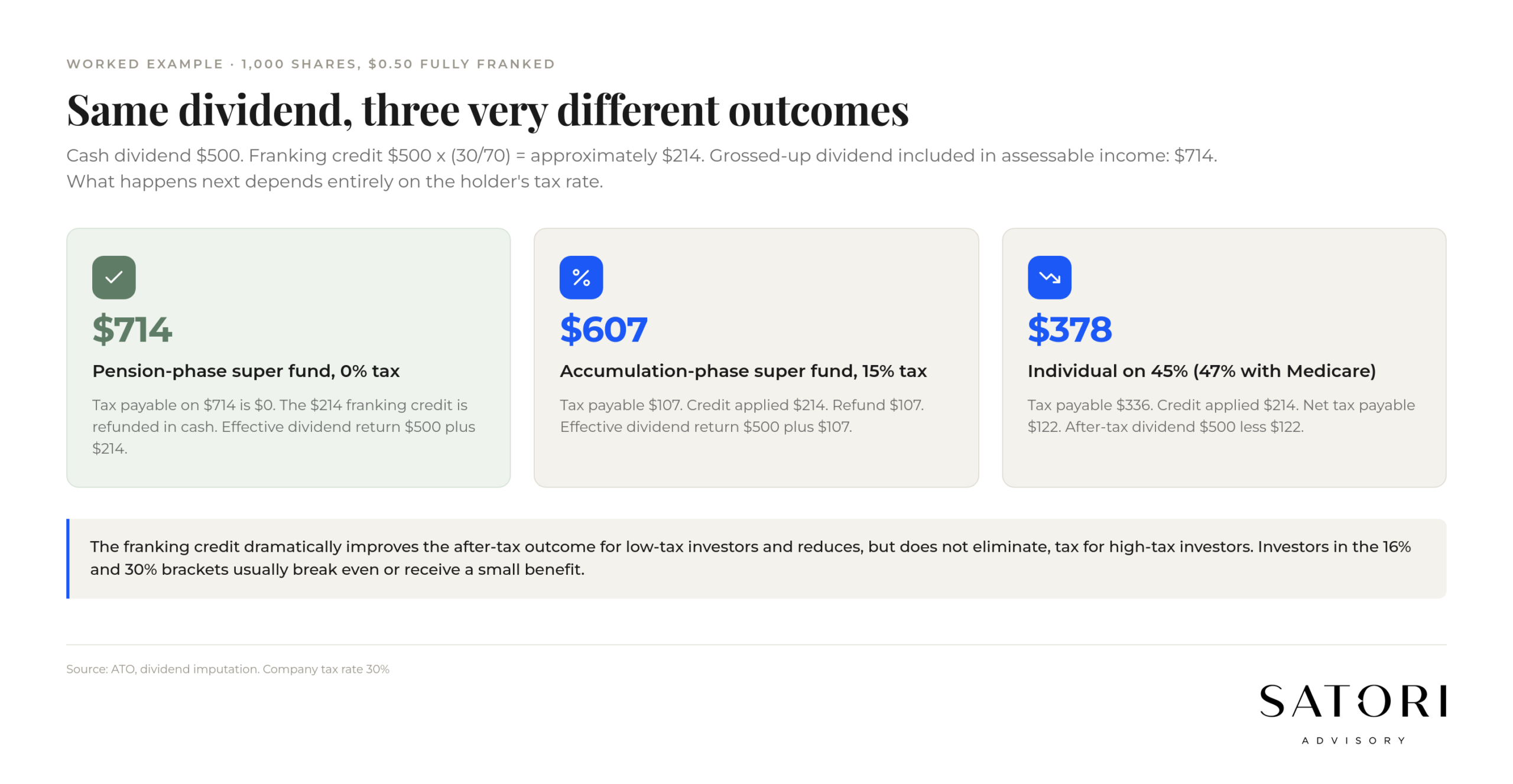
Consider 1,000 shares in ABC Pty Ltd, trading at $10.00 per share. ABC pays a fully franked dividend of $0.50 per share. The company tax rate is 30%.
Cash dividend: 1,000 × $0.50 = $500.
Franking credit: $500 × (30 / 70) = approximately $214.
Grossed-up dividend included in assessable income: $500 + $214 = $714.
Three different shareholder outcomes:
Pension-phase super fund (0% tax): tax payable on $714 = $0. Franking credit refunded: $214. Effective dividend return $500 + $214 = $714.
Accumulation-phase super fund (15% tax): tax payable on $714 = $107. Franking credit applied: $214. Refund: $107. Effective dividend return $500 + $107 = $607.
Individual on 45% marginal rate (47% with Medicare): tax payable on $714 = $336. Franking credit applied: $214. Net tax payable: $122. After-tax dividend $500 − $122 = $378.
The franking credit dramatically improves the after-tax outcome for low-tax investors and reduces (but does not eliminate) tax for high-tax investors.
Who benefits most from franking credits
The lower your tax rate, the larger the proportional benefit.
Pension-phase super funds and retirees with low taxable income often receive cash refunds because the franking credit exceeds the tax they owe.
Accumulation-phase super funds (15% tax) receive significant value because their tax rate is well below the company tax rate.
Investors in the middle marginal brackets (16% and 30%) usually break even or receive a small benefit.
Investors at the top marginal rate (45% plus Medicare) still benefit, but pay net additional tax on the grossed-up dividend.
Fully franked vs partly franked vs unfranked
Fully franked: the dividend carries franking credits at the full company tax rate. The company has already paid Australian company tax on the underlying profit.
Partly franked: only part of the dividend is franked. The rest is unfranked. Common where some of the underlying profit came from overseas sources where Australian company tax was not paid.
Unfranked: no franking credits attached. Common with foreign income, certain trust distributions, and companies with limited Australian-taxed profits.
Check the company’s dividend statement or the ATO MyTax pre-fill to confirm the franking percentage for each dividend.
Recent change: off-market buybacks (from November 2023)
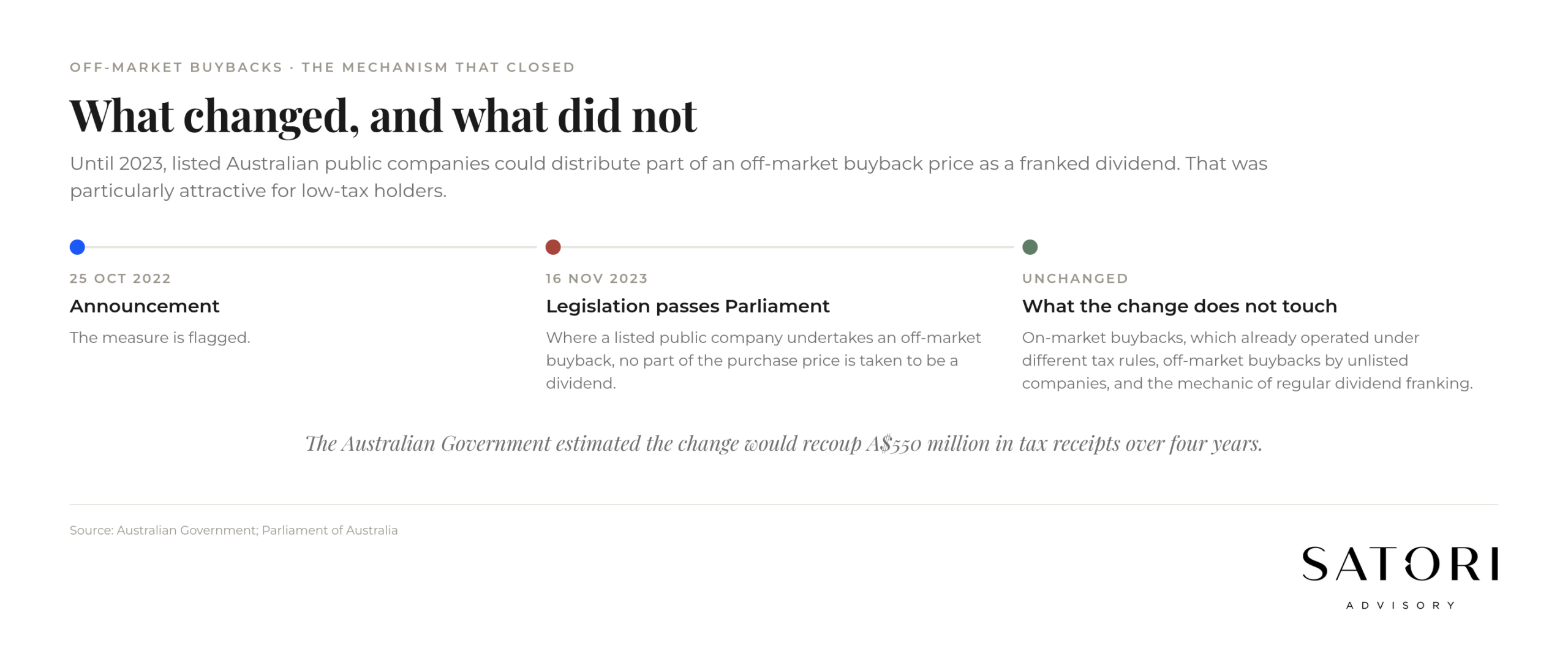
Until 2023, listed Australian public companies could undertake off-market share buybacks and distribute part of the buyback price as a franked dividend. This was particularly attractive for low-tax shareholders, who effectively monetised excess franking credits.
Legislation ended that mechanism for any off-market buyback announced after 7:30pm AEDT on 25 October 2022. Where a listed public company undertakes an off-market buyback, no part of the purchase price is taken to be a dividend. The changes apply to listed-company buybacks announced after 7:30pm AEST on 25 October 2022.
The change does not affect on-market buybacks (which already operated under different tax rules) or off-market buybacks by unlisted companies. The mechanic of regular dividend franking is unchanged.
The Australian Government estimated the change would recoup A$550 million in tax receipts over four years.
How Satori thinks about franking credits in portfolios
Franking credits matter most for income-focused portfolios held by low-tax investors. For a pension-phase SMSF or a retiree on a modest marginal rate, fully franked Australian shares can deliver after-tax yields several percentage points higher than the headline dividend rate.
For high-tax accumulators (working professionals at the top marginal rate), franking credits reduce the tax drag on dividends but they are not a reason to overweight Australian shares versus international equities. The portfolio construction question is broader than any single tax feature.
Two cautions worth holding.
Do not chase franking credits at the expense of portfolio quality. Concentrating in high-franking-yield Australian shares (often the major banks) can create concentration risk that overwhelms the tax benefit.
Do not assume direct equities are a substitute for cash and term deposits. The capital can fall meaningfully even when the franked dividend continues.
What to do next
Check the franking percentage on each Australian dividend you receive (your platform statement or the ATO pre-fill will show it).
If you hold an SMSF in pension phase, confirm with your accountant that excess franking credits are being claimed as cash refunds where eligible.
If you are building a retirement income strategy, model the after-tax yield on a franked-dividend portfolio against your actual marginal rate (or the fund’s tax rate).
How Satori Advisory works
At Satori Advisory we integrate your tax, business, wealth and lending as a prosperity engine, aligned with what matters most to you. With a clear roadmap, informed by data and backed by decades of strategic experience, we simplify the complex. We don’t offer pre-packaged solutions. We deliver tailored, end-to-end advice that reflects your reality and ambitions. You’ll work directly with senior advisers who listen deeply, think boldly and act with purpose. Feel cared for by our trusted team and curated network of financial and business specialists, as we empower you to make smart decisions and realise your potential, powered by numbers.
Frequently asked questions
How do franking credits work in Australia?
An Australian company pays company tax on its profits. When the company distributes those profits as a franked dividend, the shareholder receives a franking credit representing the tax already paid. The shareholder includes both the dividend and the franking credit in assessable income, then receives a credit for the tax the company already paid.
What are franking credits?
Tax credits attached to dividends paid by Australian companies. They represent the company tax already paid on the underlying profit. The shareholder uses the credit to offset tax payable on the grossed-up dividend, removing double taxation of company profits.
Who is eligible for franking credits in Australia?
Australian-resident shareholders who receive franked dividends from Australian companies are generally eligible. Non-residents do not receive the credit. Super funds, individuals, trusts and companies are all eligible to use franking credits to reduce tax payable.
Can I get a franking credit refund?
Yes, if your franking credits exceed the tax you owe. Pension-phase super funds (0% tax) and individuals on very low taxable income often receive cash refunds. Accumulation-phase super funds (15% tax) often receive partial refunds. The refund mechanism survived the 2019 election cycle and is still in force in 2026.
What is a fully franked dividend?
A dividend that carries franking credits at the full company tax rate, indicating the underlying profit has had Australian company tax paid on it in full. Partly franked dividends carry credits on only part of the dividend. Unfranked dividends carry no credits.
What changed about off-market buybacks in November 2023?
Listed Australian public companies can no longer distribute franked dividends through off-market share buybacks. Where a listed company undertakes an off-market buyback, no part of the purchase price is treated as a dividend. The change applies to buybacks announced after 7:30pm AEST 25 October 2022. Unlisted company buybacks are unaffected.
Do US-style dividends carry franking credits?
No. The franking credit system is Australian. Dividends from US companies (such as those held through international ETFs or direct US shares) generally do not carry franking credits, and US withholding tax usually applies.
Ready to talk?
If you would like a calm, no-pressure conversation about how this applies to your specific situation, we are here to help.
Please feel free to get in touch on 1300 925 081 or send an email to [email protected] if you’d like to book in a chat on the above or on other matters.
Disclaimer
This article contains general information only and has been prepared without considering your objectives, financial situation or needs. It is not personal financial advice, taxation advice or legal advice and should not be relied upon when making financial decisions. Before acting on any information, consider its appropriateness to your circumstances and seek professional advice where appropriate.