
Table of Contents
EOFY for an Australian company is mostly the same playbook every year, but the dollar figures move and a few rules drift each cycle. The 2026-27 checklist below uses current ATO figures.
Go through this with your accountant or adviser well before 30 June. Most of the high-value moves cannot be done retrospectively.
Move 1: Use the instant asset write-off (small business)
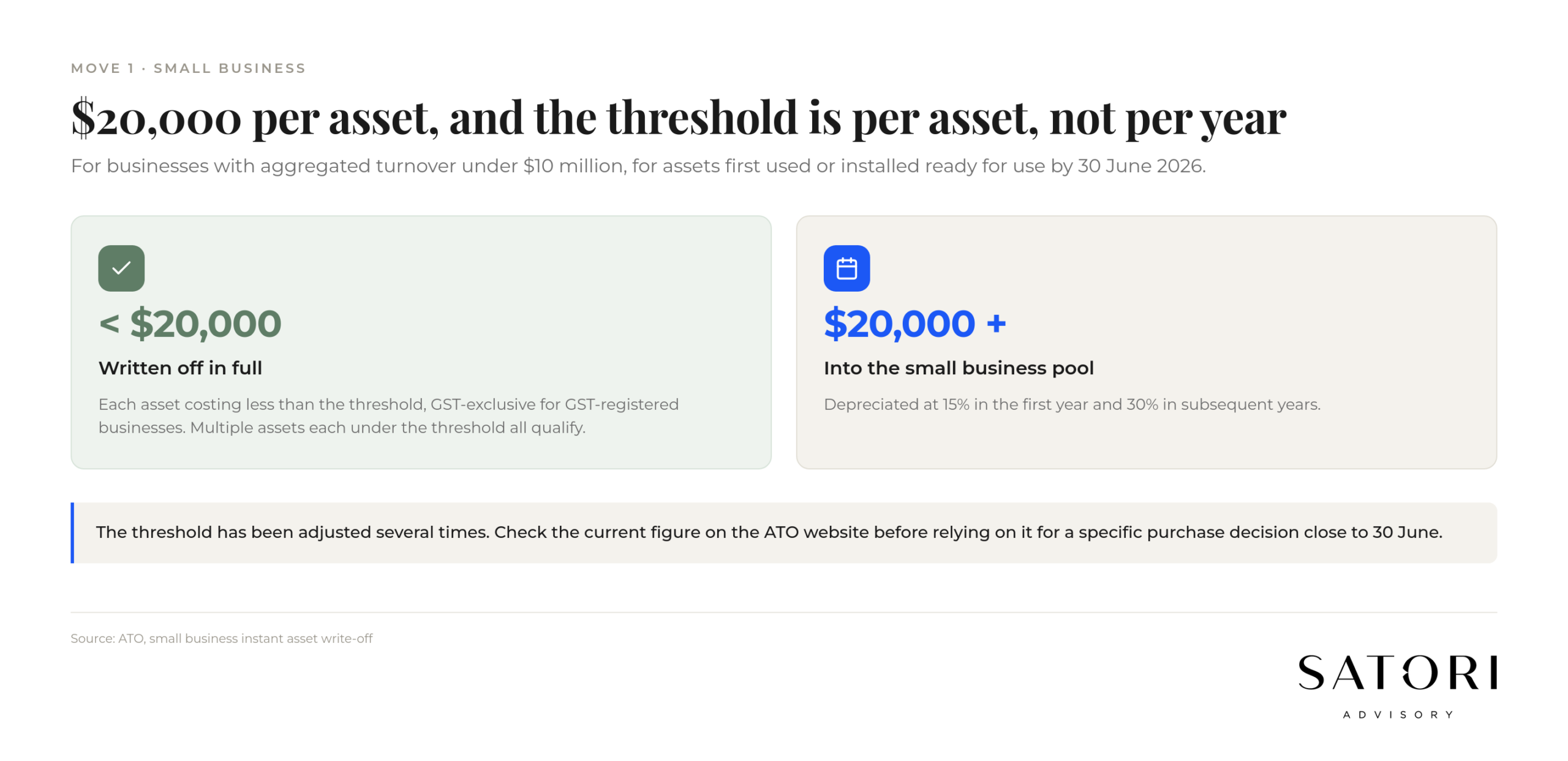
For businesses with aggregated turnover under $10 million, the small business instant asset write-off was $20,000 per asset for assets first used or installed ready for use by 30 June 2026. The ATO has not published a threshold for 2026-27. The Government announced on 12 May 2026 that it would make the $20,000 threshold permanent from 1 July 2026, but that measure is not yet law, so confirm the current position at ato.gov.au before committing to a purchase.
Each asset costing less than $20,000 (GST-exclusive for GST-registered businesses) can be written off in full in the year of acquisition. Multiple assets each under the threshold all qualify; there is no overall cap on the number of assets.
Assets costing $20,000 or more can be allocated to the small business pool and depreciated at 15% in the first year and 30% in subsequent years.
Note: the write-off threshold has been adjusted several times. Check the current threshold on the ATO website before relying on this figure for a specific purchase decision close to 30 June.
Move 2: Review Division 7A loan accounts
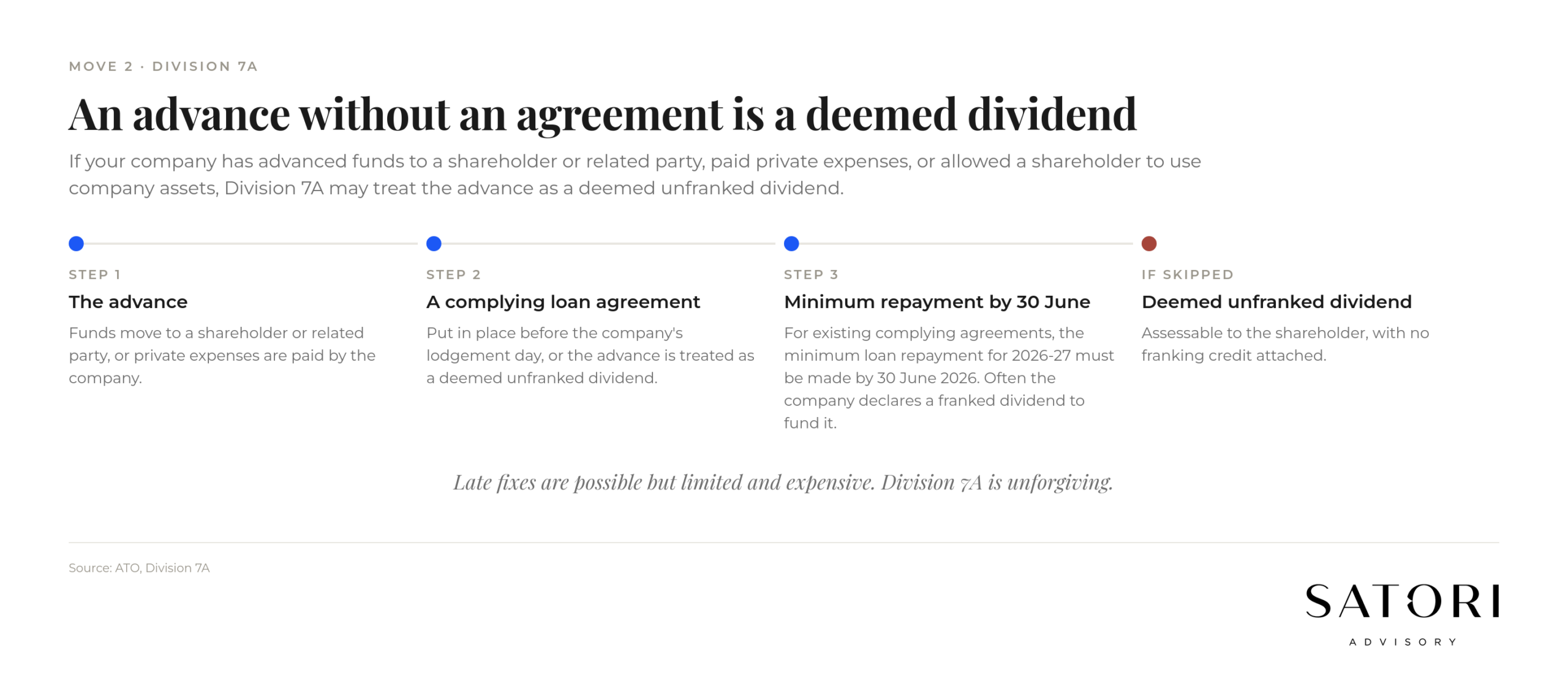
If your company has advanced funds to a shareholder or related party, paid private expenses, or allowed a shareholder to use company assets, Division 7A may treat the advance as a deemed unfranked dividend unless a complying loan agreement is in place.
If you have shareholder loan accounts under existing complying agreements, the minimum loan repayment for 2026-27 must be made by 30 June 2026. Often this requires the company to declare a franked dividend before 30 June to fund the repayment.
Talk to us before EOFY if you think the company has advanced funds to shareholders without an agreement. Late fixes are possible but limited and expensive.
Move 3: Pay June quarter super before 30 June
The June quarter Super Guarantee (1 April to 30 June) is due by 28 July 2026 to satisfy the SG obligation. But if the company wants to claim the deduction in 2026-27, the contribution must be received by the super fund by 30 June 2026.
Pay early. The clearing-house pipeline (whether through a commercial provider or the ATO’s Small Business Superannuation Clearing House) often takes several days. Contributions still sitting at the clearing house on 30 June do not count as received by the fund.
From 1 July 2025 the SG rate is 12%. For directors paid via the company, this is also a chance to top up your own super before EOFY (subject to the $32,500 concessional cap).
Move 4: Write off bad debts and obsolete stock
A bad debt is only deductible if you have brought the income to account as assessable income in a prior year and have given up reasonable attempts to recover it. The write-off must be recorded in your books by 30 June.
Obsolete plant and equipment that is still on the depreciation schedule but no longer used should be scrapped before 30 June so the remaining written-down value can be deducted in the current year.
Stock: a stocktake is required if your stock has moved by more than $5,000 from the previous year. Obsolete stock can be written down to net realisable value at year-end.
Move 5: Bring forward repairs, consumables, and prepayments
Repairs that are not capital improvements are deductible when incurred. If you have repairs scheduled for July, consider bringing them forward into June if cashflow allows.
Consumables (stationery, office supplies, IT consumables) ordered and received before 30 June are deductible in the current year.
Prepayments of 12 months or less are deductible in the year paid for small business entities (aggregated turnover under $50M). Larger entities are subject to apportionment.
Move 6: Document director and employee bonuses
Director fees and employee bonuses can be deductible in 2026-27 even if paid after 30 June, provided the company has ‘definitely committed’ to the payment by year-end.
Definitely committed usually means a board resolution before 30 June, with a quantified amount and the employee or director notified before year-end.
Pay the bonus within a reasonable period after year-end. Long delays can be challenged.
Move 7: Confirm your base-rate-entity status
For 2026-27, the company tax rate is 25% if the company is a base-rate entity. Base-rate entity means aggregated turnover under $50 million AND no more than 80% of assessable income being base-rate-entity passive income (interest, dividends, rent, royalties, net capital gains, etc).
If your company is in the 30% bracket and could be in the 25% bracket, the cause is usually one of two things: aggregated turnover crossed $50M (consider grouping rules), or passive income proportion exceeded 80% (usually triggers in a year with large dividend or capital gain income).
Review before EOFY. Sometimes restructuring or timing decisions can preserve base-rate eligibility.
Move 8: Taxable payments annual reporting (TPAR)
If your business is in building and construction, cleaning, courier, road freight, IT, security/investigation/surveillance, or mixed services, you must file a Taxable Payments Annual Report (TPAR) for contractor payments. The 2026-27 TPAR is due by 28 August 2026.
Start the data extraction now. Many businesses underestimate the time needed to pull contractor payments by ABN and reconcile against MYOB/Xero entries.
What NOT to do
Do not pay June quarter super on 30 June via a clearing house. It will not reach the fund in time.
Do not assume shareholder advances are ‘just loans’ without a complying agreement. Division 7A is unforgiving.
Do not bring forward expenses just to drop this year’s tax if you expect a higher-tax year next year. The deduction may be worth more next year.
Do not scrap assets on the depreciation schedule without proper accounting records of the scrapping decision.
Do not delay the TPAR data extraction. The 28 August deadline arrives faster than it looks.
Director Penalty Notices: a structural risk worth reviewing
The director penalty regime allows the ATO to recover unpaid GST, PAYG withholding, LCT, WET, and Super Guarantee amounts personally from directors. Resigning after the event does not remove the obligation.
Review your company’s compliance position before 30 June. If you receive a Director Penalty Notice, the response window is short and the personal exposure is real.
How Satori Advisory works
At Satori Advisory we integrate your tax, business, wealth and lending as a prosperity engine, aligned with what matters most to you. With a clear roadmap, informed by data and backed by decades of strategic experience, we simplify the complex. We don’t offer pre-packaged solutions. We deliver tailored, end-to-end advice that reflects your reality and ambitions. You’ll work directly with senior advisers who listen deeply, think boldly and act with purpose. Feel cared for by our trusted team and curated network of financial and business specialists, as we empower you to make smart decisions and realise your potential, powered by numbers.
Frequently asked questions
What is the company tax rate in Australia in 2026-27?
25% for base-rate entities (aggregated turnover under $50 million and passive income under 80% of total income). 30% for all other companies.
What is the instant asset write-off threshold in 2026-27?
It was $20,000 per asset for small businesses with aggregated turnover under $10 million, for assets first used or installed ready for use by 30 June 2026. The ATO has not published a threshold for 2026-27 and the announced permanent extension is not yet law. The threshold has been adjusted multiple times so confirm on the ATO website close to your purchase decision.
When does the company need to pay June quarter super to claim the deduction?
By 30 June 2026, meaning received by the super fund, not just sent to a clearing house. Pay several days early to allow for clearing-house processing time.
What is Division 7A?
A part of the tax law that treats unpaid loans or private benefits provided by a company to shareholders or their associates as deemed unfranked dividends, taxable at the recipient’s marginal rate, unless a complying loan agreement is in place and minimum repayments are made each year.
What is a base-rate entity for company tax?
A company with aggregated turnover under $50 million and no more than 80% of assessable income being passive (interest, dividends, rent, royalties, net capital gains). Base-rate entities pay 25% company tax; others pay 30%.
When is the Taxable Payments Annual Report (TPAR) due?
By 28 August each year. The 2026-27 TPAR is due 28 August 2026. Applies to businesses in building, cleaning, courier, road freight, IT, security/investigation/surveillance, and mixed services.
Can directors be held personally liable for unpaid company tax?
Yes. The Director Penalty regime can attach personally to unpaid GST, PAYG withholding, Super Guarantee, LCT, and WET. Resigning after the event does not remove the personal exposure.
Ready to talk?
If you would like a calm, no-pressure conversation about how this applies to your specific situation, we are here to help.
Please feel free to get in touch on 1300 925 081 or send an email to [email protected] if you’d like to book in a chat on the above or on other matters.
Disclaimer
This article contains general information only and has been prepared without considering your objectives, financial situation or needs. It is not personal financial advice, taxation advice or legal advice and should not be relied upon when making financial decisions. Before acting on any information, consider its appropriateness to your circumstances and seek professional advice where appropriate.