
Table of Contents
EOFY is the only period in the Australian tax year where a small number of decisions, made in the right order, can meaningfully change your tax outcome. The window is real and the rules are dated. Most of the high-value moves cannot be done retrospectively.
Below is a 2026 checklist for individuals, in order of dollar impact for most Australian wealth-and-tax clients.
Move 1: Use your full concessional contributions cap
The 2026-27 concessional contributions cap is $32,500. That includes employer SG, salary sacrifice, and personal deductible contributions.
If your YTD employer SG plus any salary sacrifice is under the cap, you can make a personal deductible contribution to top up. The contribution must be received by your fund by 30 June 2026 and you must lodge a Notice of Intent to Claim a Deduction before the earlier of lodging your tax return or 30 June 2027.
Your fund must acknowledge the notice in writing before you claim. Without that acknowledgement, the deduction is not valid.
Move 2: Use unused carry-forward concessional cap (last chance for 2020-21)
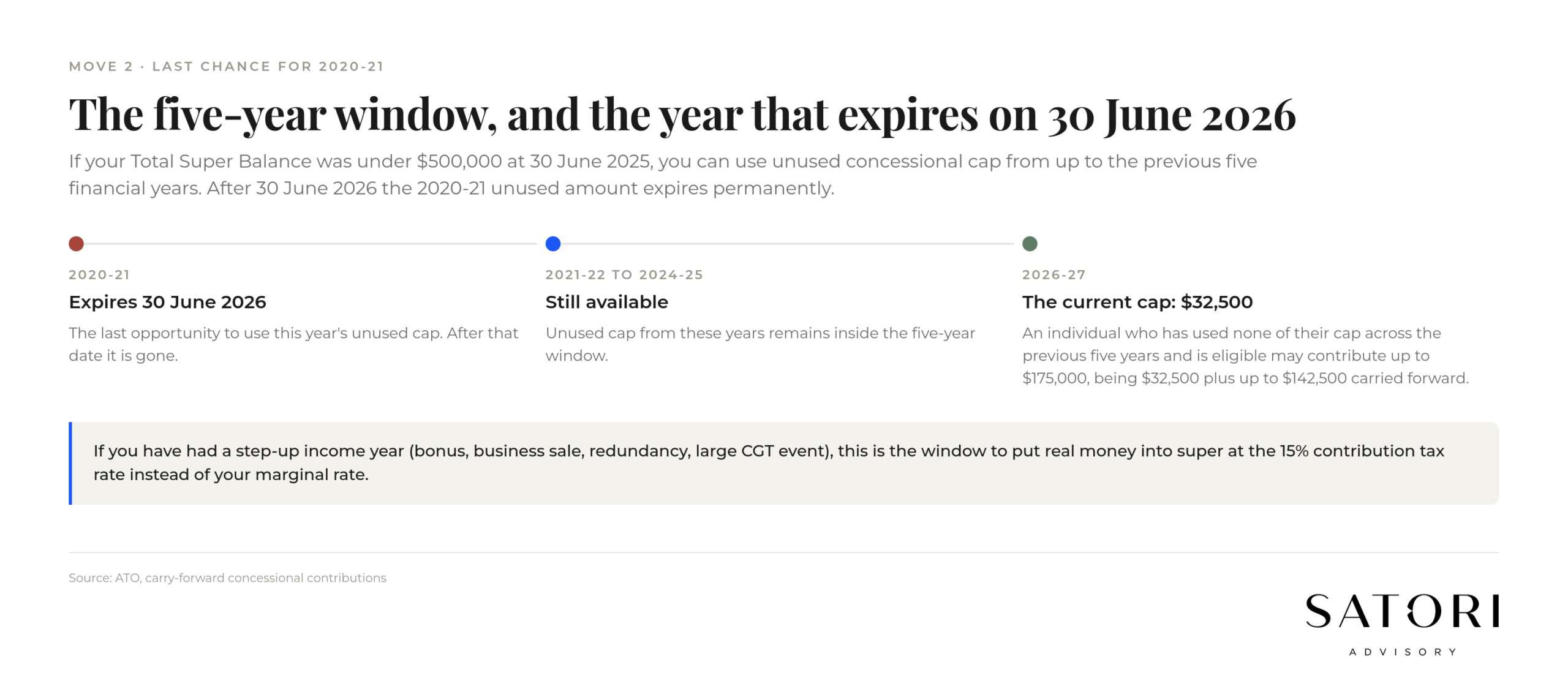
If your Total Super Balance was under $500,000 at 30 June 2025, you can use unused concessional cap from up to the previous five financial years.
30 June 2026 is the LAST opportunity to use unused 2020-21 concessional cap. After that date, the 2020-21 unused amount expires permanently.
An individual who has used none of their concessional cap across the previous five years and is eligible to carry forward may contribute up to $175,000 in 2026-27 ($32,500 current cap plus up to $142,500 carry-forward).
If you have had a step-up income year (bonus, business sale, redundancy, large CGT event), this is the window to put real money into super at the 15% contribution tax rate instead of your marginal rate.
Move 3: Government co-contribution
For 2026-27, if you earn under $47,488 and make an after-tax super contribution of $1,000, the government will contribute up to $500 to your super. The benefit phases out completely at $62,488.
Eligibility requires at least 10% of your income to come from salary or business activity.
This is small in absolute terms but it is a 50% effective return on the $1,000 if you qualify. Worth a check in households with one higher-earner and one lower-earner.
Move 4: Work-from-home deduction
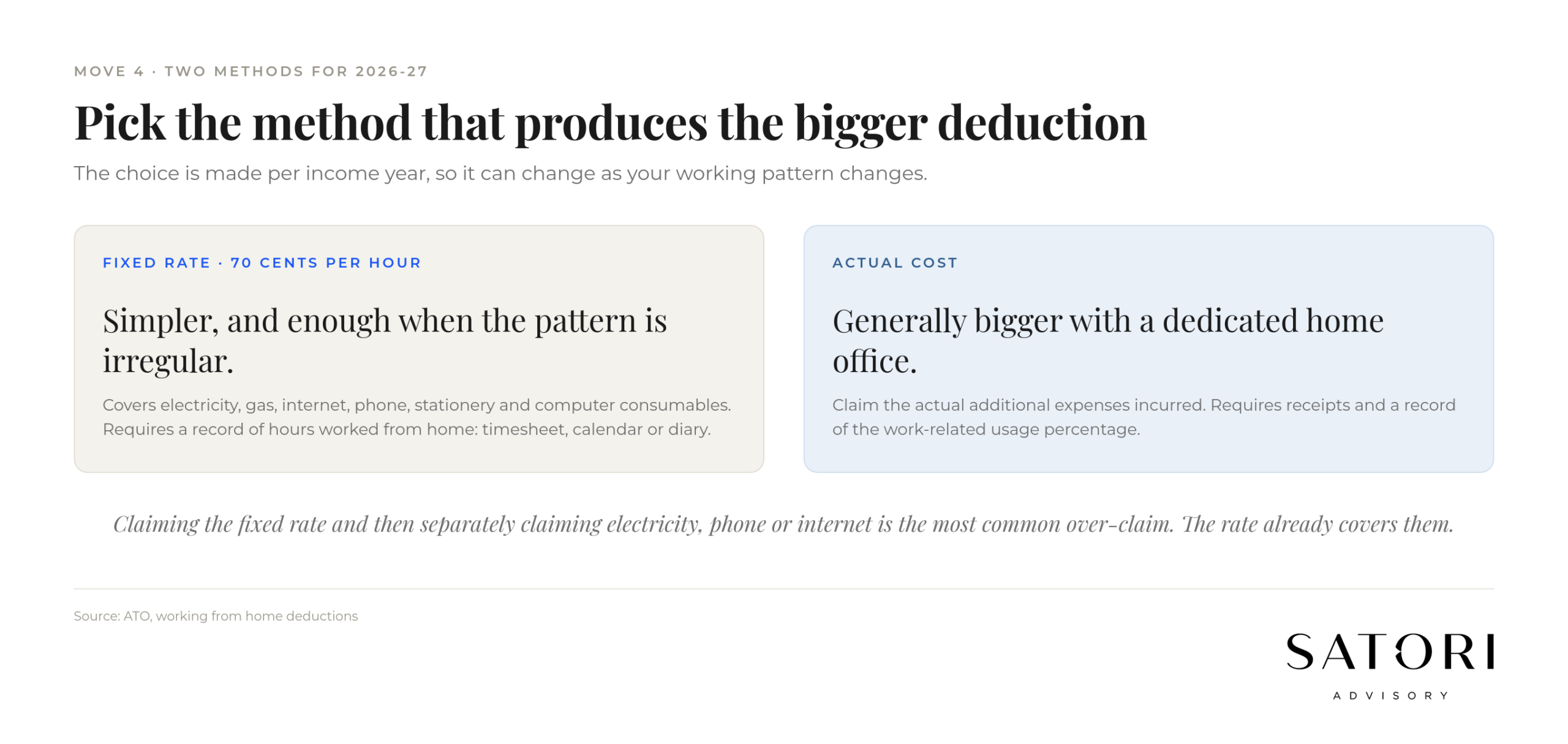
Two methods for 2026-27.
Fixed rate method: 70 cents per hour worked from home. Covers electricity, gas, internet, phone, stationery, and computer consumables. Requires a record of hours worked from home (timesheet, calendar, diary).
Actual cost method: claim the actual additional expenses incurred. Requires receipts and a record of work-related usage percentage. Generally produces a higher deduction if you have a dedicated home office space, but is more record-keeping.
Pick the method that produces the bigger deduction for your situation. The choice is per income year.
Move 5: Realise capital losses
If you hold investments that are below cost and you have realised capital gains earlier in the year, consider crystallising the losses before 30 June to offset the gains.
Two important rules.
Capital losses can only be offset against capital gains, not against income. Excess losses carry forward indefinitely until used.
The wash sale rules apply. Selling an asset to realise the loss and buying it back the next day (or via a related entity) can be challenged by the ATO. Get the timing right or accept a longer gap before any re-entry.
Move 6: Prepay deductible interest and bring forward deductions
If you hold an investment property or share margin loan, you can usually prepay up to 12 months of interest before 30 June and claim the full prepayment in the current year. Useful when your income this year is higher than next year.
Other deductible expenses to consider bringing forward:
Tax-deductible donations to registered DGRs.
Professional memberships and subscriptions paid for the next 12 months.
Income-protection insurance premiums (eligible portions).
Self-education expenses that meet the work-related test.
Repairs and maintenance on an investment property that are not capital in nature.
What NOT to do
Do not top up concessional super contributions blindly. Above the $32,500 cap (plus eligible carry-forward), the excess is taxed at your marginal rate plus an excess contribution charge.
Do not lodge a Notice of Intent for a contribution you have already partly or fully withdrawn or rolled over. The fund cannot acknowledge it and the deduction is invalid.
Do not realise a capital loss on an asset you intend to buy back immediately. Wash sale rules can deny the loss.
Do not bring forward expenses just to reduce this year’s tax. If your marginal rate next year is higher, holding the deduction is worth more.
Sequence for the next two weeks
Pull your YTD concessional contributions from your super fund or payroll.
Pull your YTD realised capital gains and losses from your broker or platform.
Decide whether to make a personal deductible super contribution and lodge the Notice of Intent.
Decide whether to realise any unrealised capital losses to offset gains.
Decide whether to prepay deductible interest or bring forward other deductible expenses.
Get the contributions and prepayments processed by 30 June, not on 30 June. Funds and brokers slow down in the final days.
How Satori Advisory works
At Satori Advisory we integrate your tax, business, wealth and lending as a prosperity engine, aligned with what matters most to you. With a clear roadmap, informed by data and backed by decades of strategic experience, we simplify the complex. We don’t offer pre-packaged solutions. We deliver tailored, end-to-end advice that reflects your reality and ambitions. You’ll work directly with senior advisers who listen deeply, think boldly and act with purpose. Feel cared for by our trusted team and curated network of financial and business specialists, as we empower you to make smart decisions and realise your potential, powered by numbers.
Frequently asked questions
What is the concessional super contribution cap for 2026-27?
$32,500, up from $30,000 in 2025-26. Combined cap covering employer SG, salary sacrifice, and personal deductible contributions.
How much can I contribute under carry-forward in 2026?
If your Total Super Balance was under $500,000 at 30 June 2025 and you have not used your concessional cap in the previous five years, up to $167,500 in 2026-27 ($32,500 current cap plus up to $137,500 carry-forward). 30 June 2026 is the last chance to use 2020-21 unused cap.
What is the work-from-home fixed rate for 2026?
70 cents per hour worked from home for 2026-27. The rate covers electricity, gas, internet, phone, stationery, and computer consumables. You can choose actual cost method instead if it produces a larger deduction.
What is the deadline for personal deductible super contributions?
The contribution must be received by your super fund by 30 June 2026 and you must lodge a Notice of Intent to Claim a Deduction with the fund before the earlier of lodging your tax return or 30 June 2027. The fund must acknowledge the notice in writing before you claim.
Can I offset capital losses against my income?
No. Capital losses can only offset capital gains. Excess losses carry forward indefinitely until you have gains to offset them against.
What is the Government co-contribution for 2026-27?
Up to $500 on a $1,000 after-tax super contribution if you earn under $47,488. Phases out completely at $62,488. At least 10% of your income must come from salary or business activity.
Should I prepay interest on my investment loan before 30 June?
Often yes, especially if your taxable income this year is higher than next year. Most lenders allow prepayment of up to 12 months of interest, which can be claimed in full in the current year. Confirm with your lender and accountant before committing.
Ready to talk?
If you would like a calm, no-pressure conversation about how this applies to your specific situation, we are here to help.
Please feel free to get in touch on 1300 925 081 or send an email to [email protected] if you’d like to book in a chat on the above or on other matters.
Disclaimer
This article contains general information only and has been prepared without considering your objectives, financial situation or needs. It is not personal financial advice, taxation advice or legal advice and should not be relied upon when making financial decisions. Before acting on any information, consider its appropriateness to your circumstances and seek professional advice where appropriate.