
Table of Contents
Australian SMSFs have grown to around 600,000 funds collectively holding roughly 30 per cent of total superannuation assets. The appeal is real: control over investments, direct property access, transparency, and the ability to coordinate the super strategy with the rest of your financial life.
The other side of the appeal is the trustee role. Running an SMSF is not a passive investment activity. It is a legal responsibility, with annual audit, ongoing compliance, and personal accountability.
Below is a 2026 lens on when an SMSF makes sense, what setup involves, and what the trustee role actually requires.
When an SMSF makes sense
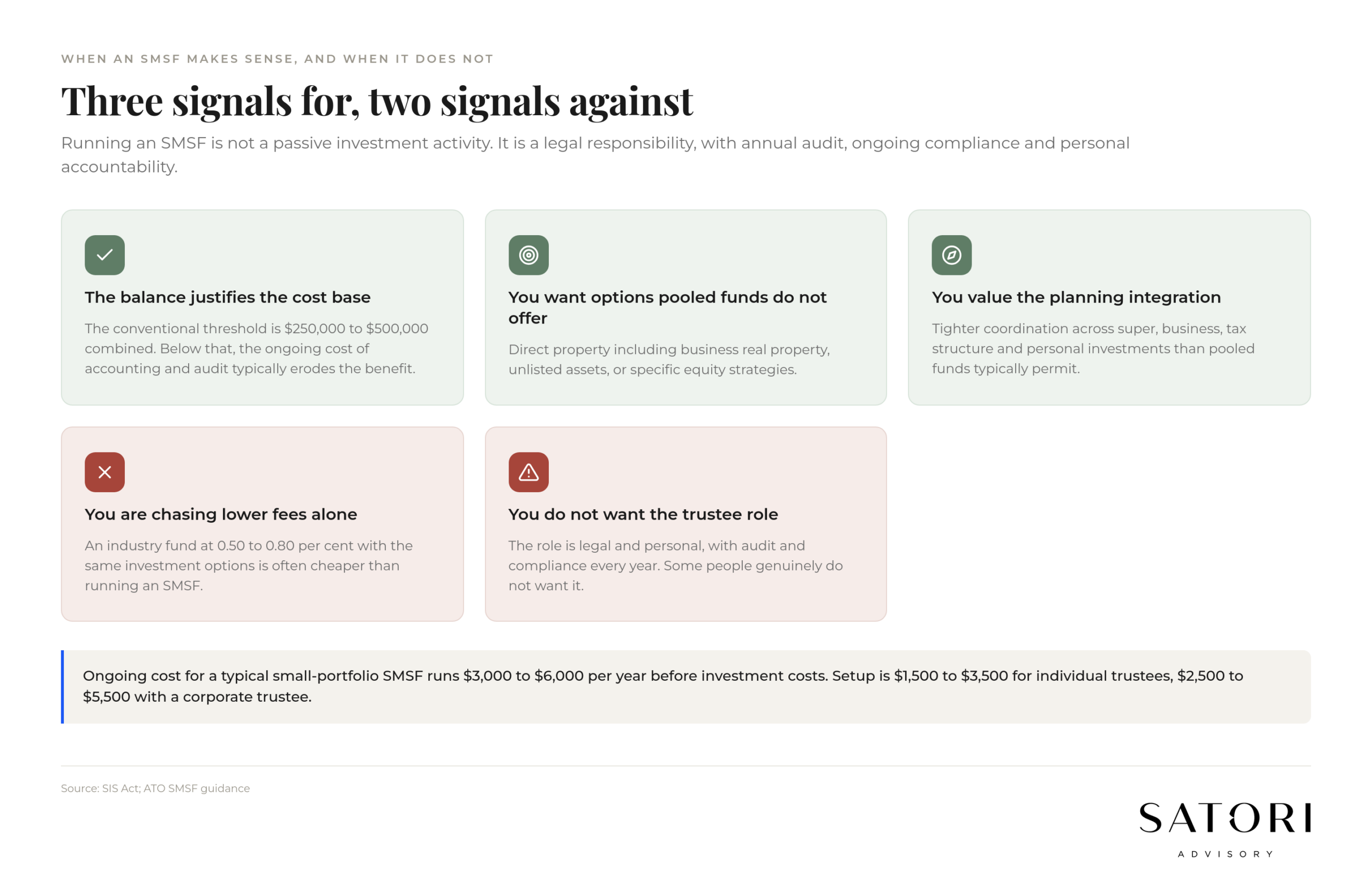
Three signals that an SMSF is the right vehicle.
Combined member balance is high enough to justify the cost base. The conventional threshold is $250,000-$500,000 combined; below that, the ongoing cost of accounting and audit typically erodes the benefit versus an industry or retail fund.
You want investment options that pooled funds do not offer. Direct property (including business real property purchased by your business), unlisted assets, specific equity strategies, or concentrated active positions are easier inside an SMSF.
You value the planning integration. SMSFs allow tighter coordination across super, business, tax structure, and personal investments than pooled funds typically permit.
Two signals that an SMSF is the wrong vehicle.
You are looking for lower fees alone. An industry fund at 0.50-0.80 per cent fees with the same investment options is often cheaper than running an SMSF.
You do not want the trustee responsibility. The role is legal and personal, with audit and compliance every year. Some people genuinely do not want it.
Setup: the practical steps
Six steps from decision to running fund.
Choose the trustee structure: individual trustees (each member must be a trustee, up to 6 members) or corporate trustee (a Pty Ltd company acts as trustee, with the members as directors). Corporate trustee is generally preferred for asset protection, continuity through member changes, and clean compliance.
Set up the trust deed. The deed governs how the fund operates and must be drafted by a qualified provider. Typical cost $300-$800.
Apply for ABN, TFN, and ATO registration as a complying super fund.
Open a bank account in the name of the SMSF.
Prepare the investment strategy document covering the six SIS Act factors: risk, return, composition (diversification), liquidity, ability to meet liabilities, insurance.
Roll over existing super balances from your previous fund(s) into the SMSF.
Setup costs in 2026 are typically $1,500-$3,500 for individual trustees, $2,500-$5,500 for corporate trustee (including incorporation of the company), plus the trust deed cost.
The trustee role: what the SIS Act actually requires
Trustees of an SMSF have personal legal obligations under the Superannuation Industry (Supervision) Act 1993. The major obligations:
Formulate, regularly review, and give effect to an investment strategy. Must address risk, return, composition (including diversification), liquidity, the fund’s ability to meet liabilities, and insurance.
Sole purpose test. The fund’s sole purpose must be to provide retirement benefits to members (or death benefits to dependants). Mixing personal benefit (e.g. using a fund property for personal stays) breaches this.
Arm’s-length transactions. Investments and dealings with related parties must be at market terms.
No early access. Funds cannot be accessed before preservation age except in narrow specified circumstances (severe financial hardship, terminal illness, etc.).
Member benefit rules. Contributions, withdrawals, and pension payments must follow the rules.
Annual audit. Every SMSF must have an annual independent audit by an approved SMSF auditor.
ATO returns. SMSFs lodge an annual return covering income tax, regulatory information, and member contribution caps.
Penalties for non-compliance can be material: up to $4,200 per trustee under SIS Act section 34 for strategy failures; civil and criminal penalties for serious breaches.
Ongoing costs in 2026
Beyond setup, the ongoing cost base typically runs:
Accounting and audit: $2,000-$5,000 per year, depending on complexity. Funds with simpler investment portfolios (listed shares, ETFs, cash, term deposits) sit at the lower end. Funds holding direct property, unlisted assets, or limited recourse borrowing arrangements sit at the higher end.
ATO supervisory levy: a small annual amount paid through the fund.
Trust deed updates: every few years to keep up with legislative changes. Typically $300-$600 when required.
Investment costs: brokerage on direct shares, ETF management fees, property management fees if the fund holds direct property.
Advice fees: where the trustees engage a financial adviser for strategy and ongoing advice. Often a flat fee or hourly basis.
Combined ongoing cost for a typical small-portfolio SMSF: $3,000-$6,000 per year before investment costs.
Division 296: the constraint in force since 1 July 2026
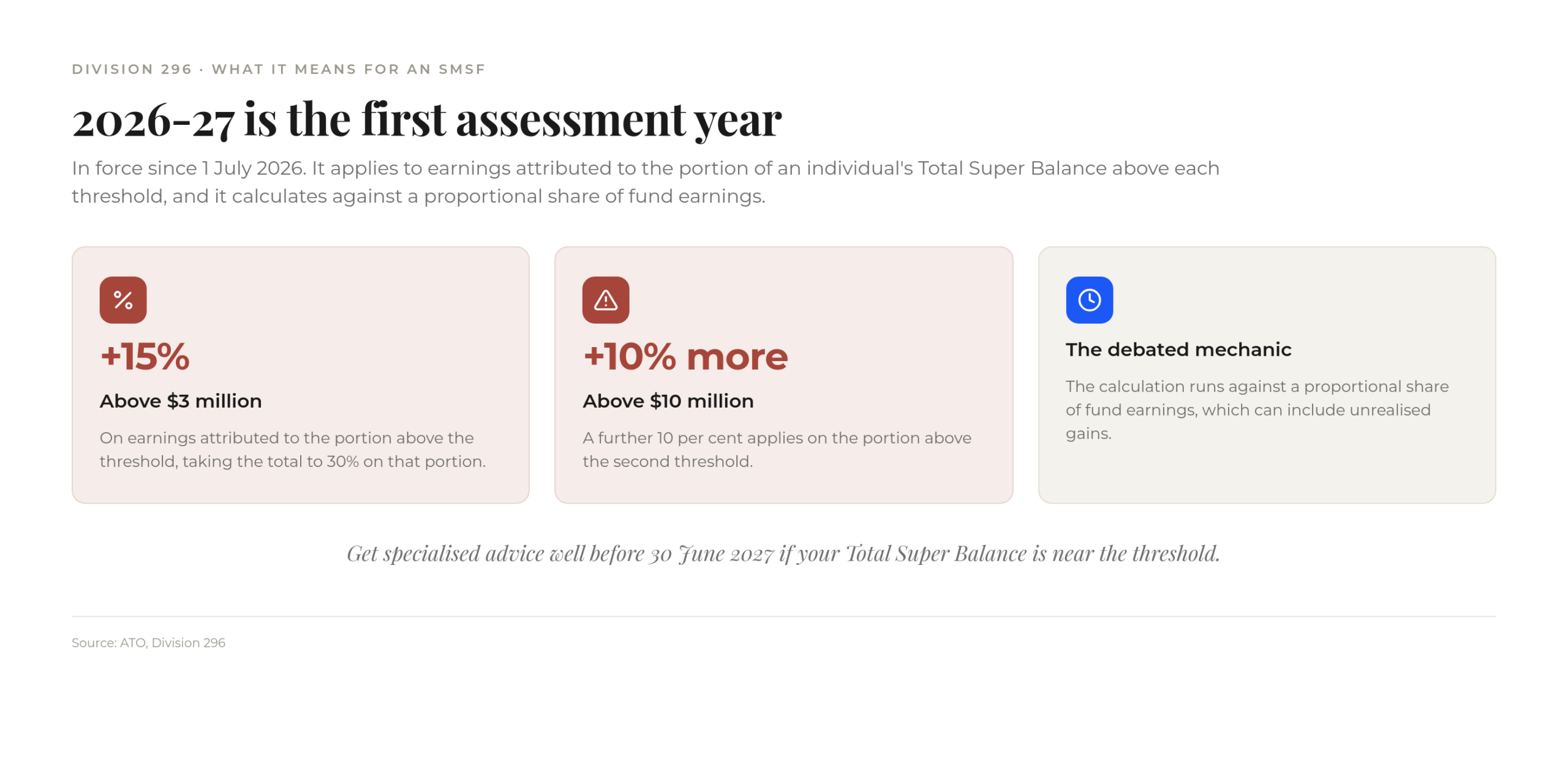
Division 296 has been in force since 1 July 2026. It adds 15 per cent tax on earnings attributed to the portion of an individual’s Total Super Balance above $3 million, taking the total to 30 per cent on that portion. A further 10 per cent applies on the portion above $10 million. Note: the 2026-27 concessional contributions cap is $32,500 and the non-concessional cap is $130,000. These apply to all SMSF members. Division 296 is a separate additional tax that affects only members with Total Super Balances above $3 million.
Division 296 calculates against a proportional share of fund earnings, worked out from the fund’s taxable income for the year. Capital gains only enter the calculation when they are realised. The original February 2023 design would have captured unrealised gains and drew heavy criticism; that approach was dropped in the redesign announced on 13 October 2025 and does not appear in the law as enacted. Funds can elect to reset the cost base of their CGT assets to market value as at 30 June 2026, so pre-commencement growth is excluded.
For SMSF trustees with balances near or above $3 million, the 2026-27 financial year is the first assessment year. Planning conversations under way include: withdrawals above the threshold (subject to access rules), redirecting future contributions outside super, and timing the realisation of capital gains.
Get specialised advice well before 30 June 2027 if your TSB is near the threshold.
Common mistakes new SMSF trustees make
Treating the investment strategy as a set-and-forget document. Annual review and documented updates are required.
Mixing fund and personal money in a single account. Strict separation is mandatory.
Holding a single property at 90 per cent or more of fund assets without documenting why. The ATO 90 per cent concentration threshold triggers heightened audit scrutiny.
Using fund property for personal benefit (a holiday stay in a fund-owned house). Breaches the sole purpose test.
Missing the 28-day window for member contribution allocation decisions, the 30-day window for related-party transaction documentation, or the annual return deadline.
Trying to lend to a related party. Generally not permitted (with narrow exceptions).
Buying assets from a related party that are not business real property or listed securities. Generally not permitted.
How Satori works with SMSF clients
We run SMSFs as part of the broader integrated plan, not as a standalone product.
For setup, we coordinate the trust deed, corporate trustee, regulatory registrations, and initial investment strategy with the rest of your financial life.
For ongoing operation, we run the annual investment strategy review, coordinate the independent audit, and ensure trustee documentation is current and compliant.
Division 296 planning is now a structural part of every SMSF engagement for clients with balances approaching or above $3 million.
What to do next
If you are considering an SMSF, run the cost-benefit against an industry or retail fund at your current balance. If the combined balance is below $250,000, the SMSF rarely makes sense purely on costs.
If you already have an SMSF, confirm the trustee documentation is current (investment strategy reviewed in last 12 months, trust deed current).
If your TSB is approaching $3 million, get a Division 296 modelling pass now that the tax applies.
How Satori Advisory works
At Satori Advisory we integrate your tax, business, wealth and lending as a prosperity engine, aligned with what matters most to you. With a clear roadmap, informed by data and backed by decades of strategic experience, we simplify the complex. We don’t offer pre-packaged solutions. We deliver tailored, end-to-end advice that reflects your reality and ambitions. You’ll work directly with senior advisers who listen deeply, think boldly and act with purpose. Feel cared for by our trusted team and curated network of financial and business specialists, as we empower you to make smart decisions and realise your potential, powered by numbers.
Frequently asked questions
What is an SMSF in Australia?
A Self-Managed Super Fund. A super fund where you (and up to 5 other members) are the trustees and have legal responsibility for the fund’s operation, investments, and compliance. Roughly 600,000 SMSFs in Australia hold around 30% of total super assets.
How much do you need to start an SMSF in Australia?
Conventionally $250,000-$500,000 combined member balance for the cost base to be justified versus an industry fund. Below that, the ongoing accounting, audit, and advice costs typically erode the benefit.
How much does an SMSF cost in 2026?
Setup costs typically $1,500-$3,500 (individual trustees) or $2,500-$5,500 (corporate trustee). Ongoing costs typically $2,000-$5,000 per year for accounting and audit, plus ATO supervisory levy and any advice fees. Combined ongoing cost for a small portfolio fund: $3,000-$6,000 per year before investment costs.
What are the trustee obligations of an SMSF?
Under the SIS Act: formulate and review an investment strategy; sole purpose test; arm’s-length transactions; no early access; member benefit rules; annual independent audit; annual ATO return. Penalties for non-compliance start at $4,200 per trustee for strategy failures.
Individual trustees or corporate trustee for an SMSF?
Corporate trustee is generally preferred. Reasons: cleaner asset protection (the company holds the assets), continuity through member changes (no title transfers required when a member leaves or joins), and tidier compliance. Cost premium is $1,000-$2,000 at setup.
Can my SMSF buy my own business premises?
Yes, business real property can be acquired by an SMSF from a related party at market value, and leased back to the related-party business at market rent. This is one of the most common reasons business owners establish an SMSF. Strict compliance with the rules is essential.
Does Division 296 affect my SMSF?
If any member’s Total Super Balance is above $3 million, yes. From 1 July 2026, Division 296 adds 15 per cent on earnings attributed to the portion of TSB above $3 million (total 30 per cent), with a further 10 per cent on the portion above $10 million. Get specialised advice before 30 June 2027 if any member is near the threshold.
Ready to talk?
If you would like a calm, no-pressure conversation about how this applies to your specific situation, we are here to help.
Please feel free to get in touch on 1300 925 081 or send an email to [email protected] if you’d like to book in a chat on the above or on other matters.
Disclaimer
This article contains general information only and has been prepared without considering your objectives, financial situation or needs. It is not personal financial advice, taxation advice or legal advice and should not be relied upon when making financial decisions. Before acting on any information, consider its appropriateness to your circumstances and seek professional advice where appropriate.