
Table of Contents
Australian home loan rates have priced investors differently to owner-occupiers since the APRA macroprudential cycle of 2017-2018. The differential has persisted into 2026.
For households holding both an owner-occupied home and an investment property, the rate structure creates a genuine decision: how to think about the investor premium, when interest-only on the investment is the right call despite the higher rate, and how the upcoming 1 July 2027 reforms affect the math.
Below is a 2026 lens.
Why investors pay more
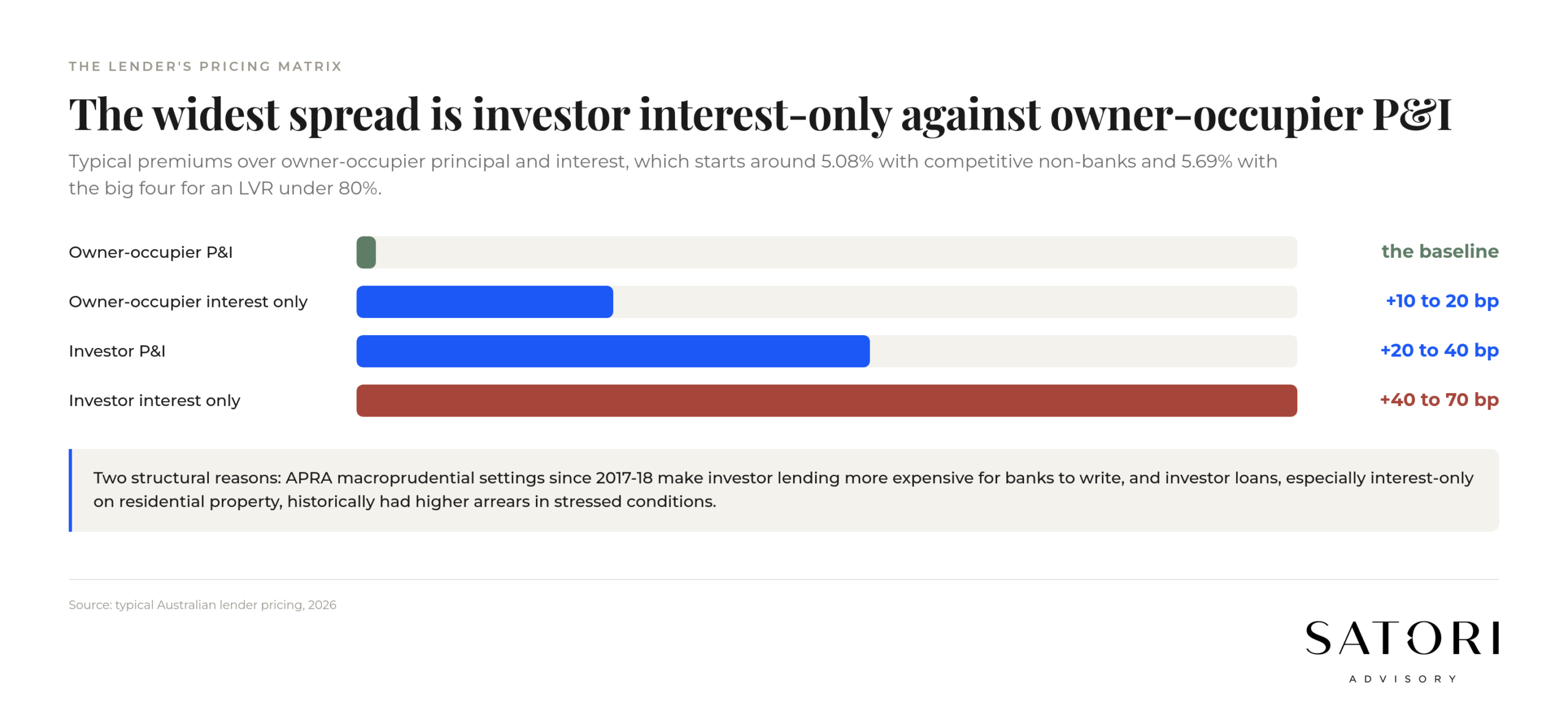
Two structural reasons.
APRA regulatory pricing. Since 2017-2018, APRA has applied macroprudential settings that effectively make investor lending more expensive for banks to write at the same risk profile. Lenders pass the cost through as a higher headline rate on investor loans.
Lender risk perception. Investor loans (especially interest-only on residential property) historically had higher arrears in stressed conditions than owner-occupier P&I loans. Lenders price for that risk.
Typical premium in 2026: As context, the RBA cash rate is 4.35% as of May 2026.
Owner-occupier P&I: the RBA’s average rate on new owner-occupier principal-and-interest loans was 6.15 per cent in May 2026. Individual lender pricing varies widely, so compare live offers rather than a headline number.
Owner-occupier IO: on RBA data for May 2026, about 76 basis points higher than owner-occupier P&I. Interest-only is the most expensive owner-occupier pricing on that series.
Investor P&I: on RBA data for May 2026, about 16 basis points higher than owner-occupier P&I.
Investor IO: on RBA data for May 2026, about 34 basis points higher than owner-occupier P&I.
The investor IO premium versus owner-occupier P&I is the widest spread in the typical lender’s pricing matrix.
Why investors still choose IO despite the premium
The economic answer: tax deductibility.
Interest on a loan used to acquire an income-producing investment property is generally deductible in 2025-26. Principal repayments are not.
For an investor on a high marginal rate (47% top combined rate including Medicare), the after-tax cost of investor IO interest can be meaningfully lower than the headline rate suggests.
Worked example. An investor on the top marginal rate has a $500,000 investment loan at 6.20% IO. Annual interest: $31,000. After-tax deduction worth 47%: $14,570. After-tax cost of holding the loan: about $16,430, or an effective rate of 3.29%.
Compare to an owner-occupier P&I loan at 5.70% on the same balance: no deduction available, so the full $28,500 of annual interest is paid from after-tax dollars.
The investor IO loan looks more expensive at the headline rate but cheaper after tax for high-income investors with a clear cashflow plan.
The freed-up cashflow (no principal repayments) can be redirected to non-deductible debt (the owner-occupied mortgage) or to concessional super, both of which are typically more tax-effective than paying down deductible investor debt.
When investor IO is the wrong call
Three situations where investor IO does not earn the premium.
Marginal rate is low. Below 30% marginal, the after-tax saving on deductible interest narrows, and the headline premium is harder to justify.
The investor cashflow position is comfortable and the property is the only investment leverage. Paying down principal builds equity at no opportunity cost.
The IO period is long and there is no plan for the cliff. The loan converts to P&I at the end of the IO period; the step-up in repayments needs to be planned.
The 1 July 2027 reforms: what changes
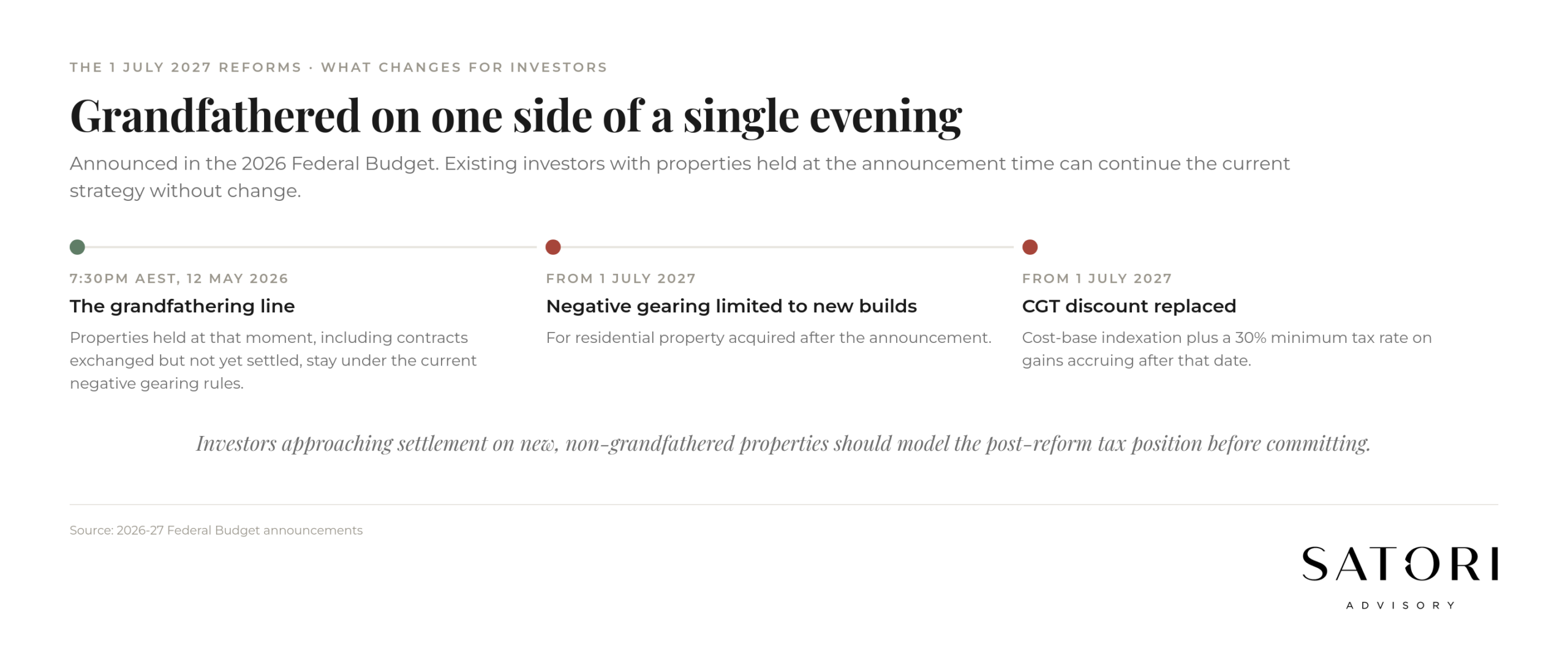
The 2026 Federal Budget announced sweeping reforms to negative gearing and capital gains tax.
From 1 July 2027:
Negative gearing for residential property is limited to new builds. Existing investors with properties held at 7:30pm AEST 12 May 2026 (the announcement) are grandfathered from the negative gearing change.
The 50% CGT discount for individuals, trusts and partnerships is replaced with cost-base indexation plus a 30% minimum tax rate on capital gains accruing after 1 July 2027.
Practical implications for investor IO strategy:
Existing investors with grandfathered negative gearing can continue the current IO strategy without change.
New residential property investments after 12 May 2026 may face different tax treatment unless they are new builds.
Investors approaching settlement on new (non-grandfathered) properties should model the post-reform tax position carefully before committing.
APRA serviceability still applies
When you apply for an investor loan (new or refinance), the lender tests serviceability at your rate plus APRA’s 3 percentage point buffer. So if your investor IO rate would be 6.20%, the lender assesses serviceability at 9.20%.
Most lenders also apply their own debt-to-income policy, commonly around 6x gross annual income. APRA also limits banks to no more than 20% of new mortgage lending at a DTI of 6 or more, since 1 February 2026.
Both settings can affect your borrowing capacity even when the cashflow looks comfortable at the actual rate. Test serviceability at the buffered rate before falling in love with a property.
How Satori thinks about investor vs owner-occupier structuring
We coordinate the lending decision with the broader plan: tax position, super contribution strategy, business cashflow, and the wider property strategy.
For high-income clients with both an owner-occupied home and an investment property, the structure that usually maximises after-tax wealth is: owner-occupier P&I (non-deductible debt paid down aggressively, often with offset) plus investor IO (deductible debt held longer, with freed-up cashflow redirected to non-deductible debt or super).
The 1 July 2027 reforms are a meaningful change, especially for investors considering new (non-grandfathered) residential property purchases. Worth a planning conversation before commitment.
What to do next
If you hold both an owner-occupied home and an investment property, model your current structure against the alternative (investor P&I + owner-occupier IO, or other combinations) at your actual marginal rate.
If you are considering a new investment property purchase, factor the 1 July 2027 reforms into the after-tax modelling.
If your investor IO period is ending in the next 12 months, plan the conversion or extension now.
How Satori Advisory works
At Satori Advisory we integrate your tax, business, wealth and lending as a prosperity engine, aligned with what matters most to you. With a clear roadmap, informed by data and backed by decades of strategic experience, we simplify the complex. We don’t offer pre-packaged solutions. We deliver tailored, end-to-end advice that reflects your reality and ambitions. You’ll work directly with senior advisers who listen deeply, think boldly and act with purpose. Feel cared for by our trusted team and curated network of financial and business specialists, as we empower you to make smart decisions and realise your potential, powered by numbers.
Frequently asked questions
Why do investors pay higher home loan rates than owner-occupiers in Australia?
APRA’s macroprudential interventions since 2017-2018 effectively made investor lending more expensive for banks to write. Lenders pass through the cost as a higher headline rate, and on RBA data for new loans in May 2026 that premium was about 34 basis points for investor IO over owner-occupier P&I.
Is investor interest tax-deductible in Australia?
Generally yes for residential investment property in 2025-26, subject to negative gearing rules. The interest on the loan used to acquire or improve the investment property is deductible at the investor’s marginal rate. Principal repayments are not deductible.
What changes for investment property tax from 1 July 2027?
Under the reforms announced in the 2026 Federal Budget, negative gearing for residential property is limited to new builds, and the 50% CGT discount for individuals/trusts/partnerships is replaced with cost-base indexation plus a 30% minimum tax rate on gains accruing after 1 July 2027. Pre-12 May 2026 7:30pm AEST holdings are grandfathered from the negative gearing change.
What is the typical investor IO premium in 2026?
On RBA data for new loans in May 2026, about 34 basis points over owner-occupier P&I. Owner-occupier IO sat about 76 basis points over owner-occupier P&I, and investor P&I about 16 basis points over. These gaps move with the cycle, so check live pricing.
Should I pay interest-only on my investment loan?
Often yes if you are on a high marginal rate, the property cashflow is supported, and you have a productive use for the freed-up cashflow (paying down non-deductible debt or concessional super). Often no if your marginal rate is low or your cashflow is already comfortable.
What is the APRA serviceability buffer for investor loans?
3 percentage points (since late 2021, maintained in 2026). The lender tests your serviceability at your actual rate plus 3%. Most lenders also apply their own DTI policy, commonly around 6x gross annual income. APRA also limits banks to no more than 20% of new mortgage lending at a DTI of 6 or more, since 1 February 2026.
Ready to talk?
If you would like a calm, no-pressure conversation about how this applies to your specific situation, we are here to help.
Please feel free to get in touch on 1300 925 081 or send an email to [email protected] if you’d like to book in a chat on the above or on other matters.
Disclaimer
This article contains general information only and has been prepared without considering your objectives, financial situation or needs. It is not personal financial advice, taxation advice or legal advice and should not be relied upon when making financial decisions. Before acting on any information, consider its appropriateness to your circumstances and seek professional advice where appropriate.