Table of Contents
Stamp duty is one of the biggest one-off costs in buying a property in Australia. For first home buyers, it can also be the most negotiable, because every state and territory offers some form of concession.
Below is a 2026 lens on how the stamp duty rules work in the three largest states (NSW, VIC, QLD), plus the federal scheme that complements them.
NSW: First Home Buyer Assistance Scheme
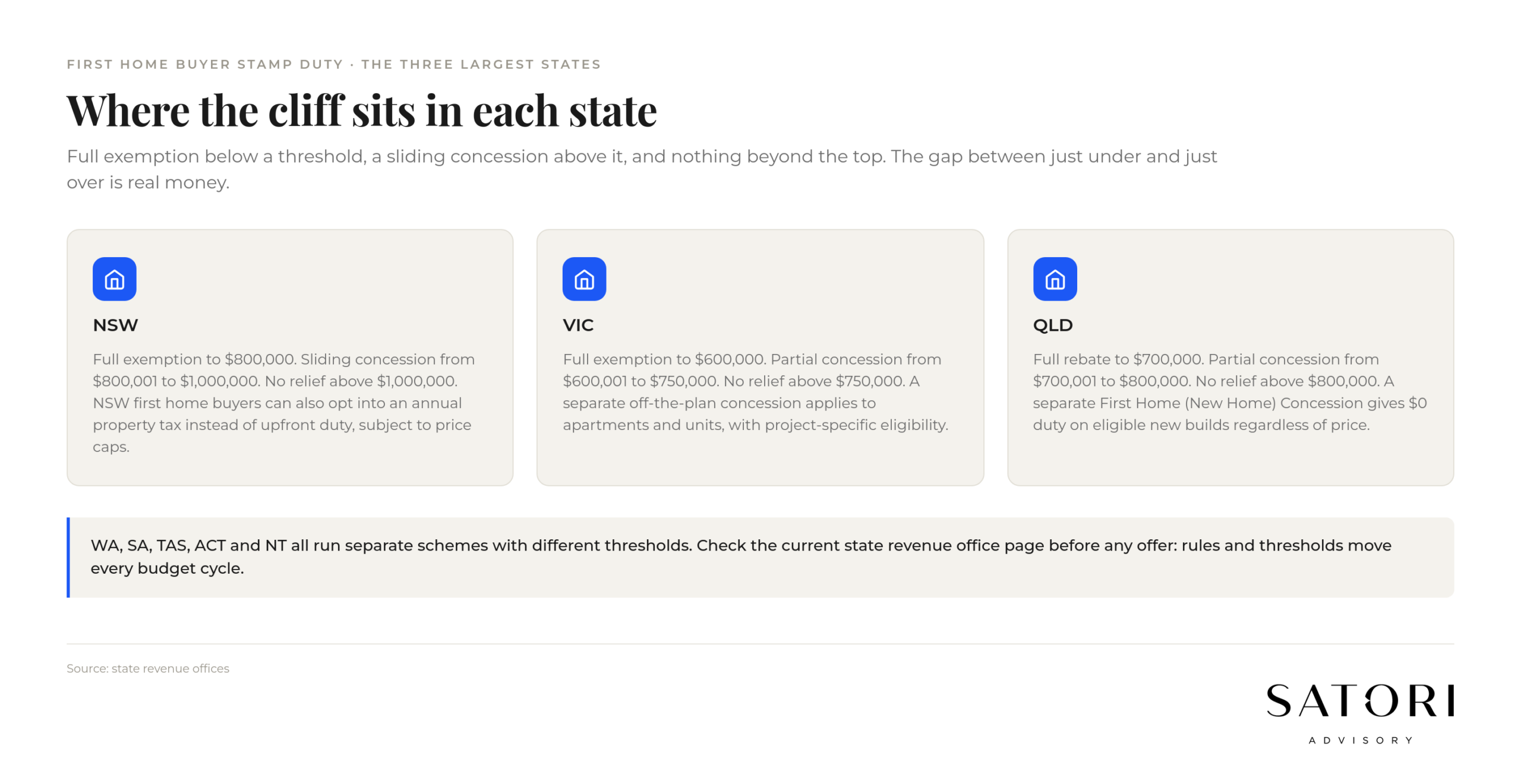
Full exemption: properties up to $800,000.
Concession on a sliding scale: properties $800,001 to $1,000,000.
No relief: properties over $1,000,000.
Alternative: NSW first home buyers can opt into an annual property tax instead of the upfront stamp duty (subject to property price caps and rules).
The annual property tax option suits buyers expecting to hold for a short period or who prefer to spread the cost across years. The break-even point varies by property price and holding period; model both before choosing.
VIC: First Home Buyer Duty Exemption / Concession
Full exemption: properties up to $600,000.
Partial concession on a sliding scale: properties $600,001 to $750,000.
No relief: properties over $750,000.
Off-the-plan concession: separate concession available for apartments and units purchased off the plan, with eligibility specific to the project.
QLD: First Home Concession
Full rebate: properties up to $700,000.
Partial concession on a sliding scale: properties $700,001 to $800,000.
No relief: properties over $800,000.
First Home (New Home) Concession: $0 stamp duty on eligible new builds regardless of price, provided residency and other requirements are met.
Vacant land concession: separate concession available for vacant land where you intend to build your first home.
Other states and territories (high-level)
WA, SA, TAS, ACT, NT all run separate FHB schemes with different thresholds. The general structure is similar (full exemption below a threshold, partial concession in a sliding range, no relief above the upper threshold), but exact numbers vary.
Check the current state revenue office page before any offer. Rules and thresholds move every budget cycle.
The federal First Home Guarantee (5% deposit scheme)
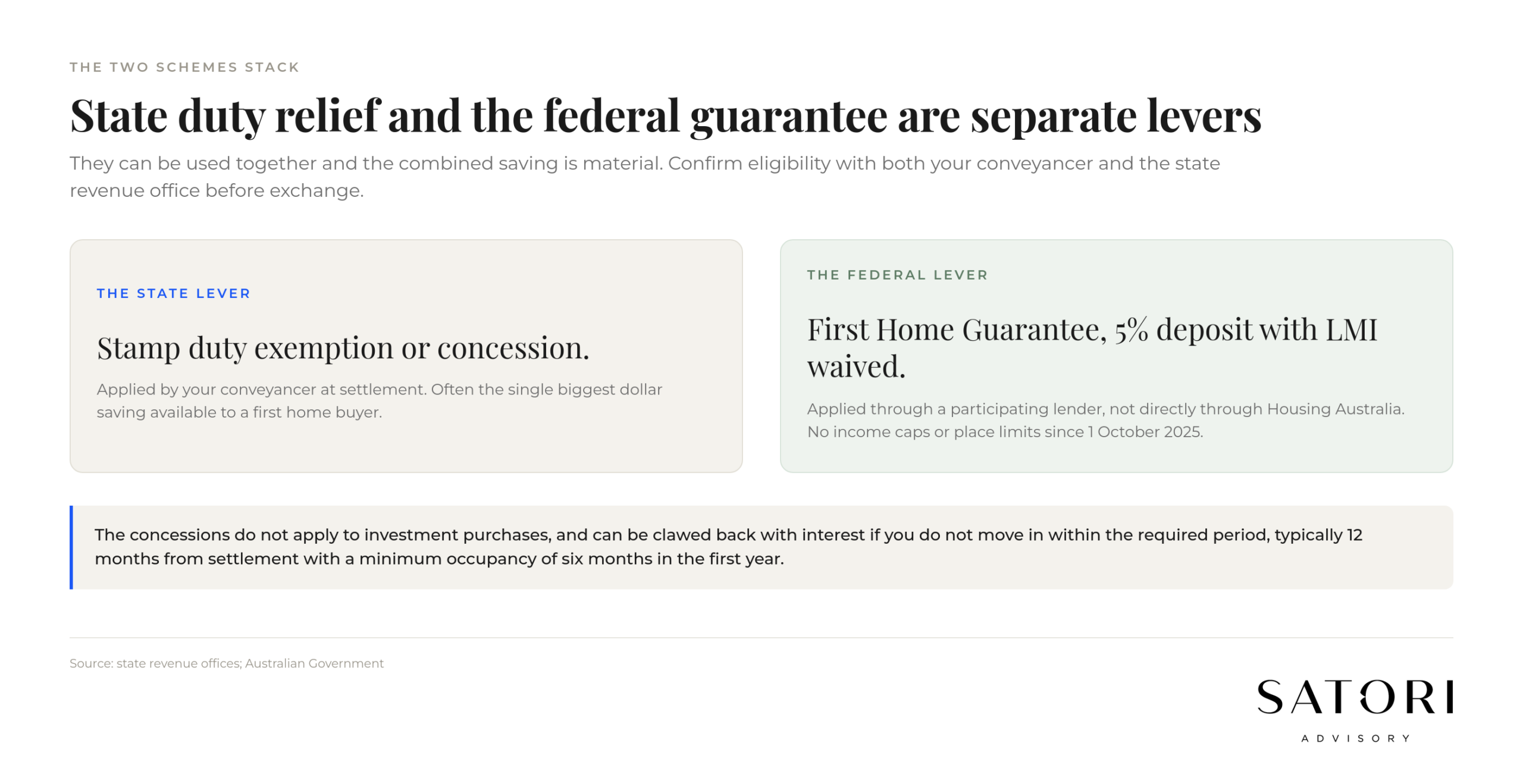
From 1 October 2025, the federal First Home Guarantee was redesigned. The key 2026 features:
No income caps (removed October 2025).
No place limits (removed October 2025).
No LMI on a 5% deposit.
10-year first home buyer lookback (you have not owned residential property in Australia in the last 10 years).
Owner-occupier only (the property must be your principal place of residence).
Property must be inside the regional price caps for your state and city.
The federal scheme is applied for through a participating lender, not directly through Housing Australia. Pairs with most state stamp duty concessions.
Common eligibility requirements across states
You have never previously owned residential property in Australia.
The property will be your principal place of residence.
You must move in within a specified period (typically 12 months from settlement).
You must occupy the property for a minimum continuous period (typically 6 months in the first year).
If you have ever held an interest in Australian residential property (including jointly with a partner), you generally do not qualify. Some states have narrow exceptions.
How to use the concessions well
Three practical moves.
Buy under the upper threshold where possible. The gap between a $799,000 NSW purchase (full exemption) and an $810,000 purchase (concession only) can be tens of thousands of dollars in stamp duty.
Use the federal First Home Guarantee with the state concession if eligible. The two scheme types can stack and produce material savings.
Confirm eligibility with both your conveyancer and the state revenue office before exchange. The conveyancer applies the concession on settlement; the state revenue office is the final arbiter if there is a dispute.
When the concessions do NOT apply
Investment property purchases: stamp duty concessions for first home buyers generally do not apply to investment property.
Properties above the upper concession threshold: full stamp duty applies. This is a real cliff in some states.
If you (or your partner) have ever owned Australian residential property: most states disqualify you, with narrow exceptions for hardship or property held briefly before sale.
If you do not move in within the required period: the concession can be clawed back with interest.
How Satori works with first home buyers
We coordinate the stamp duty question with the rest of the buying decision: pre-approval, structure (joint vs single name), federal First Home Guarantee eligibility, and the broader financial plan (super contributions, FHSS, ongoing cashflow).
The stamp duty concession is often the single biggest dollar saving available to a first home buyer. Getting the structure right at exchange is the difference between claiming the full benefit and missing it.
What to do next
Pull the current threshold for your state from the state revenue office website.
If your property target is near the upper concession threshold, talk to your conveyancer about whether buying slightly under makes sense.
Confirm First Home Guarantee eligibility through your lender or broker.
If you have ever held an interest in Australian residential property, confirm eligibility carefully before exchanging contracts.
How Satori Advisory works
At Satori Advisory we integrate your tax, business, wealth and lending as a prosperity engine, aligned with what matters most to you. With a clear roadmap, informed by data and backed by decades of strategic experience, we simplify the complex. We don’t offer pre-packaged solutions. We deliver tailored, end-to-end advice that reflects your reality and ambitions. You’ll work directly with senior advisers who listen deeply, think boldly and act with purpose. Feel cared for by our trusted team and curated network of financial and business specialists, as we empower you to make smart decisions and realise your potential, powered by numbers.
Frequently asked questions
What is the stamp duty threshold for first home buyers in NSW in 2026?
Full exemption up to $800,000. Concession on a sliding scale for properties $800,001 to $1,000,000. NSW first home buyers can also opt into an annual property tax instead of the upfront stamp duty.
What is the stamp duty threshold for first home buyers in VIC?
Full exemption up to $600,000. Partial concession on a sliding scale for properties $600,001 to $750,000. No relief above $750,000. Separate off-the-plan concession available for eligible apartments.
What is the stamp duty threshold for first home buyers in QLD?
Full rebate up to $700,000 under the First Home Concession. Partial concession $700,001 to $800,000. For eligible new builds, $0 stamp duty regardless of price under the First Home (New Home) Concession.
Can I use the federal First Home Guarantee and the state stamp duty concession together?
Yes. The federal First Home Guarantee (5% deposit, no LMI, no income caps from 1 October 2025) can stack with most state stamp duty concessions for eligible first home buyers.
Who qualifies as a first home buyer in Australia?
Generally, you must never have previously owned residential property in Australia, the property must be your principal place of residence, and you must move in within a specified period (typically 12 months) and occupy for a minimum continuous period. Exact rules vary by state.
Do stamp duty concessions apply to investment property?
No. Stamp duty concessions for first home buyers apply only to properties intended as your principal place of residence.
What happens if I do not move into the property in time?
The concession can be clawed back with interest. If your circumstances change (delay due to renovation, illness, etc.), contact the state revenue office before the deadline expires to discuss any extension.
Ready to talk?
If you would like a calm, no-pressure conversation about how this applies to your specific situation, we are here to help.
Please feel free to get in touch on 1300 925 081 or send an email to [email protected] if you’d like to book in a chat on the above or on other matters.
Disclaimer
This article contains general information only and has been prepared without considering your objectives, financial situation or needs. It is not personal financial advice, taxation advice or legal advice and should not be relied upon when making financial decisions. Before acting on any information, consider its appropriateness to your circumstances and seek professional advice where appropriate.