
Table of Contents
Property flipping (buying a property, improving it, selling it for a profit) sits in an awkward tax zone in Australia. Some flips are taxed at CGT rates with the 50% discount. Some are taxed as ordinary income with no discount. Some attract GST. The treatment depends not on what you call the activity but on how the ATO sees it.
Below is a 2026 lens on how the ATO actually classifies property flipping, where the GST trap lives, and what changes after 1 July 2027 under the reforms announced in the 2026 Federal Budget.
How the ATO actually classifies property flipping
The ATO does not have a binary ‘flip = income’ or ‘flip = CGT’ rule. They look at the totality of the activity.
Three factors carry most weight.
Intention. Did you buy the property with the primary purpose of making a profit on resale, or for some other reason (main residence, long-term rental income)? Documents created at the time of purchase are evidence.
Scale. Was this a one-off, or are you running multiple properties through the same cycle? More properties moving through the cycle pushes toward ‘business’.
Repetition. Is this the first time, or is there a pattern over several years? Repetition pushes toward ‘business’ even if each individual project looks like a one-off.
Three typical fact patterns
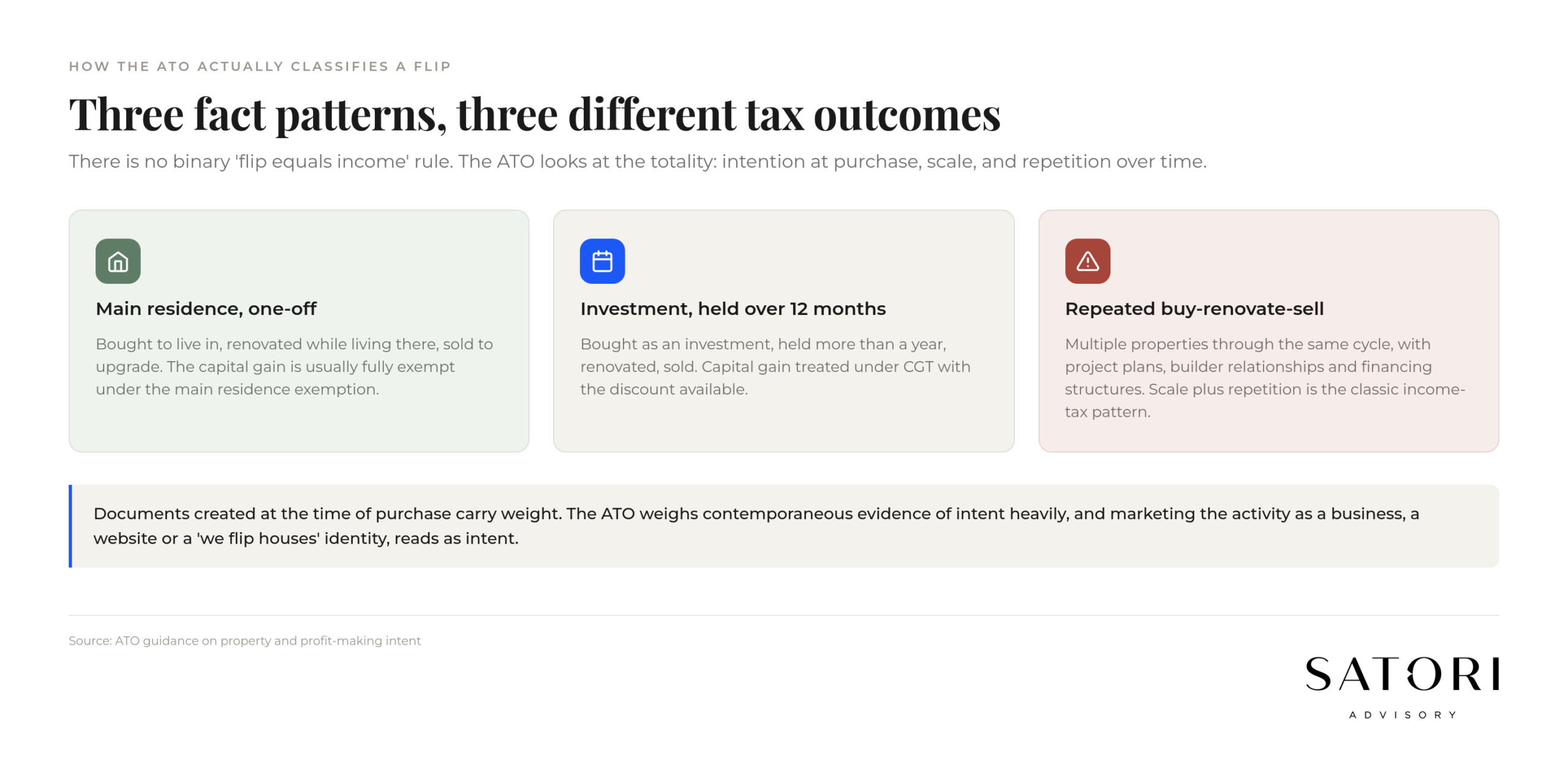
Pattern 1: Main residence renovation and sale (one-off). You bought the property to live in, renovated while living there, then sold to upgrade. The capital gain is usually fully exempt under the main residence exemption, subject to specific eligibility rules.
Pattern 2: Investment property renovation and sale (one-off, held more than 12 months). You bought as an investment, held for more than 12 months, renovated, sold. Capital gain is taxed under CGT, with the 50% discount available for individuals, trusts and partnerships in 2025-26.
Pattern 3: Repeated buy-renovate-sell cycle (business-like). You move multiple properties through the same cycle, often with project plans, builder relationships, financing structures, and a clear profit-making intent. The ATO is likely to treat the profits as ordinary income, taxed at your marginal rate without the CGT discount. Full business deductions are available.
The GST trap
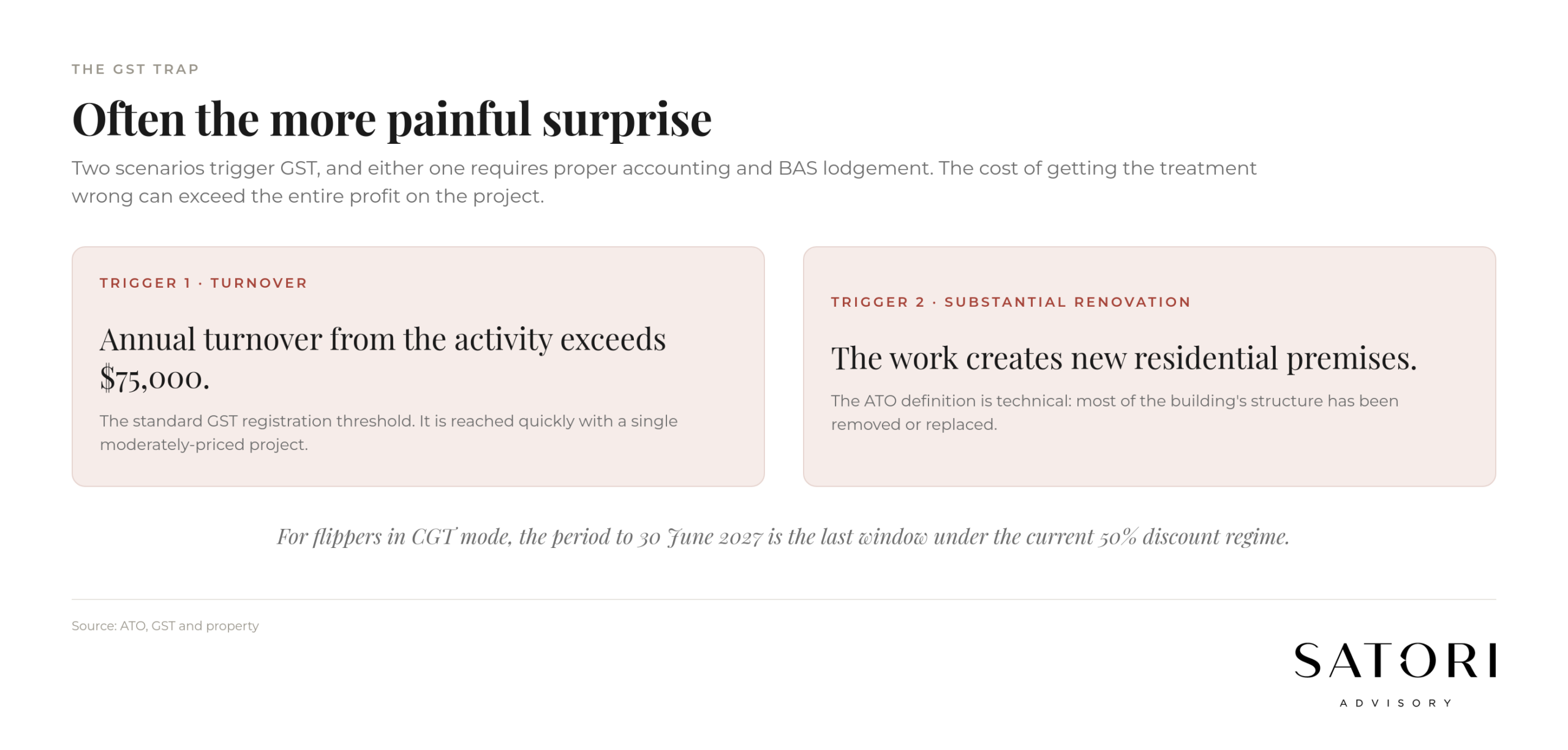
GST is often the more painful surprise.
GST applies in two main scenarios.
You are carrying on an enterprise and your annual turnover from the activity reaches $75,000. Both parts matter. The ATO treats a personal property investor as not carrying on an enterprise, so no GST registration is required and the result is a capital gain or loss. Once it is a profit-making activity or a renovation business, the $75,000 registration threshold is reached quickly with a single moderately-priced flip.
The renovation qualifies as a ‘substantial renovation’ creating new residential premises. The ATO’s definition is technical: most of the building’s structure has been removed or replaced. A substantial renovation triggers GST on the full sale price, with input tax credits available on the renovation costs.
Both scenarios require proper accounting and BAS lodgement. The cost of getting GST treatment wrong can exceed the entire profit on the project.
CGT discount: how it works in 2025-26
For 2025-26, individuals, discretionary trusts, and partnerships that hold an asset for more than 12 months can apply a 50% discount to the capital gain.
Companies do not get the discount. Super funds get a different discount (33.33%).
On a $200,000 capital gain held more than 12 months: an individual at the 47% top marginal rate (including Medicare) pays tax on $100,000 of the gain at 47% = $47,000 in tax. Without the discount, the tax would be $94,000.
The discount is one of the most valuable features of the current regime for individual property investors and flippers in CGT mode.
What changes from 1 July 2027 (2026 Federal Budget reforms)
The 2026 Federal Budget announced sweeping reforms to negative gearing and capital gains tax for residential property and other assets.
Key reforms relevant to property flipping:
From 1 July 2027, the 50% CGT discount for individuals, trusts and partnerships is replaced with cost-base indexation plus a 30% minimum tax rate on capital gains.
The CGT reform applies to gains that accrue after 1 July 2027. Gains accrued before that date continue to be treated under the existing 50% discount rules.
Negative gearing for residential property is being limited to new builds from 1 July 2027. Properties held at 7:30pm AEST 12 May 2026 (the announcement) are grandfathered from the negative gearing change. The CGT reforms have separate, time-of-gain transitional rules.
Practical implication for active property flippers in CGT mode: the period to 30 June 2027 is the last window under the current 50% discount regime. The right move depends on your specific facts; talk to your accountant well ahead of the change.
Common mistakes that turn a CGT-friendly flip into an income tax flip
Marketing the activity as a business (a website, a brand, a ‘we flip houses’ identity). The ATO reads this as intent.
Running multiple flips concurrently and treating them all as ‘one-offs’. Scale plus repetition is the classic income-tax pattern.
Not keeping documentation of the original intent at purchase. The ATO weighs contemporaneous evidence heavily.
Trading through a company without considering the loss of the 50% CGT discount.
Getting the GST question wrong in either direction: assuming it cannot apply, or assuming it must. It turns on whether you are carrying on an enterprise first.
How Satori helps property flippers
Property flipping done thoughtfully can be a strong wealth-building activity. Done without coordination across structure, tax, GST, lending, and exit, it routinely returns less than the spreadsheet says.
We coordinate the structure (sole trader vs trust vs company), the tax treatment, the GST registration if relevant, the lending strategy, and the exit timing into one plan. The objective is not to maximise activity. The objective is to maximise after-tax wealth created per project.
With the 2027 CGT reforms ahead, we are running planning conversations with active property clients now. The decisions are time-bounded.
What to do next
If you have done one flip and are considering a second, get the tax and structure question reviewed before you commit. The first decision determines a lot of what follows.
If you have done multiple flips and have been treating each as a one-off CGT event, get a second opinion. The ATO position on repeated activity is firm.
If you have meaningful unrealised property gains accrued before 1 July 2027, model the impact of the upcoming CGT reform on your specific situation.
How Satori Advisory works
At Satori Advisory we integrate your tax, business, wealth and lending as a prosperity engine, aligned with what matters most to you. With a clear roadmap, informed by data and backed by decades of strategic experience, we simplify the complex. We don’t offer pre-packaged solutions. We deliver tailored, end-to-end advice that reflects your reality and ambitions. You’ll work directly with senior advisers who listen deeply, think boldly and act with purpose. Feel cared for by our trusted team and curated network of financial and business specialists, as we empower you to make smart decisions and realise your potential, powered by numbers.
Frequently asked questions
Is property flipping legal in Australia?
Yes. Buying, renovating, and selling property is legal. The question is how the activity is taxed. The ATO classifies the activity based on intention, scale and repetition, which determines whether profits are taxed as ordinary income or as capital gains.
How does the ATO tax property flipping?
It depends on the activity. A one-off main residence renovation and sale is usually CGT (often exempt). A one-off investment property held more than 12 months is CGT with the 50% discount in 2025-26. A repeated, business-like pattern of buying, renovating and selling is usually taxed as ordinary income with no CGT discount.
When does GST apply to property flipping?
The conditions stack, they are not alternatives. First, you have to be carrying on an enterprise: a personal property investor is not, and is assessed under CGT. Once you are, you may need to register for GST when turnover reaches $75,000. Whether the work qualifies as a ‘substantial renovation’ is what determines if the sale is of new residential premises and therefore taxable rather than input taxed. Where GST applies, input tax credits are available on renovation costs. The criteria are set out in GSTR 2003/3 from paragraph 53.
Does the CGT 50% discount apply to flipped property?
It depends on the holding period and the ATO classification. If the property was held for more than 12 months and the activity is classified as CGT (not ordinary income), the 50% discount applies for individuals, trusts and partnerships in 2025-26. If the activity is classified as ordinary income, no discount.
What changes for property CGT from 1 July 2027?
Under the reforms announced in the 2026 Federal Budget, the 50% CGT discount for individuals, trusts and partnerships is replaced with cost-base indexation plus a 30% minimum tax rate on capital gains accruing after 1 July 2027. Gains accrued before that date continue under the existing 50% discount rules.
Can I avoid being classified as a property trader?
Sometimes, with deliberate structuring. Holding for longer than 12 months, keeping each project as an obvious one-off, not marketing as a flipping business, and documenting investment intent at purchase all push toward CGT treatment. But repeated activity over multiple years usually triggers the income tax classification regardless of how each project is presented.
What is a substantial renovation for GST purposes?
An ATO-defined concept where most of the building’s structure has been removed or replaced. A substantial renovation creates ‘new residential premises’ for GST purposes and triggers GST on the full sale price, with input tax credits available on renovation costs.
Ready to talk?
If you would like a calm, no-pressure conversation about how this applies to your specific situation, we are here to help.
Please feel free to get in touch on 1300 925 081 or send an email to [email protected] if you’d like to book in a chat on the above or on other matters.
Disclaimer
This article contains general information only and has been prepared without considering your objectives, financial situation or needs. It is not personal financial advice, taxation advice or legal advice and should not be relied upon when making financial decisions. Before acting on any information, consider its appropriateness to your circumstances and seek professional advice where appropriate.