
Table of Contents
The set of advisers an Australian business owner works with usually evolves through the life of the business. Early on the accountant is the only adviser. By the time the business is genuinely valuable, the list extends to lawyer, financial planner, mortgage broker, business mentor, possibly an industry-specific consultant, possibly an executive coach.
Most owners pick advisers reactively (when a problem arrives) rather than strategically. The result is a team of professionals who individually mean well but collectively do not produce the leverage the owner expected.
Below is a 2026 lens on how to build the team deliberately, plus a newer category of risk worth holding: the external influence on brand value that did not exist as a discipline 15 years ago.
Three categories of adviser
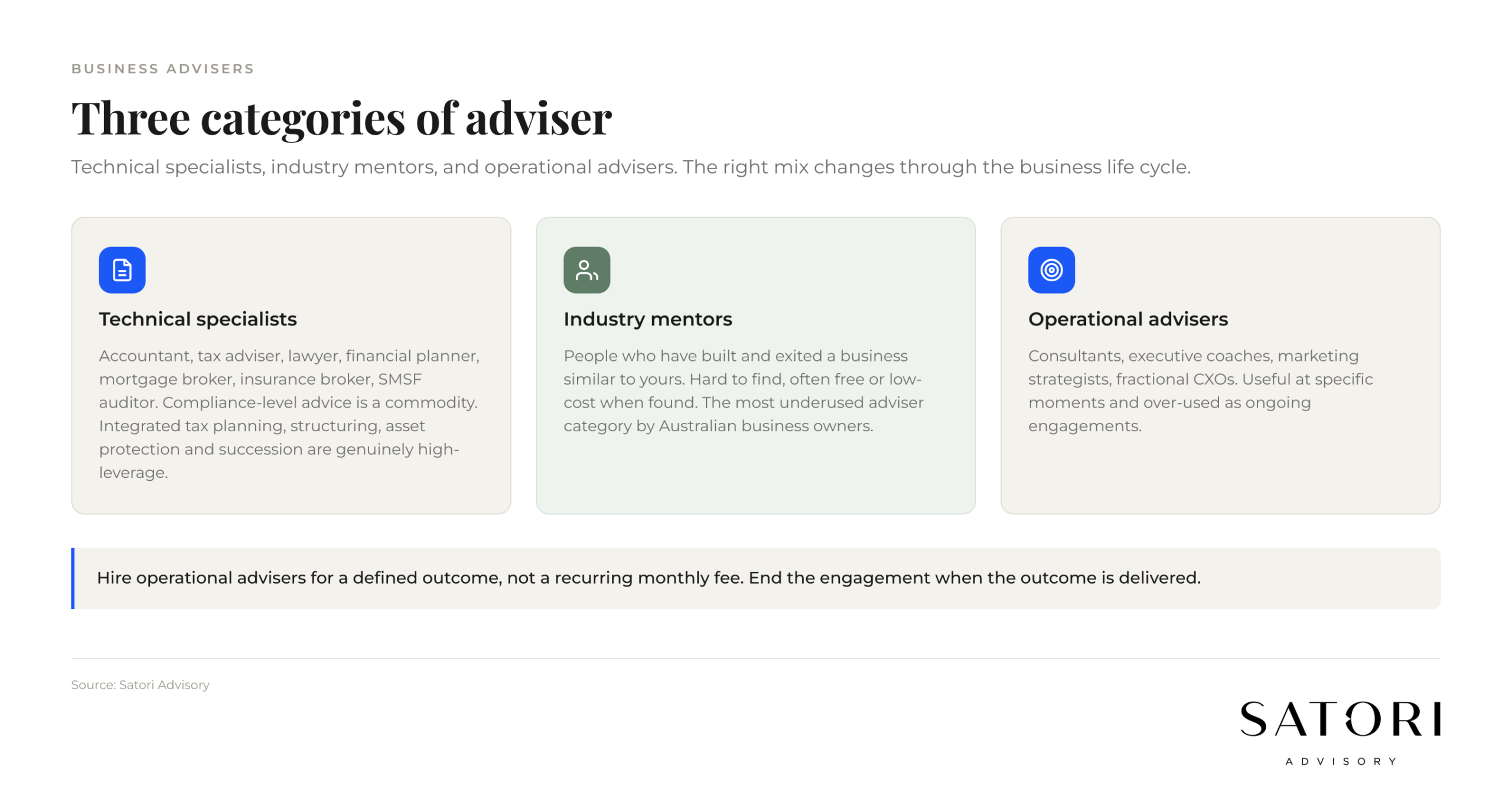
Technical specialists, industry mentors, and operational advisers. The right mix changes through the business life cycle.
Technical specialists
Accountant, tax adviser, lawyer, financial planner, mortgage broker, insurance broker, SMSF auditor.
Compliance-level technical advice is a commodity at the lower end. Most accountants and bookkeepers can lodge a return and run a payroll.
Higher-end technical advice (integrated tax planning, complex structuring, asset protection, succession) is genuinely high-leverage. The dollar value of getting the structure and tax right at scale can be hundreds of thousands of dollars per year.
How to choose: look for credentials (CFP, CPA, CA, registered tax agent), look for the practice’s range of services (single discipline or integrated), and look for whether they coordinate with your other advisers.
Industry mentors
People who have built and exited a business similar to yours.
Hard to find, hard to value, often free or low-cost when found. The most underused adviser category by Australian business owners.
What a mentor delivers that no consultant can: pattern recognition from having lived through the same stage in a similar business. They have seen which decisions matter and which do not.
How to choose: look for someone who has actually built a business at the stage you are at or one stage ahead, who is now in a position to share rather than sell, and who you can meet with regularly enough that the relationship has texture.
Operational advisers
Business consultants, executive coaches, marketing strategists, fractional CXOs.
Useful at specific moments (a brand reset, an operational redesign, a culture transition) and over-used as ongoing engagements.
How to choose: hire for a defined outcome, not for a recurring monthly fee. End the engagement when the outcome is delivered.
Adviser mix by business stage
Early stage (pre-revenue to roughly $1M revenue): generalist accountant for compliance, one strong industry mentor, no full-time advisers. The owner does most of the work.
Scaling stage (roughly $1M to $10M revenue): specialist technical advisers (tax planning beyond compliance, lawyer for contracts, possibly a financial planner for the owner’s personal wealth), continued mentor engagement, project-based operational advice when needed.
Mature stage (roughly $10M+): integrated advice (tax, wealth, lending, succession), board-level mentor or non-executive director, specialist consultants for specific strategic moves (acquisition, exit prep, new market entry).
The newer risk: external influence on brand value
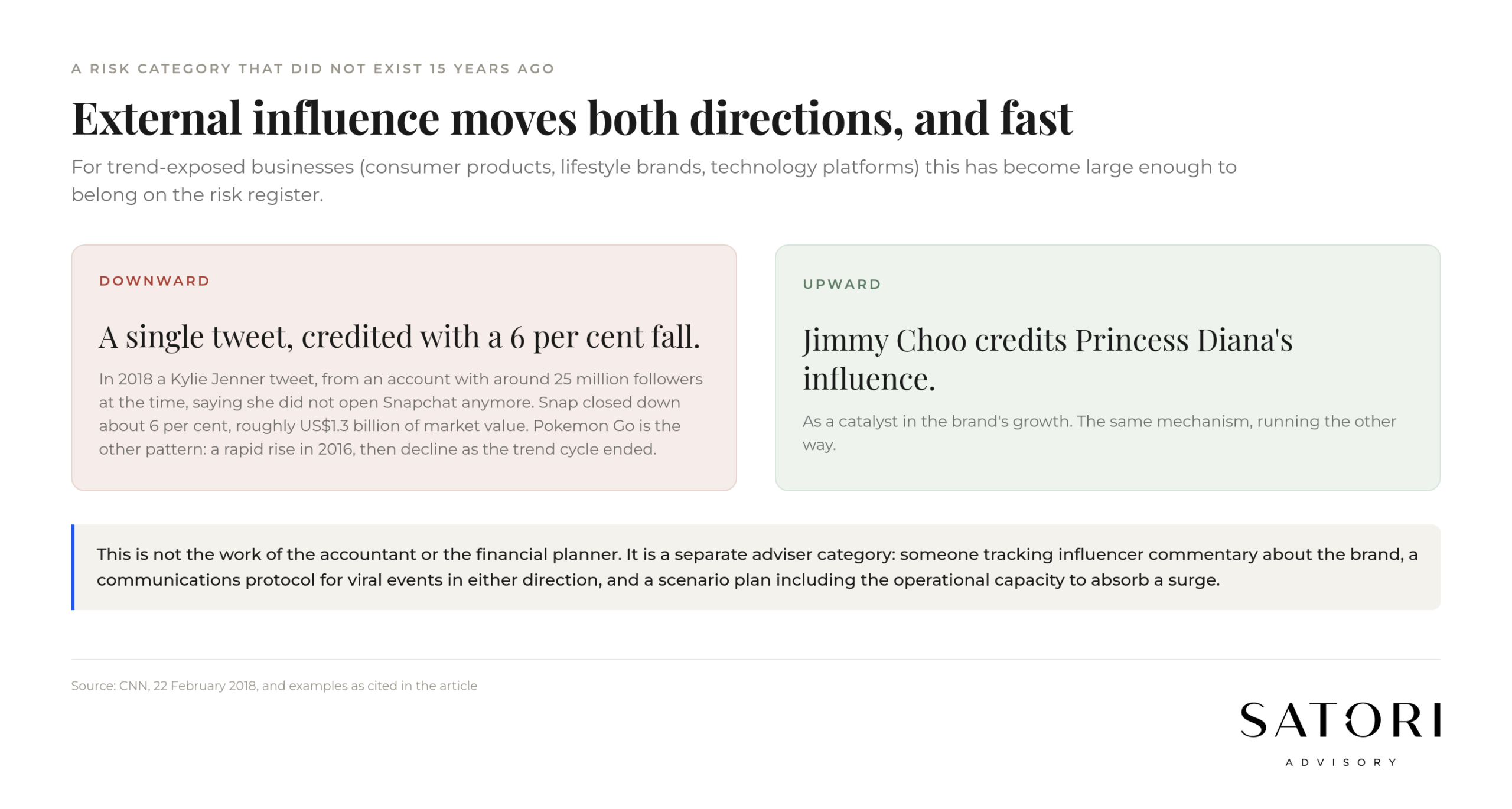
Beyond your professional advisers, modern Australian businesses face a category of risk that did not exist as a discipline 15 years ago: the influence of external figures on brand value.
Two well-documented examples illustrate the speed.
In 2018, a Kylie Jenner tweet (around 25 million followers at the time) saying she did not open Snapchat anymore was credited with a 6 per cent fall in Snap Inc’s share price, wiping roughly US$1.3 billion off market capitalisation in a single day (CNN, 22 February 2018). The price clawed back a portion the same day but the demonstration was complete.
Pokemon Go rose to massive heights in 2016 then declined rapidly as the trend cycle ended. The lesson is to have a strategy to capitalise on trend-based attention and sustain it for as long as possible, and never forget the core customer base.
The opposite direction works the same way. Jimmy Choo credits Princess Diana’s stylish influence as a catalyst for taking the brand from beautiful to desirable. Camilla (the Australian kaftan designer) became globally recognised after Oprah Winfrey wore her colourful designs. Kate Middleton wearing Topshop sells out the item almost immediately.
What this means for the adviser mix
For trend-exposed businesses (consumer products, lifestyle brands, technology platforms), the external influence risk has become large enough to belong in the risk register alongside the traditional categories.
Practical inclusions:
A media or PR adviser who tracks influencer commentary about the brand or the category.
A communications protocol for responding to viral influence events (in either direction).
A scenario plan for a sudden drop or surge in attention, including operational capacity to absorb a surge.
This is not the work of the accountant or the financial planner. It is a separate adviser category, often part-time or project-based, that did not exist as a recognised discipline two decades ago.
How Satori works with business owner clients
For our business owner clients, we coordinate the technical advice across tax, wealth, lending, and structure. Our role usually grows over the life of the business: light-touch compliance early, deep structural advice as the business scales, integrated wealth and succession work as the owner approaches exit.
We do not provide industry mentorship or operational consulting. Where those are needed, we will often introduce clients into our network and stay coordinated with the work being done.
The integration matters more as the business gets bigger. Decisions on structure, distributions, super, lending, and personal investment all interact.
What to do next
Map your current adviser team across the three categories: technical, mentor, operational.
Identify gaps. The most common gap is no genuine industry mentor.
Decide whether your current technical advisers are commodity-level or integrated. Upgrade the technical layer when the business hits the scale where the dollar value justifies the higher fee.
If your business is trend-exposed, add the external influence dimension to your risk register and plan accordingly.
How Satori Advisory works
At Satori Advisory we integrate your tax, business, wealth and lending as a prosperity engine, aligned with what matters most to you. With a clear roadmap, informed by data and backed by decades of strategic experience, we simplify the complex. We don’t offer pre-packaged solutions. We deliver tailored, end-to-end advice that reflects your reality and ambitions. You’ll work directly with senior advisers who listen deeply, think boldly and act with purpose. Feel cared for by our trusted team and curated network of financial and business specialists, as we empower you to make smart decisions and realise your potential, powered by numbers.
Frequently asked questions
What is the difference between a business adviser and a business mentor?
A business adviser is typically a paid professional (accountant, lawyer, consultant) providing specialist technical or operational advice. A business mentor is typically someone who has built and exited a similar business and shares their experience, often free or low-cost. Both are valuable; most Australian owners under-invest in mentors.
Do I need a business adviser if I am a sole trader?
At minimum, a registered tax agent or accountant for compliance. Beyond that, the value of additional advisers (legal, financial planning, lending) depends on the complexity of the business and your personal financial picture. Most sole traders benefit from at least an integrated tax and personal financial planning conversation once a year.
How do I find a good business mentor in Australia?
Look in industry associations, alumni networks, owner peer groups, and your professional network. Look for someone who has built and exited a business at the stage you are at or one stage ahead, who is in a position to share rather than sell, and who you can meet with regularly.
How much should I budget for business advisers?
For early-stage businesses, a few thousand dollars per year covers compliance accounting and ad-hoc legal. For scaling businesses, $20,000 to $80,000 per year across the adviser team is common. For mature businesses with integrated advice and board-level input, six figures is common. The right figure is what produces a multiple in business value over the same period.
What is influence risk for a business brand?
The risk that an external figure (social media influencer, celebrity, named industry voice) moves brand value sharply in either direction through a single piece of commentary. The risk is highest for trend-exposed consumer brands and technology platforms with concentrated brand identity.
Are business adviser fees tax deductible in Australia?
Generally yes, where the advice relates to the running of an income-producing business. Tax agent fees, accountant fees, legal fees on business matters, and consultant fees on business strategy are typically deductible. Confirm specific deductibility with your tax agent.
Ready to talk?
If you would like a calm, no-pressure conversation about how this applies to your specific situation, we are here to help.
Please feel free to get in touch on 1300 925 081 or send an email to [email protected] if you’d like to book in a chat on the above or on other matters.
Disclaimer
This article contains general information only and has been prepared without considering your objectives, financial situation or needs. It is not personal financial advice, taxation advice or legal advice and should not be relied upon when making financial decisions. Before acting on any information, consider its appropriateness to your circumstances and seek professional advice where appropriate.