
Table of Contents
Comprehensive Credit Reporting (CCR) was introduced in Australia in 2018, replacing the previous negative-only credit reporting system. It became mandatory for large ADIs under the 2021 Act, phased across 1 July 2021 and 1 July 2022.
Most Australians now have a credit file that contains both their positive payment history and the negative events. Lenders see a much more complete picture than they used to. For most borrowers this is a net positive; for some it requires a bit more care.
Below is a 2026 lens on what CCR actually means for an Australian borrower.
What was on a credit file before CCR
Negative-only credit reporting, in force until 2014 in Australia, recorded only the bad stuff: defaults, court judgments, bankruptcies, applications for credit, and serious credit infringements.
There was no positive information. A borrower who had paid their home loan on time for 20 years looked the same on the file as a borrower who had only borrowed for the first time the prior week.
From 2014 the transitional system added some positive information (account types, limits, open/close dates). From 2018 the full CCR system, including 24 months of repayment history, was introduced.
What is on your credit file under CCR in 2026
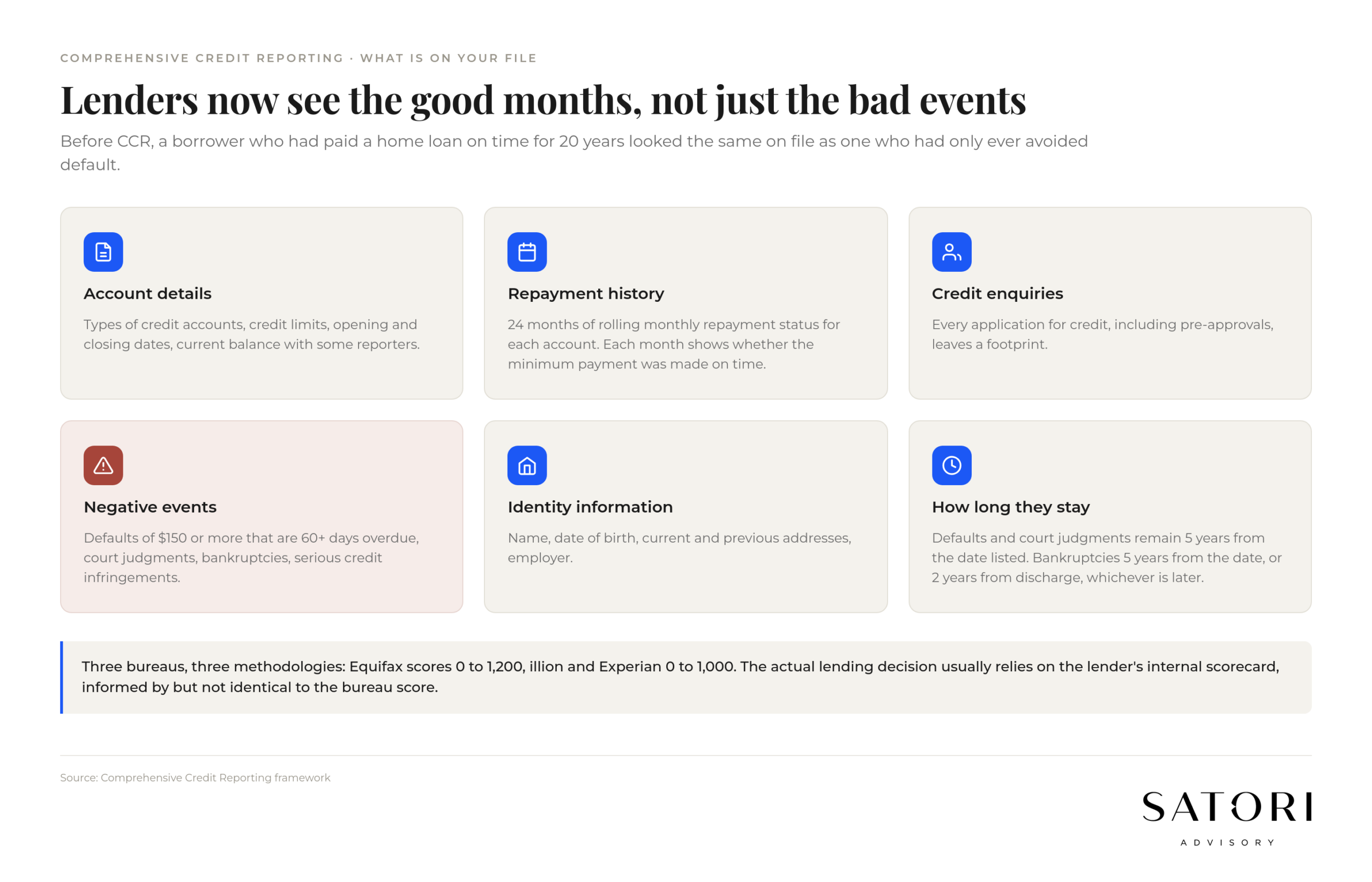
Account details: types of credit accounts you hold, credit limits, account opening and closing dates, current balance (some reporters).
Repayment history: 24 months of rolling monthly repayment status for each credit account. Each month shows whether the minimum payment was made on time.
Credit enquiries: every application for credit (including pre-approvals) leaves a footprint.
Negative events: defaults of $150 or more that are 60+ days overdue, court judgments, bankruptcies, serious credit infringements.
Identity information: name, date of birth, current and previous addresses, employer.
How the score is built
Australia’s main credit reporting bodies are Equifax and Experian. Each runs its own scoring methodology, so the score varies between them.
Typical score ranges:
Equifax: 0 to 1,200. ‘Average’ is 661-734. ‘Good’ is 735-852. ‘Very Good’ is 853-1,000. ‘Excellent’ is 1,000+.
Experian also scores from 0 to 1,000, with similar tiers at different thresholds.
Experian: 0 to 1,000. Similar structure.
The actual lending decision usually relies on the lender’s internal scorecard, which is informed by but not identical to the bureau score. Different lenders weight the same data differently.
What helps and what hurts your score
Helps (in approximate order of impact):
Consistent on-time monthly payments across all credit accounts.
Long credit history with stable accounts.
Low credit utilisation (using a small portion of your available credit limits).
Variety of credit types managed responsibly (e.g. a home loan plus a credit card).
Few credit enquiries in a recent period.
Hurts (in approximate order of impact):
Recent missed or late payments, especially across multiple accounts.
Recent defaults of $150+ that are 60+ days overdue.
Multiple credit applications in a short window (especially declined applications).
High credit card limits relative to your income.
Bankruptcy or serious credit infringements (which can stay on file for 5-7 years).
What to do before applying for a home loan
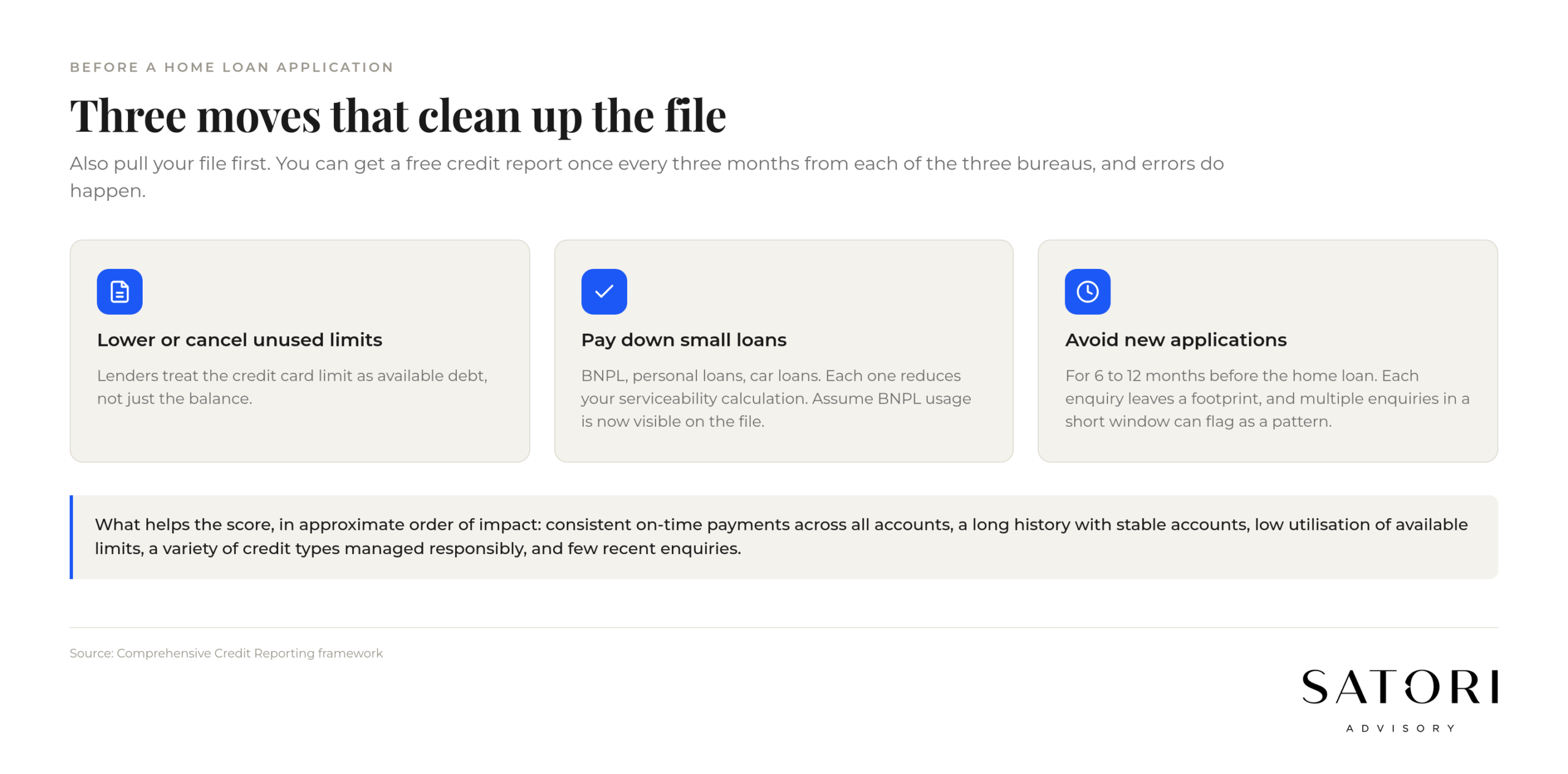
Three practical moves to clean up the file before applying.
Lower or cancel credit card limits you do not need. Lenders treat the limit as available debt, not just the balance.
Pay down small loans (BNPL, personal loans, car loans) where practical. Each loan reduces your serviceability calculation.
Avoid new credit applications for 6 to 12 months before the home loan. Each enquiry leaves a footprint and multiple enquiries in a short window can flag with subsequent lenders.
Also check your credit file before applying. You can get a free credit report once every three months from each of the three bureaus. Errors do happen and getting them corrected before a lender pulls the file is much easier than after.
BNPL and the credit file
Buy Now Pay Later (BNPL) products were historically outside the formal credit reporting framework. Reform proposals during 2024-2025 have brought BNPL more closely into the National Consumer Credit Protection regime, with some providers now reporting to the bureaus.
If you use BNPL regularly, assume your usage may now be visible on the credit file. Multiple active BNPL accounts can affect serviceability calculations even when individual balances are small.
Recovering from a credit incident
A late payment, default, or other negative event can be recovered from, but it takes time and consistent behaviour.
Defaults remain on the credit file for 5 years from the date listed.
Bankruptcies remain on the file for 5 years from the date of bankruptcy (or 2 years from discharge, whichever is later).
Court judgments remain for 5 years.
After the timeframes expire the negative event drops off automatically. In the meantime, consistent on-time payments on all current accounts demonstrate recovery.
How Satori uses credit file awareness in lending plans
For our lending clients, we pull and review the credit file early in the process. We identify any errors, plan the timing of any new applications to avoid the enquiry footprint, and structure the loan application around the strongest profile the file can support.
For borrowers in recovery mode after a credit incident, we work backwards from the lender’s serviceability and credit policy to identify which lender’s policy best fits the current profile.
What to do next
Pull a free copy of your credit report from each of the three bureaus.
Check for errors and dispute any inaccurate listings.
If a home loan is on your 6-12 month horizon, avoid new credit applications and lower unused credit card limits now.
If you have had a credit incident, give the rebuild time and document the consistent on-time payments.
How Satori Advisory works
At Satori Advisory we integrate your tax, business, wealth and lending as a prosperity engine, aligned with what matters most to you. With a clear roadmap, informed by data and backed by decades of strategic experience, we simplify the complex. We don’t offer pre-packaged solutions. We deliver tailored, end-to-end advice that reflects your reality and ambitions. You’ll work directly with senior advisers who listen deeply, think boldly and act with purpose. Feel cared for by our trusted team and curated network of financial and business specialists, as we empower you to make smart decisions and realise your potential, powered by numbers.
Frequently asked questions
What is Comprehensive Credit Reporting in Australia?
Australia’s positive credit reporting system, in force in its comprehensive form since 12 March 2014 and mandatory for large ADIs from 2021-2022, that records both positive and negative credit information on consumer credit files. Unlike the previous negative-only system, CCR includes 24 months of rolling repayment history, account types, credit limits, and account open/close dates.
Who reports to CCR in Australia in 2026?
Large ADIs, including the four major banks, have been mandatory CCR reporters since the phase-in across 1 July 2021 and 1 July 2022. Many other Australian lenders and credit providers participate but may not report all data types. BNPL providers are increasingly being brought into the formal reporting regime.
What is my credit score and where do I check it?
Australia’s main credit reporting bodies calculate scores: Equifax from 0 to 1,200 and Experian from 0 to 1,000. You can get a free credit report once every three months from each bureau. Multiple free services (Get Credit Score, Credit Savvy, Finder) show your score for free.
How is my credit score calculated in Australia?
Each bureau uses its own methodology, but the main factors are repayment history (24-month rolling window), credit utilisation, credit history length, types of credit, and recent applications. The lender’s internal scorecard usually weights the same data differently.
How long do late payments stay on my credit file?
Repayment history is reported on a rolling 24-month basis. Older late payments drop off as more recent months are added. Serious defaults of $150+ that are 60+ days overdue remain on the file for 5 years from the date listed.
Does checking my own credit score hurt it?
No. Checking your own credit file is a ‘soft’ enquiry that does not affect your score. Only credit applications (where a lender pulls the file) are ‘hard’ enquiries that leave a footprint.
How can I improve my credit score before applying for a home loan?
Three high-impact moves. Make all payments on time for 12+ months before applying. Lower or cancel unused credit card limits (limit counts as debt, not just balance). Avoid new credit applications for 6-12 months before the home loan to keep recent enquiries low.
Ready to talk?
If you would like a calm, no-pressure conversation about how this applies to your specific situation, we are here to help.
Please feel free to get in touch on 1300 925 081 or send an email to [email protected] if you’d like to book in a chat on the above or on other matters.
Disclaimer
This article contains general information only and has been prepared without considering your objectives, financial situation or needs. It is not personal financial advice, taxation advice or legal advice and should not be relied upon when making financial decisions. Before acting on any information, consider its appropriateness to your circumstances and seek professional advice where appropriate.