
Table of Contents
Most Australians use the same approach to tax every year because the first one worked. Often it still works. Sometimes the situation has outgrown the approach and the gap shows up as missed deductions, surprise bills, or audit exposure.
Below is a 2026 lens on when DIY is fine, when a tax agent earns their fee, and how a real accountant differs from a tax agent.
When DIY through myTax is fine
myTax (accessed via myGov) is genuinely good for simple situations.
PAYG employee with a single income source.
Standard work-related deductions (WFH, professional memberships, donations).
No investment property, no business income, no SMSF, no material share or crypto activity.
ATO pre-fill covers most of the work; you confirm and lodge.
If that describes you, doing your own return takes 30 to 60 minutes and saves the tax agent fee.
When a tax agent earns their fee
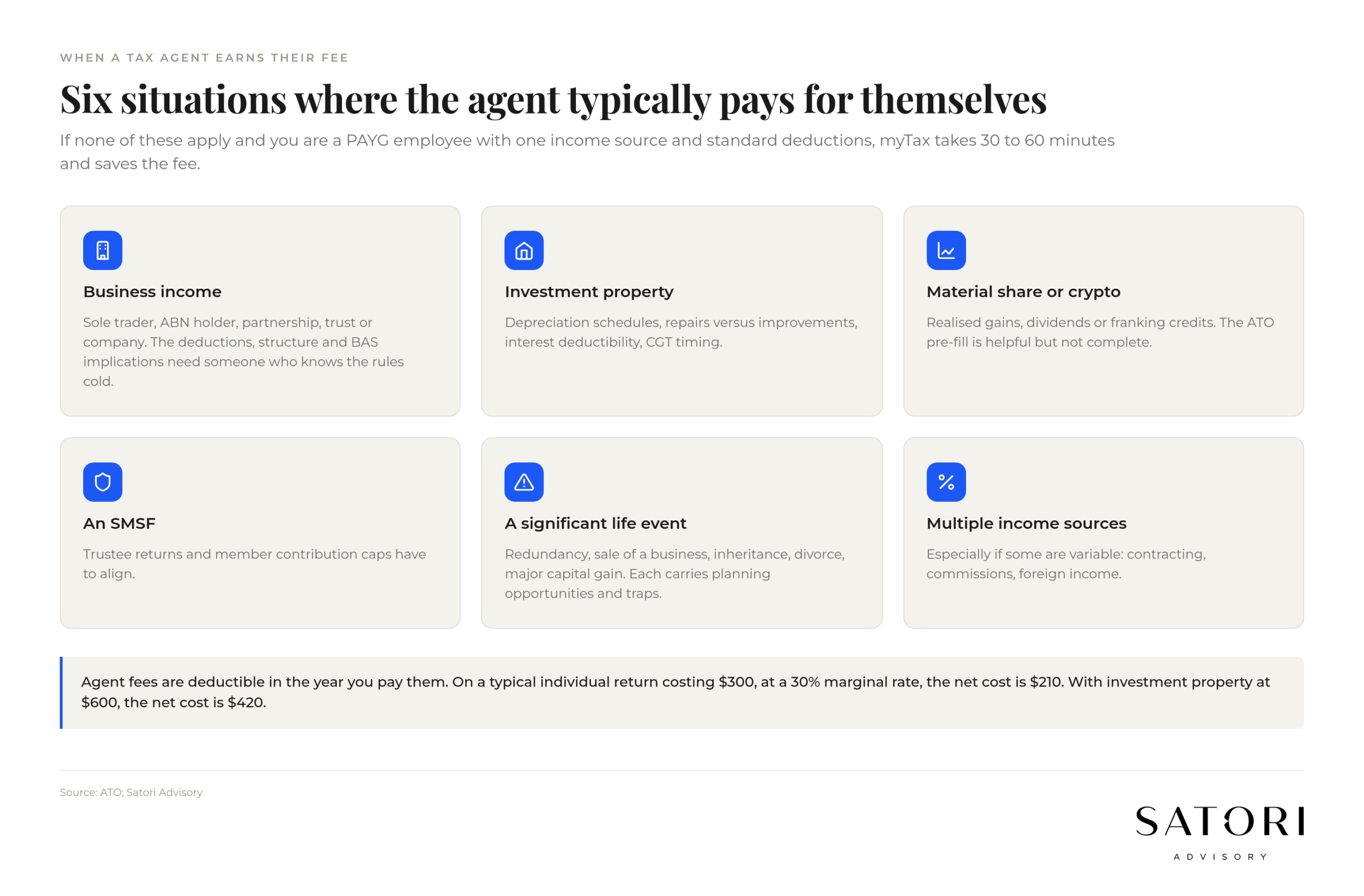
Six situations where a tax agent typically pays for themselves.
Business income (sole trader, ABN holder, partnership, trust or company). The deductions, structure, and BAS implications need someone who knows the rules cold.
Investment property (or properties). Depreciation schedules, repairs vs improvements, interest deductibility, CGT timing.
Material share or crypto portfolio with realised gains, dividends, or franking credits. The ATO pre-fill is helpful but not complete.
SMSF: trustee returns and member contribution caps have to align.
Significant life event in the year: redundancy, sale of a business, inheritance, divorce, major capital gain. Each carries planning opportunities and traps.
Multiple income sources, especially if some are variable (contracting, commissions, foreign income).
The tax agent lodgement deadline extension
If you lodge through a registered tax agent and you are on the agent’s lodgement programme, your lodgement deadline is typically extended from 31 October to as late as 15 May of the following year.
The extension can be useful if you need additional time to gather information (especially for SMSF, business returns, or complex investment returns). It also gives the tax agent space to schedule your return outside the October crush.
Tax agent fees are deductible
Fees paid to a registered tax agent for preparing your tax return are deductible in the year you pay them.
On a typical individual return costing $300, with a 30% marginal rate, the net cost is $210. With investment property at $600, the net cost at the same rate is $420.
The deductibility moves the effective cost meaningfully closer to break-even with DIY for any situation where the agent finds even one or two deductions you would have missed.
The difference between a tax agent and an accountant
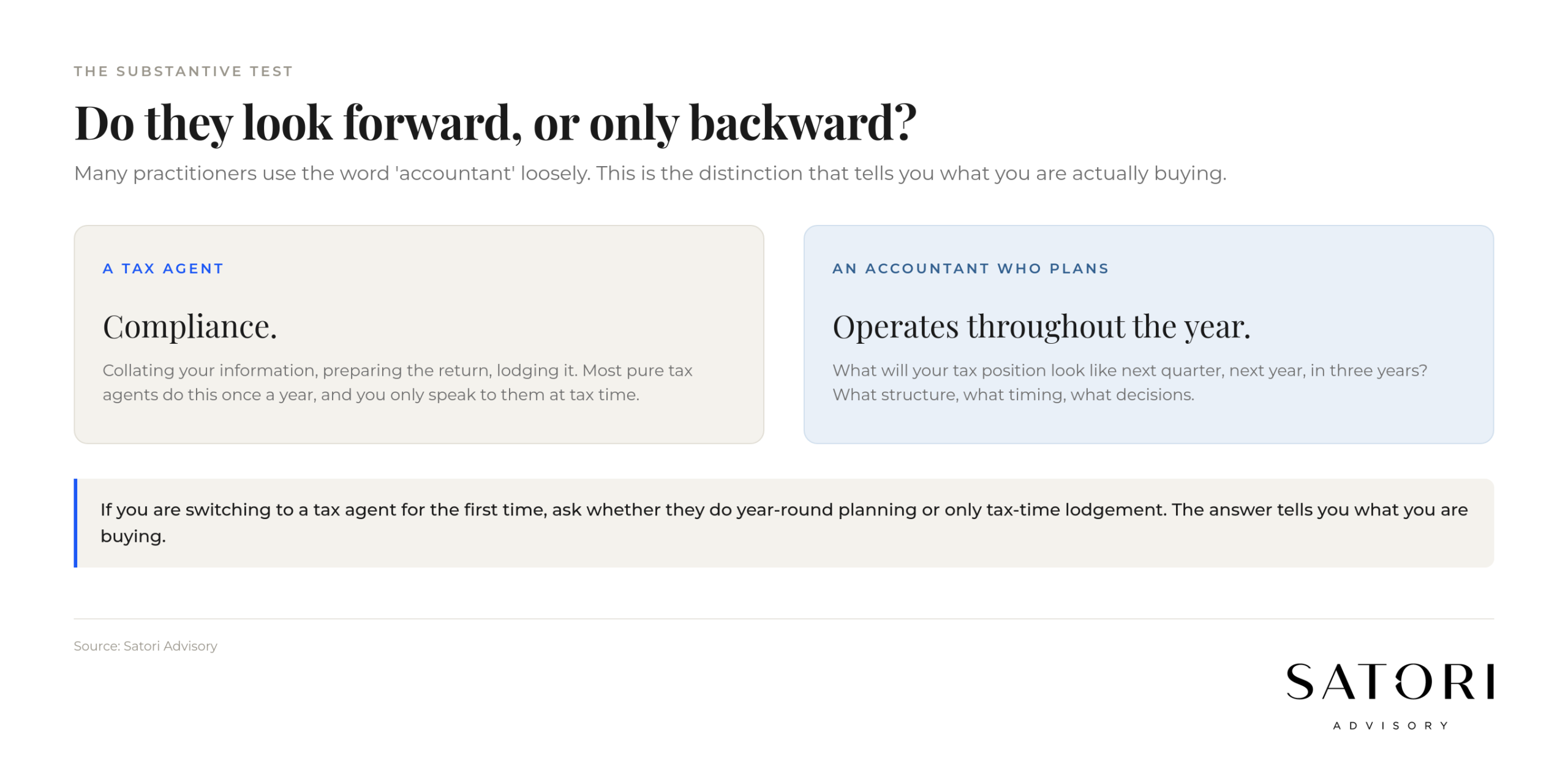
Not all tax-related professionals do the same work.
A tax agent focuses on compliance: collating your information, preparing the return, and lodging it. Most pure tax agents do this once a year and you only speak to them at tax time.
An accountant who provides tax planning advice operates throughout the year. They look ahead: what will your tax position look like next quarter, next year, in three years? What structure changes are worth considering? What contributions, timing decisions or asset realisations should be considered before 30 June?
Many practitioners use ‘accountant’ loosely. The substantive test is whether they look forward (planning) or only backward (lodgement). For business owners and high-net-worth individuals, the planning is usually worth more than the lodgement.
Reviewing prior years
A good accountant will sometimes review your previous returns and identify deductions or treatments that were missed. If material, an amendment can be lodged for up to two years (or longer in certain cases).
At Satori, where we believe a new client has underclaimed in previous years, we conduct a review and lodge adjustments where appropriate. Money returned to you that someone else missed.
Other services a real accounting practice provides
Beyond annual returns, a full-service accounting practice typically covers:
BAS lodgement for GST-registered businesses.
Year-end compliance for SMSFs, including audit coordination.
Entity setup: trusts, sole trader registrations, Pty Ltd companies.
Salary packaging and structuring.
Negative gearing and investment property tax strategies.
Asset restructuring before sale or generational transfer.
Tax-effective structuring of professional services income (PSI considerations).
How Satori thinks about the choice
At Satori we understand that paying the right amount of tax, and not a cent more, means more disposable income in your pocket. Our accountants will ensure you are doing just that, and help structure your accounts or business to maximise income at the same time.
If your situation is genuinely simple (PAYG, one income, standard deductions), DIY through myTax is fine. If your situation has any of the six complexity flags above, a real accountant doing year-round planning is usually worth several times the lodgement fee.
What to do next
Be honest about which side of the line you are on. If you have business income, an investment property, an SMSF, material share or crypto activity, or a meaningful life event in the year, the DIY route is often false economy.
If you are switching to a tax agent for the first time, ask whether they do year-round planning or only tax-time lodgement. The answer tells you what you are buying.
If you have done your own returns for years and your situation has grown, get a one-off prior-year review. The cost is small; the upside can be material.
How Satori Advisory works
At Satori Advisory we integrate your tax, business, wealth and lending as a prosperity engine, aligned with what matters most to you. With a clear roadmap, informed by data and backed by decades of strategic experience, we simplify the complex. We don’t offer pre-packaged solutions. We deliver tailored, end-to-end advice that reflects your reality and ambitions. You’ll work directly with senior advisers who listen deeply, think boldly and act with purpose. Feel cared for by our trusted team and curated network of financial and business specialists, as we empower you to make smart decisions and realise your potential, powered by numbers.
Frequently asked questions
Should I use a tax agent in Australia?
It depends on your situation. PAYG employees with simple deductions can often DIY through myTax. Anyone with business income, investment property, SMSF, material shares or crypto, or a significant life event in the year usually benefits from a tax agent or accountant.
What is the deadline for lodging tax through a tax agent?
Typically as late as 15 May of the following year, provided you are on the agent’s lodgement programme before 31 October. The DIY deadline through myTax is 31 October.
Are tax agent fees deductible?
Yes. Fees paid to a registered tax agent for preparing your tax return are deductible in the year you pay them. The deduction makes the effective cost meaningfully smaller than the headline fee.
What is the difference between a tax agent and an accountant?
A tax agent focuses on compliance and lodgement. An accountant looks ahead and provides planning advice across the year. The substantive test is whether they only look backward (lodgement) or also forward (planning).
How much does a tax agent cost in Australia?
There is no published benchmark: neither the ATO nor the Tax Practitioners Board sets or publishes agent fees. As a rough guide from what we see in the Australian market in 2026, a standard individual return sits around $150 to $400, a return with an investment property around $400 to $700, and business or SMSF returns from $1,000. Ask for a quote up front, and remember the fee is deductible the following year.
Can a tax agent lodge amended prior-year returns?
Yes, generally for up to two years from the original lodgement, longer in certain circumstances. Worth doing if a previous return missed material deductions or used the wrong treatment.
Ready to talk?
If you would like a calm, no-pressure conversation about how this applies to your specific situation, we are here to help.
Please feel free to get in touch on 1300 925 081 or send an email to [email protected] if you’d like to book in a chat on the above or on other matters.
Disclaimer
This article contains general information only and has been prepared without considering your objectives, financial situation or needs. It is not personal financial advice, taxation advice or legal advice and should not be relied upon when making financial decisions. Before acting on any information, consider its appropriateness to your circumstances and seek professional advice where appropriate.