Table of Contents
Work clothing deductions are one of the smaller items on most Australian tax returns and one of the most consistently misunderstood. The ATO actively reviews this category and has confirmed that clothing claims are up nearly 20 per cent over the past several years, with much of the increase coming from over-claims and outright mistakes.
Below is a clear 2026 guide to what you can claim, what you cannot, and how the $150 laundry rule actually works.
The three eligible categories
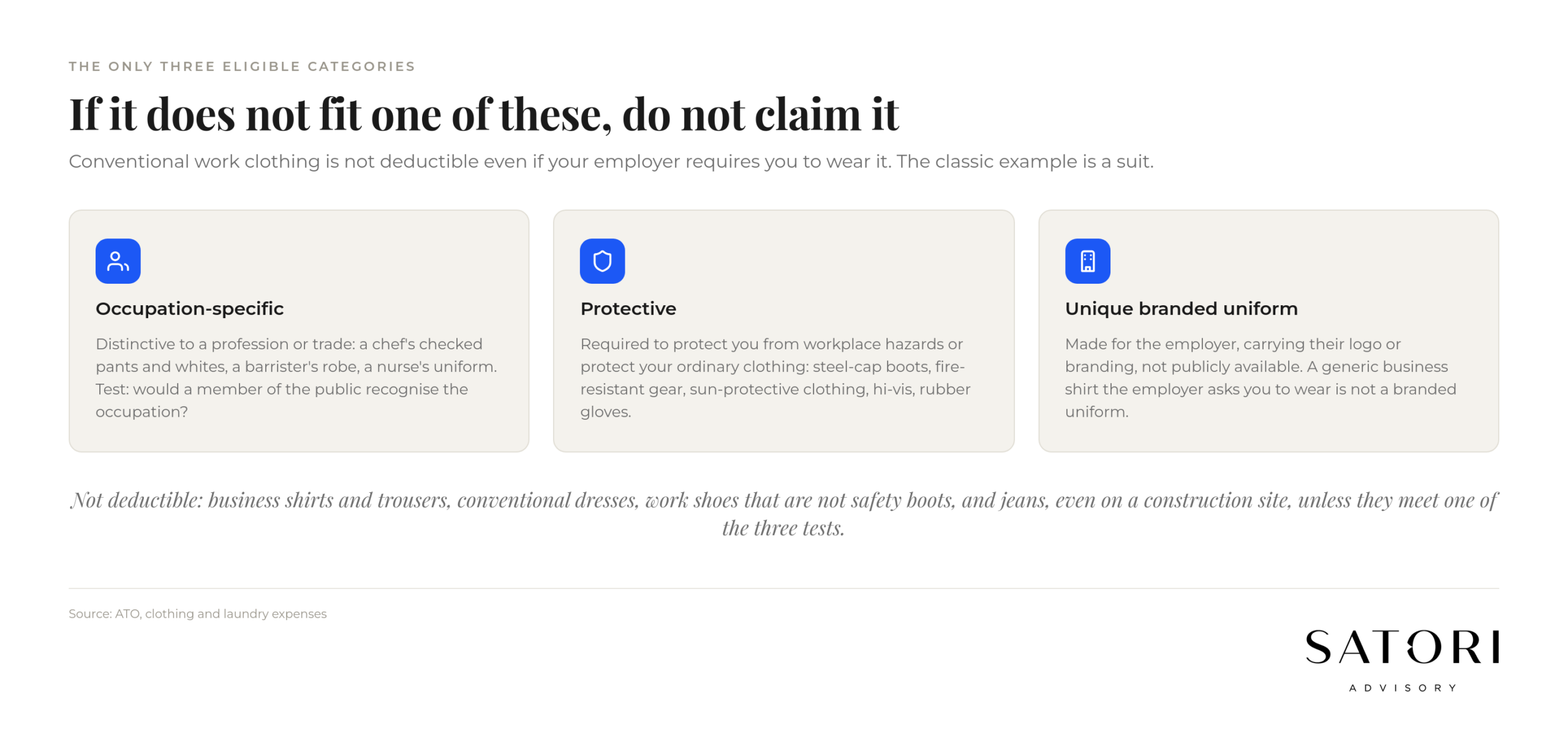
You can claim the cost of buying and cleaning work clothing in only three categories.
Occupation-specific clothing
Clothing that clearly identifies you as belonging to a particular profession or trade, where the clothing is distinctive to that occupation.
Examples: a chef’s checked pants, a chef’s whites, a barrister’s robe, a nurse’s uniform (where unique to the profession).
Test: would a member of the public, seeing the clothing, recognise the occupation? If yes, it usually qualifies.
Protective clothing
Clothing required to protect you from workplace hazards, or to protect your ordinary clothing from soiling or damage during income-earning activities.
Examples: steel-cap boots for construction or warehouse work, fire-resistant clothing, sun-protective clothing for outdoor workers, hi-vis safety vests, rubber boots for concreters or commercial cleaners, gloves, overalls, smocks and aprons.
Test: would the clothing prevent injury or damage in the course of your work? If yes, it usually qualifies.
Unique branded uniforms
Clothing designed and made for the employer, carrying the employer’s logo or branding, and not publicly available.
Examples: a shirt with the company logo embroidered on it, a registered uniform.
Test: is the clothing distinctive to the employer and not something a member of the public could buy and wear casually? If yes, it usually qualifies.
Note: a generic business shirt that the employer asks you to wear is NOT a branded uniform.
What is not deductible
Conventional work clothing, even if your employer requires you to wear it, is not deductible. The classic example: a suit.
If your employer requires you to wear a suit to the office, the suit and its dry cleaning are not deductible because the suit is conventional clothing that could be worn outside work.
Other non-deductible items: business shirts and trousers, conventional dresses, work shoes (not safety boots), jeans (even when worn on construction sites unless they are protective).
The $150 laundry rule
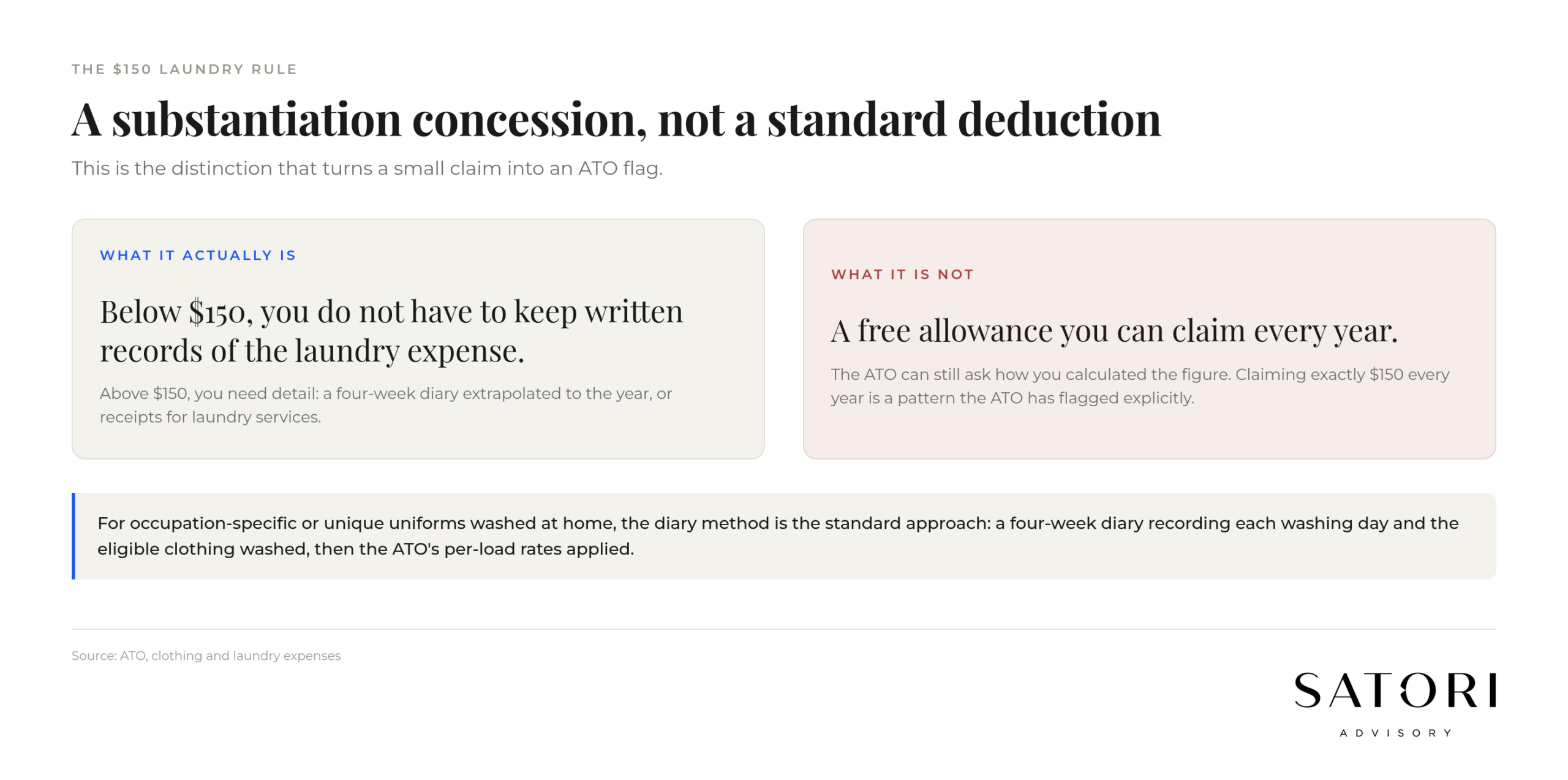
If your claim for work clothing and laundry expenses is below $150, you do not have to keep written records of the laundry expense.
Important nuance: the $150 is not a standard deduction. It is a substantiation concession. The ATO can still ask how you calculated the figure, and if you cannot explain it, the deduction can be denied.
Common mistake: claiming exactly $150 every year on the assumption it is a free allowance. The ATO has flagged this pattern explicitly. Roughly a quarter of all clothing and laundry claims are exactly $150, and many of those will not survive review.
Above $150 in laundry expense, you need detailed records: a four-week diary that you can extrapolate to the year, or actual receipts for laundry services.
How to calculate laundry expenses correctly
Two ATO-accepted methods.
Diary method: keep a four-week diary recording each washing day and the eligible work clothing washed. Apply the ATO’s per-load rates (typically $1.00 per load for work clothing washed by itself, $0.50 per load if washed with other clothes). Extrapolate the four-week figure to the full year.
Receipts method: keep receipts for actual laundry services (dry cleaning, commercial laundry).
For occupation-specific or unique uniforms washed at home, the diary method is the standard approach.
Common compliance mistakes
Claiming a suit and its dry cleaning. Not deductible.
Claiming work shoes that are conventional footwear. Not deductible.
Claiming exactly $150 every year without records. ATO flag.
Claiming the cost of clothing reimbursed by the employer. Not deductible.
Claiming damage or loss of clothing during work activities (separate provisions apply, often not deductible).
Claiming initial purchase of new uniforms when the employer provided them.
How Satori handles clothing deductions
For our tax clients, work clothing is one of the small items we sweep at the start of each return. Where the situation is clear (a tradie with steel-cap boots and hi-vis, a chef with whites, an employee with a branded uniform), the deduction is straightforward and supported by receipts.
Where the situation is borderline (industries with quasi-uniforms or grey areas), we work through the ATO criteria and document the calculation. The dollar value is rarely large, but getting it wrong is one of the easier mistakes for the ATO to spot.
What to do next
Confirm your work clothing falls into one of the three eligible categories. If it does not, do not claim it.
If you have eligible clothing, keep receipts for purchases and a four-week diary for laundry.
Avoid claiming exactly $150 every year. Calculate the figure based on your actual circumstances.
If you are unsure whether a specific item qualifies, ask your tax agent or check the ATO website before claiming.
How Satori Advisory works
At Satori Advisory we integrate your tax, business, wealth and lending as a prosperity engine, aligned with what matters most to you. With a clear roadmap, informed by data and backed by decades of strategic experience, we simplify the complex. We don’t offer pre-packaged solutions. We deliver tailored, end-to-end advice that reflects your reality and ambitions. You’ll work directly with senior advisers who listen deeply, think boldly and act with purpose. Feel cared for by our trusted team and curated network of financial and business specialists, as we empower you to make smart decisions and realise your potential, powered by numbers.
Frequently asked questions
Can I claim my work suit on tax in Australia?
No. Conventional work clothing (suits, dresses, business shirts) is not deductible even if your employer requires you to wear it. The suit must be either occupation-specific, protective, or a unique branded uniform to qualify.
What is the $150 laundry rule?
If your claim for work clothing laundry expenses is $150 or less, you do not have to keep written records. The ATO can still ask how you calculated the figure though. The $150 is a substantiation concession, not a standard deduction allowance.
Can I claim the cost of safety boots on tax?
Yes. Steel-cap boots and other safety footwear required by workplace hazards are protective clothing and are deductible, including the cost of cleaning them.
Are uniforms with a company logo deductible?
Yes, if the uniform is designed and made for the employer, carries the employer’s branding, and is not publicly available. Generic business clothing the employer asks you to wear does not qualify.
How do I calculate laundry deductions?
Two ATO-accepted methods. Diary method: keep a four-week diary, apply ATO per-load rates (typically $1.00 per load for work clothing washed alone, $0.50 mixed), extrapolate to the year. Receipts method: keep receipts for laundry services.
Can I claim clothing my employer requires me to wear?
Only if the clothing is occupation-specific, protective, or a unique branded uniform. An employer requirement to wear conventional business attire does not make that attire deductible.
Ready to talk?
If you would like a calm, no-pressure conversation about how this applies to your specific situation, we are here to help.
Please feel free to get in touch on 1300 925 081 or send an email to [email protected] if you’d like to book in a chat on the above or on other matters.
Disclaimer
This article contains general information only and has been prepared without considering your objectives, financial situation or needs. It is not personal financial advice, taxation advice or legal advice and should not be relied upon when making financial decisions. Before acting on any information, consider its appropriateness to your circumstances and seek professional advice where appropriate.