
Table of Contents
Buying a car in Australia is one of the few decisions where the financing structure can affect the total cost as much as the price of the car itself.
Below is a 2026 framework for thinking about the three main options, what the recent FBT changes mean if you are considering an electric vehicle, and how to choose the option with the lowest total cost over the period you actually plan to keep the car.
The three ways to finance a car in Australia
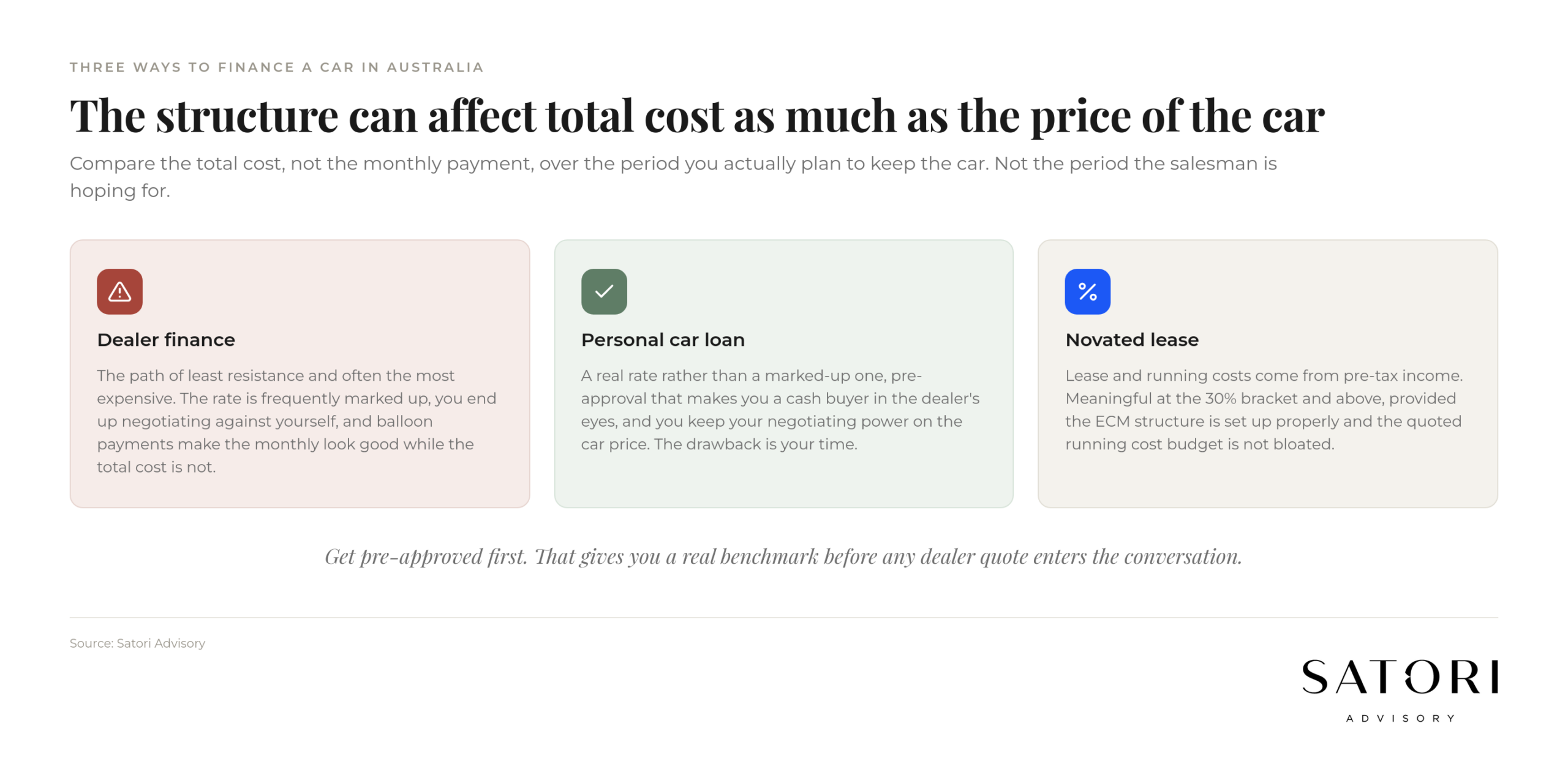
Dealer finance. The dealership arranges the loan with one of their preferred finance providers. You sign at the dealership. It is the path of least resistance and often the most expensive.
Personal car loan. You arrange the loan yourself, either through your bank or a broker. The lender pays the dealer directly. You took the time, you usually save money.
Novated lease. A salary-packaging arrangement where your employer takes the lease repayments and most running costs from your pre-tax income. It only works if your employer offers it. For employees in the right tax bracket, especially with an eligible EV, the savings can be meaningful.
Dealer finance: where the traps live
Dealers are paid for selling the car, and many are also paid for arranging the finance. That second commission is the reason a dealer can throw in the floor mats and still come out ahead.
Three traps to watch.
The rate is marked up. The interest rate quoted by the dealer is often higher than what the same lender would offer you directly, with the difference flowing back to the dealer as a commission.
You are negotiating against yourself. You walked in to negotiate the car price. Now the dealer is also negotiating the loan against you. You lose the leverage you had at the start of the conversation.
Balloon payments. Some dealer loans front-load low monthly payments and require a large final balloon. The ‘low monthly cost’ looks good. The total cost over the life of the loan is usually worse.
Personal car loan: when it is the better path
A personal car loan from your bank or via a broker gives you four advantages.
You get a real rate, not a marked-up rate. Lenders publish their rates openly, and brokers can compare across lenders.
You get pre-approval. Walking into a dealership pre-approved for a specific amount changes the conversation. You are now a cash buyer in the dealer’s eyes.
You preserve negotiating power on the car price. The dealer no longer has a second lever to pull.
You can choose loan term, repayment frequency, and features without being constrained to the dealer’s panel.
The one drawback is time. You have to make the calls, complete the paperwork, and wait for approval. For most buyers, the saving is worth the few hours of work.
Novated lease: where it shines and where it does not
A novated lease is an arrangement between you, your employer, and the leasing company. The leasing company owns the car. Your employer takes the lease and running cost payments (fuel, insurance, servicing, registration, tyres) from your pre-tax income. You get the use of the car.
The benefit is the pre-tax treatment. You are paying for the car with dollars that have not been taxed at your marginal rate. For employees on higher marginal rates, this can produce real savings versus a personal loan.
The catch is FBT. Without specific structuring, novated leases trigger Fringe Benefits Tax, which often eats most of the saving. The Employee Contribution Method (ECM) is the common structure used to minimise FBT, where you contribute post-tax dollars to offset the FBT liability.
When a novated lease works well
Your salary is at a high enough marginal rate to make the pre-tax saving meaningful (typically the 30% bracket and above).
You can negotiate the lease and ECM structure properly with your employer’s salary packaging provider.
You intend to keep the car for the lease term.
When a novated lease is less attractive
Your marginal rate is below 30%. The pre-tax saving thins out.
You are unlikely to keep the car for the full term.
The leasing company’s quoted running cost budget is bloated. Always check the assumptions.
The EV FBT exemption: where it stands in 2026
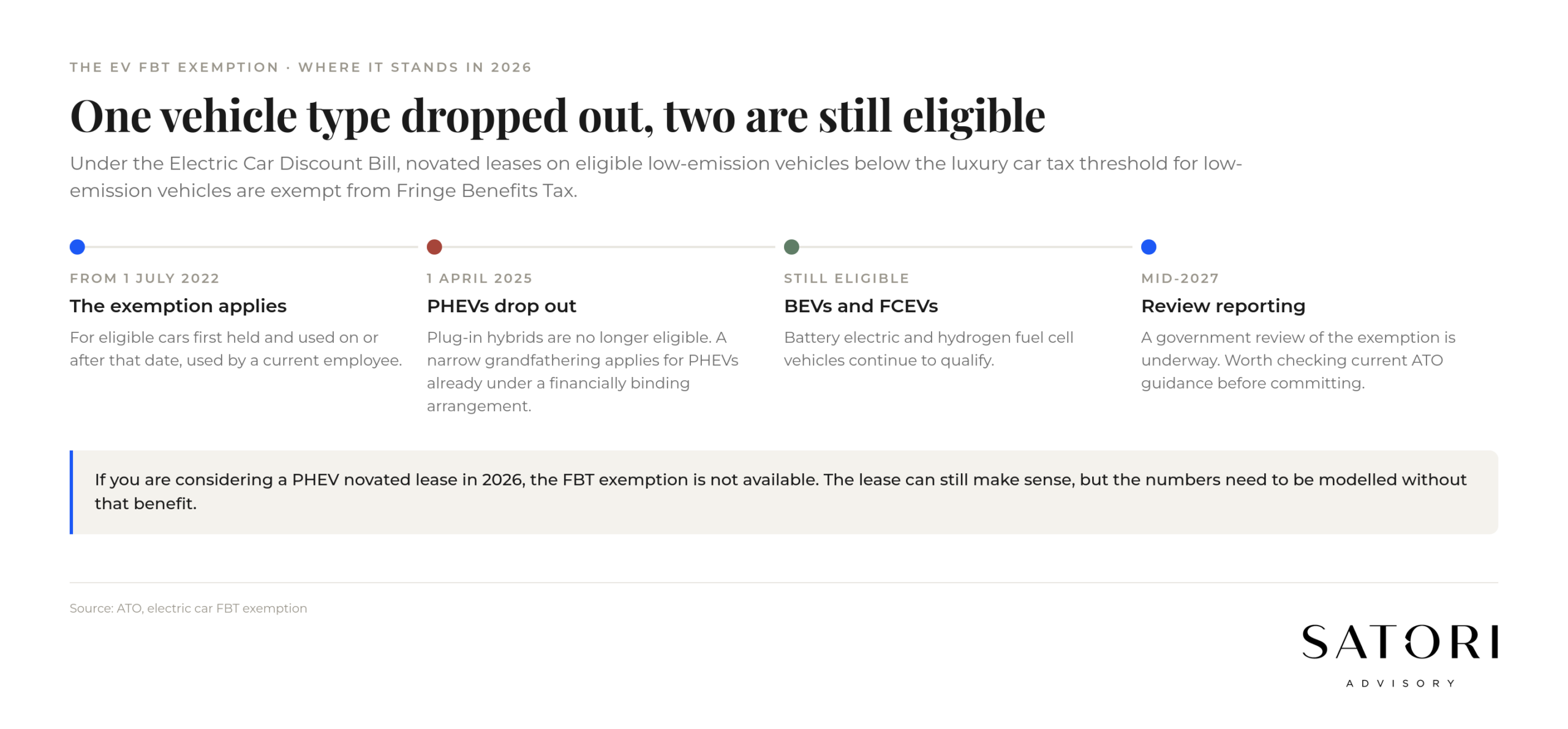
Under the Electric Car Discount Bill, novated leases on eligible low-emission vehicles below the luxury car tax (LCT) threshold for low-emission vehicles are exempt from Fringe Benefits Tax. The LCT threshold for low-emission vehicles in 2026-27 is $91,387.
PHEV exemption ended 1 April 2025
Plug-in hybrid electric vehicles (PHEVs) are no longer eligible for the FBT exemption from 1 April 2025. A narrow grandfathering applies for PHEVs already under a financially binding arrangement that was in place before that date, where the lease commitment continues unbroken. An optional lease extension is not a financially binding commitment, so the exemption ends when the original term expires.
If you are considering a PHEV novated lease in 2026, the FBT exemption is not available. The lease can still make sense, but the numbers need to be modelled without that benefit.
BEV and FCEV still eligible
Battery electric vehicles (BEVs) and hydrogen fuel cell electric vehicles continue to qualify, provided the car was first held and used on or after 1 July 2022, is used by a current employee or their associates, has never had LCT payable on its first sale, and remains under the low-emission LCT threshold ($91,387 for 2026-27).
For an employee buying an eligible BEV through a novated lease, the cost can be significantly lower than buying the same car with a personal loan. The exact saving depends on the car price, the employee’s marginal rate, and the running cost assumptions.
A government review of the EV FBT exemption is underway, with a report expected in mid-2027. Worth checking the current ATO guidance before committing.
How to actually choose
Start with the car you want and the term you intend to keep it.
Get pre-approved for a personal car loan from your bank or a broker. That gives you a real benchmark.
If your employer offers novated leasing, ask for a comparison quote on the same car, with and without the ECM structure, and with the EV exemption if applicable.
Compare the total cost (not just the monthly payment) across all three options. Include the dealer finance quote only as a sanity check.
Choose the option with the lowest total cost over the period you actually plan to keep the car. Not the period the salesman is hoping for.
How Satori Advisory works
At Satori Advisory we integrate your tax, business, wealth and lending as a prosperity engine, aligned with what matters most to you. With a clear roadmap, informed by data and backed by decades of strategic experience, we simplify the complex. We don’t offer pre-packaged solutions. We deliver tailored, end-to-end advice that reflects your reality and ambitions. You’ll work directly with senior advisers who listen deeply, think boldly and act with purpose. Feel cared for by our trusted team and curated network of financial and business specialists, as we empower you to make smart decisions and realise your potential, powered by numbers.
Frequently asked questions
Is dealer finance worse than a personal car loan?
Usually yes. Dealer finance is often marked up to include a commission to the dealer, and you negotiate the loan when you have already lost leverage on the car price. A pre-approved personal car loan typically saves money and gives you more control.
What is a novated lease and how does it work in Australia?
A novated lease is an arrangement between you, your employer, and a leasing company. The leasing company owns the car. Your employer takes lease and running cost payments from your pre-tax income. You get the use of the car. The benefit is paying for the car with pre-tax dollars.
What happens at the end of a novated lease?
Three options. Pay the residual to own the car outright, refinance the residual into a new lease, or hand the car back. The choice depends on the car’s market value at lease end versus the residual amount.
Is a novated lease worth it in 2026?
It depends on your marginal tax rate, the car, and whether the FBT structure is set up properly. For employees on the 30% bracket and above, especially on eligible electric vehicles where the FBT exemption applies, a novated lease can be the cheapest way to finance a car.
Are electric cars exempt from FBT in Australia in 2026?
Battery electric vehicles and hydrogen fuel cell vehicles below the luxury car tax threshold for low-emission vehicles ($91,387 for 2026-27) are FBT-exempt when provided via a novated lease. Plug-in hybrid electric vehicles (PHEVs) lost the exemption on 1 April 2025, with narrow grandfathering for pre-existing binding arrangements.
Did the PHEV FBT exemption end?
Yes. The plug-in hybrid FBT exemption ended on 1 April 2025. A narrow grandfathering applies for PHEVs already under a financially binding arrangement before that date. Optional lease extensions do not preserve the exemption.
What is the LCT threshold for low-emission vehicles in 2026-27?
The luxury car tax threshold for fuel-efficient (low-emission) vehicles is $91,387 for 2026-27. To qualify for the EV FBT exemption, the vehicle’s first retail price must be below this threshold.
Ready to talk?
If you would like a calm, no-pressure conversation about how this applies to your specific situation, we are here to help.
Please feel free to get in touch on 1300 925 081 or send an email to [email protected] if you’d like to book in a chat on the above or on other matters.
Disclaimer
This article contains general information only and has been prepared without considering your objectives, financial situation or needs. It is not personal financial advice, taxation advice or legal advice and should not be relied upon when making financial decisions. Before acting on any information, consider its appropriateness to your circumstances and seek professional advice where appropriate.