
Table of Contents
Mortgage stress is one of the more universal financial pressures in Australia in 2026. The RBA cash rate at 4.35%, after a sustained period of higher rates, means many borrowers are now paying meaningfully more per month than they were three years ago.
The honest framing: if your repayments are putting real pressure on your household, the worst move is to wait. Below is a practical 2026 playbook for what to do.
What mortgage stress actually means
The conventional Australian definition is housing costs (mortgage repayments plus rates and insurance) exceeding 30% of household income. The pain grows above 40%.
Above 30%, households typically start cutting non-essential spending. Above 40%, the budget starts to break in ways that show up in mental health, relationships, and longer-term wealth building.
If your household is in this zone, you are not alone, and there are concrete steps that materially help.
Step 1: Look at your real numbers
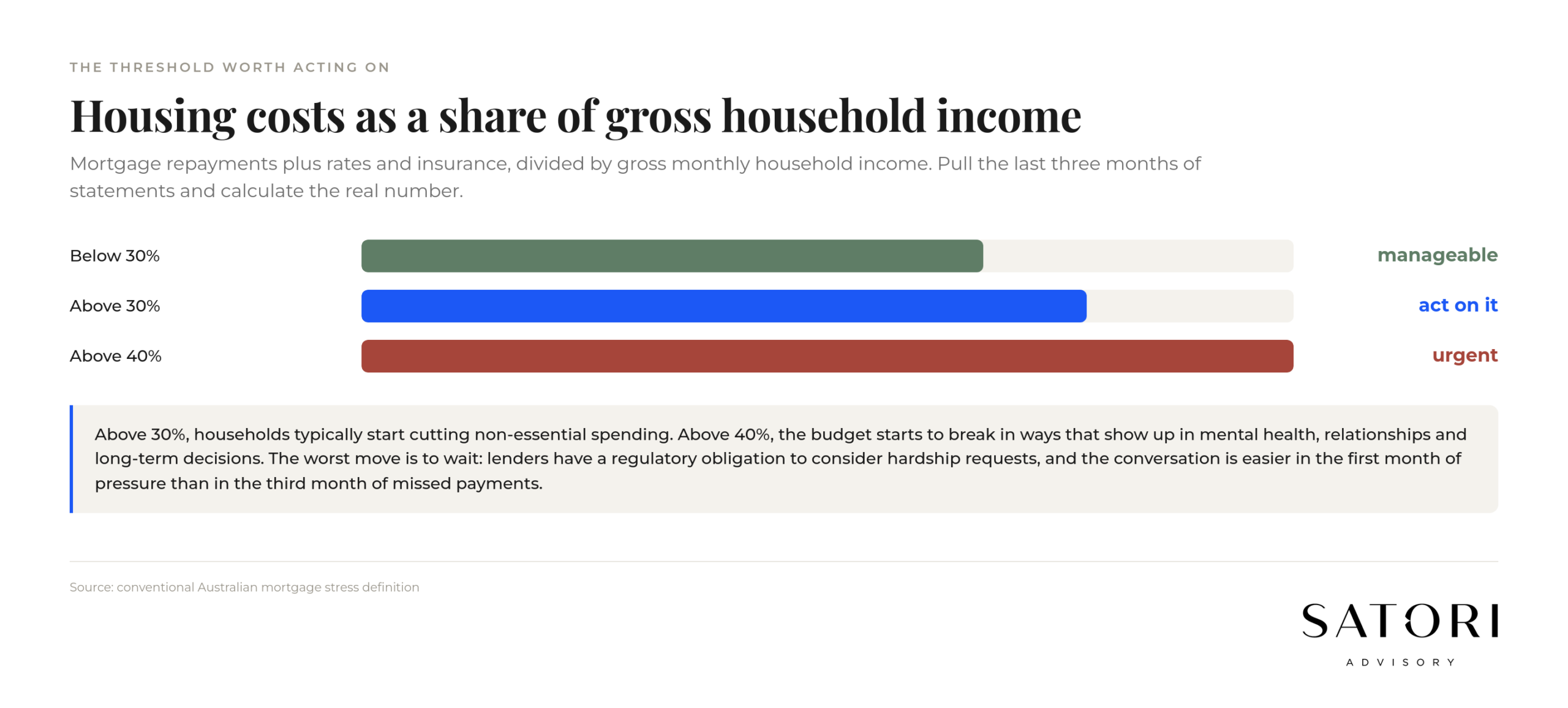
Pull the last three months of bank statements and add up actual monthly mortgage repayments plus rates plus insurance.
Divide by gross monthly household income.
Above 30% is the threshold worth acting on. Above 40% is urgent.
Also look at how much of the repayment is interest vs principal. With higher rates, more of each repayment is going to interest, which is worth understanding even if the total has not changed.
Step 2: Talk to your existing lender about hardship
Australian lenders have a regulatory obligation under the National Consumer Credit Protection Act (NCCP) and ASIC RG 271 to consider hardship requests in good faith.
The conversation does not negatively affect your credit file in most cases (some specific arrangements may be reported, but the act of asking is not).
Common hardship arrangements your lender can consider:
Reduced repayments for a defined period (usually 3 to 6 months).
Repayment pause for up to 3 months in genuine hardship.
Switch from principal and interest to interest only temporarily.
Extend the loan term to lower monthly repayments.
Capitalise missed or reduced payments and re-amortise.
Lenders prefer borrowers who engage early. The conversation is easier in the first month of pressure than in the third month of missed payments.
Step 3: Test refinancing
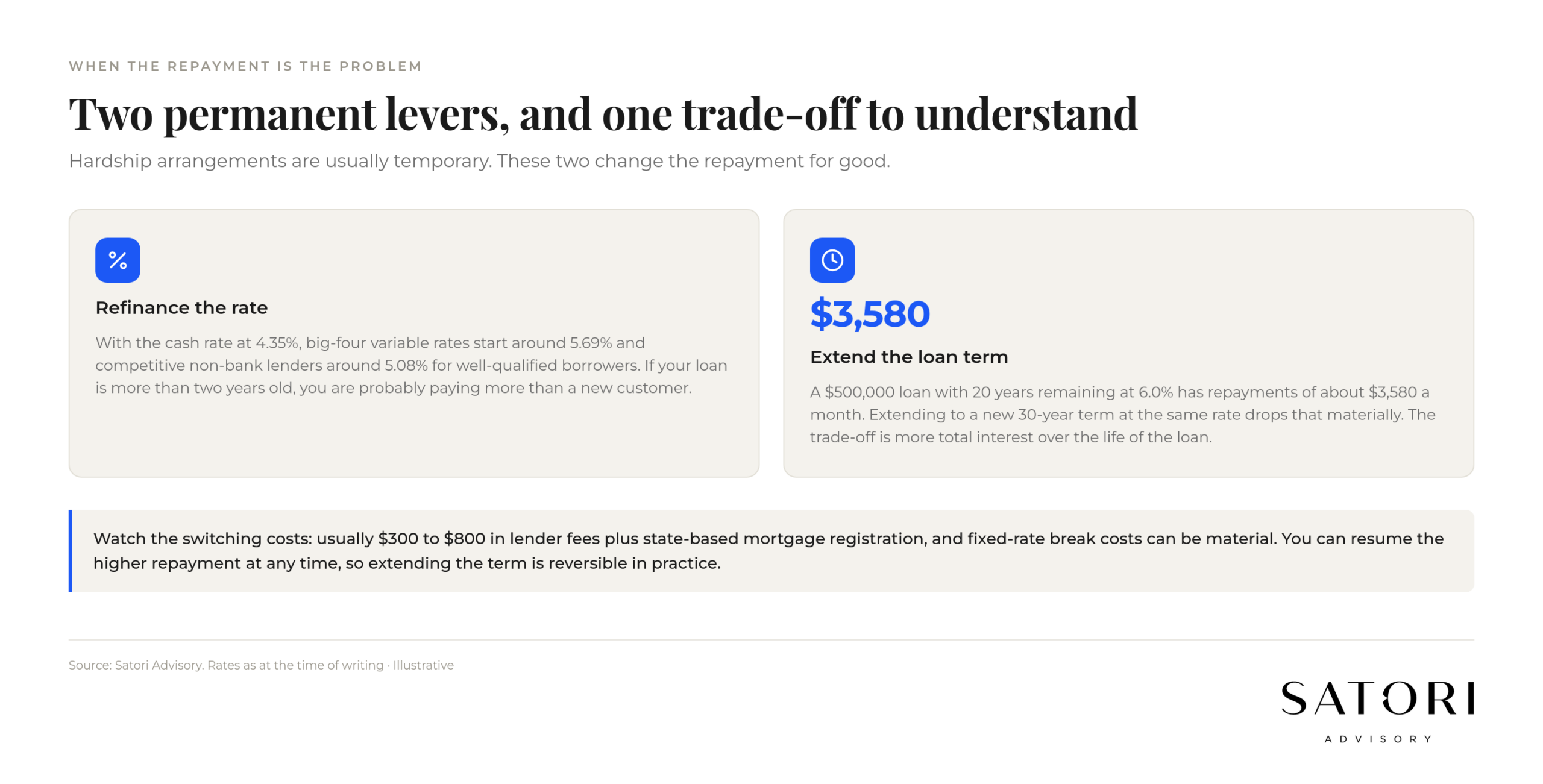
Hardship arrangements are usually temporary. Refinancing to a lower rate or longer term can permanently reduce repayments.
With the RBA cash rate at 4.35 per cent, the RBA’s average rate on new owner-occupier loans was 6.22 per cent in May 2026. Lender pricing varies widely by LVR and borrower profile. Note: when you apply to refinance, the new lender will test your serviceability at your new rate plus APRA’s 3 percentage point buffer. So if your new rate would be 5.50%, the lender assesses you at 8.50%.
If your current loan is more than two years old or you have not pushed your lender for a retention rate in 12 months, you are probably paying more than you need to. A 0.50 percentage point rate reduction on a $600,000 loan reduces monthly repayments by roughly $190 and saves about $58,000 in total interest over 25 years.
Watch the switching costs: usually $300 to $800 in lender fees plus state-based mortgage registration. Fixed-rate break costs can be material if your loan is part-fixed.
Step 4: Extend the loan term
If you are mid-loan and the monthly repayment is the problem (rather than the total interest cost), extending the loan term can meaningfully lower monthly repayments.
Example: a $500,000 loan with 20 years remaining at 6.0% has monthly repayments of about $3,580. Extending to a new 30-year loan at the same rate drops monthly repayments to about $3,000. That is $580 per month of immediate relief.
The trade-off is more total interest over the life of the loan. You can resume principal-and-interest payments at the higher level any time, so the extension is reversible.
Step 5: Review household expenses with discipline
Pull 3 to 6 months of bank statements and identify the top 3 to 5 discretionary categories where actual spending is higher than your assumption. The gap is usually meaningful.
Two or three named changes (cap takeaway at two nights, cancel unused subscriptions, swap one daily expense for a cheaper alternative) usually free $200 to $500 per month without sacrificing the household’s quality of life.
This is not a long-term solution to a structurally unaffordable loan. It is the bridge while the refinancing or hardship arrangement is being set up.
When to talk to a broker vs your existing lender
Your existing lender first if: you are looking for a hardship arrangement or a temporary modification.
A broker (especially one who works across multiple lenders) if: you are considering refinancing to permanently reduce the rate or extend the term. A good broker can identify which lender’s policy fits your current profile (employment, income mix, deposit or LVR).
If you are an existing Satori client, talk to us. Our lending team handles both conversations in coordination with the rest of your financial plan.
What NOT to do
Do not skip payments without telling the lender first. The lender will treat missed payments differently if you have engaged about hardship vs missed without notice.
Do not consolidate the mortgage with high-interest debt without modelling carefully. Putting credit card debt on a 30-year mortgage can dramatically increase the lifetime cost even though the monthly payment drops.
Do not refinance to a lender whose policy clearly does not fit you. The cost of a declined application or a poor structure exceeds the headline rate saving.
Do not assume the situation will resolve itself if rates fall. Plan for the rates you are actually paying today.
What to do next
Calculate your real housing-cost-to-income ratio this week.
If above 30%, list three options: speak to your lender about hardship, refinance comparison, extend loan term.
If above 40%, do all three this fortnight.
If your household financial position is complex (business income, multiple properties, SMSF), get integrated advice. Decisions across mortgage, tax and super often need to be made together.
How Satori Advisory works
At Satori Advisory we integrate your tax, business, wealth and lending as a prosperity engine, aligned with what matters most to you. With a clear roadmap, informed by data and backed by decades of strategic experience, we simplify the complex. We don’t offer pre-packaged solutions. We deliver tailored, end-to-end advice that reflects your reality and ambitions. You’ll work directly with senior advisers who listen deeply, think boldly and act with purpose. Feel cared for by our trusted team and curated network of financial and business specialists, as we empower you to make smart decisions and realise your potential, powered by numbers.
Frequently asked questions
What is mortgage stress in Australia in 2026?
Conventionally defined as housing costs exceeding 30% of household income. The pain grows above 40%. With the RBA cash rate at 4.35% and many legacy home loans rolling onto higher repayments, mortgage stress is a real feature of household finances in 2026.
What should I do if I cannot pay my mortgage?
Talk to your lender immediately. Australian lenders have a regulatory obligation under NCCP and ASIC RG 271 to consider hardship requests. Common arrangements include reduced repayments, repayment pauses, interest-only switches, or loan term extensions. The conversation does not negatively affect your credit file in most cases.
Does asking for a hardship arrangement hurt my credit score?
In most cases, no. The conversation itself is not reported. Some specific repayment arrangements may be reported on your credit file (e.g. formal restructures), but engaging early is almost always better than missed payments going unreported.
Can refinancing reduce my mortgage repayments?
Often yes, particularly if your current loan is more than two years old. A 0.50 percentage point rate reduction on a $600,000 loan typically drops monthly repayments by roughly $190 and saves about $58,000 in total interest over 25 years. Watch switching costs and any fixed-rate break costs.
Can I extend my mortgage term to lower repayments?
Yes. Extending the loan term reduces the monthly repayment, at the cost of more total interest over the life of the loan. You can resume higher principal-and-interest payments any time, so the extension is reversible.
What is the RBA cash rate in 2026?
4.35% as of May 2026. The RBA raised the cash rate 25 basis points on 5 May 2026, from 4.10% to 4.35%.
When should I talk to a mortgage broker vs my existing bank?
Your existing bank first if you need a hardship arrangement or temporary modification. A broker if you are considering refinancing to permanently lower the rate or extend the term, especially if your income profile is unusual or your loan needs to coordinate with other lending or business activity.
Ready to talk?
If you would like a calm, no-pressure conversation about how this applies to your specific situation, we are here to help.
Please feel free to get in touch on 1300 925 081 or send an email to [email protected] if you’d like to book in a chat on the above or on other matters.
Disclaimer
This article contains general information only and has been prepared without considering your objectives, financial situation or needs. It is not personal financial advice, taxation advice or legal advice and should not be relied upon when making financial decisions. Before acting on any information, consider its appropriateness to your circumstances and seek professional advice where appropriate.