
Table of Contents
Travel to your investment property is one of the deductions that changed materially in 2017 and continues to catch out Australian rental property owners in 2026.
The short version: if you own a residential rental property as an individual, you cannot claim travel deductions for visiting it. Below is what changed, the narrow exceptions, and what still works.
What changed in 2017
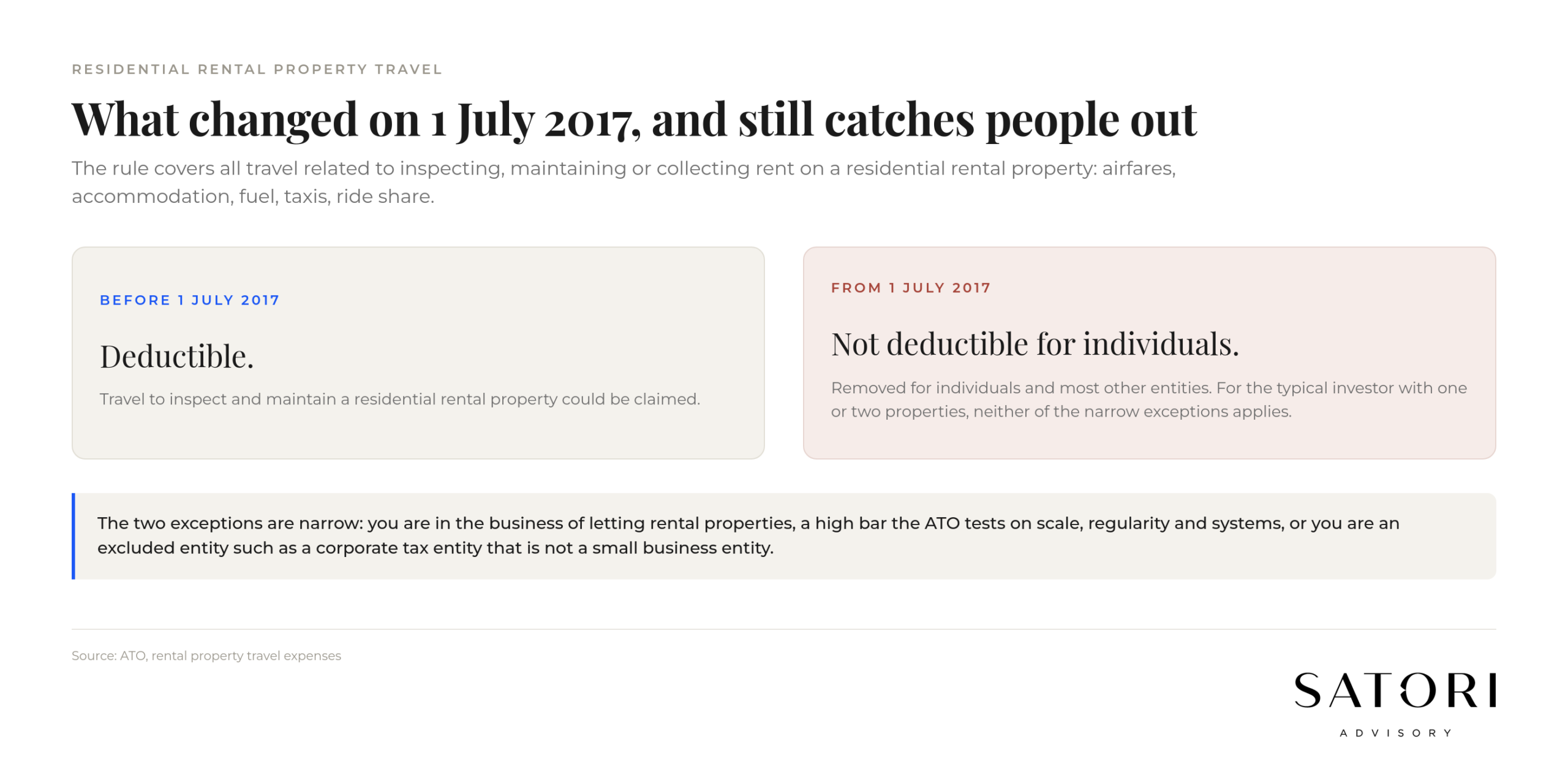
From 1 July 2017, the federal government removed the deductibility of travel costs relating to residential rental properties for individuals and most other entities. The change was introduced as an integrity measure after the ATO found that many taxpayers were either incorrectly apportioning private travel costs to investment activity, or claiming travel that was not genuinely incurred.
The rule covers all travel costs related to inspecting, maintaining, or collecting rent on a residential rental property. Airfares, accommodation, fuel, taxis, ride share, depreciation on a vehicle used for the trip: none are deductible.
The narrow exceptions
Two situations where travel can still be deducted.
You are in the business of letting rental properties. This is a high bar. The ATO looks at scale, regularity, business systems, and intention to operate as a property letting business. A small portfolio of one or two properties typically does not qualify. Multiple properties run with business-like systems, dedicated administration, and a clear letting business focus might.
You are an excluded entity. This includes a corporate tax entity that is not a small business entity, a complying super fund (with conditions), a public unit trust, and a unit trust with all members being excluded entities.
For the typical individual Australian residential property investor with one or two investment properties, neither exception applies. Treat the travel as not deductible.
What is still deductible on a residential investment property
Most other rental property deductions remain unchanged.
Interest on the loan used to acquire or improve the property. Subject to negative gearing rules (which are being reformed from 1 July 2027 to apply only to new builds for residential property; pre-12 May 2026 7:30pm AEST holdings grandfathered).
Council rates, water rates, land tax, body corporate fees.
Property insurance (building, contents you provide, landlord insurance).
Repairs and maintenance (NOT improvements, which are capital works).
Depreciation on NEW assets installed in the property (second-hand depreciation was restricted from 1 July 2017 as part of the same reform package).
Capital works deductions on the building (typically 2.5% per year for residential buildings built after 1985).
Property management fees paid to a real estate agent or property manager. This is the alternative to claiming travel: pay a professional to manage the property and deduct the fee.
Advertising costs to find tenants, lease preparation fees, conveyancing on purchase/sale (treated as capital costs).
Why property management fees are now the practical answer
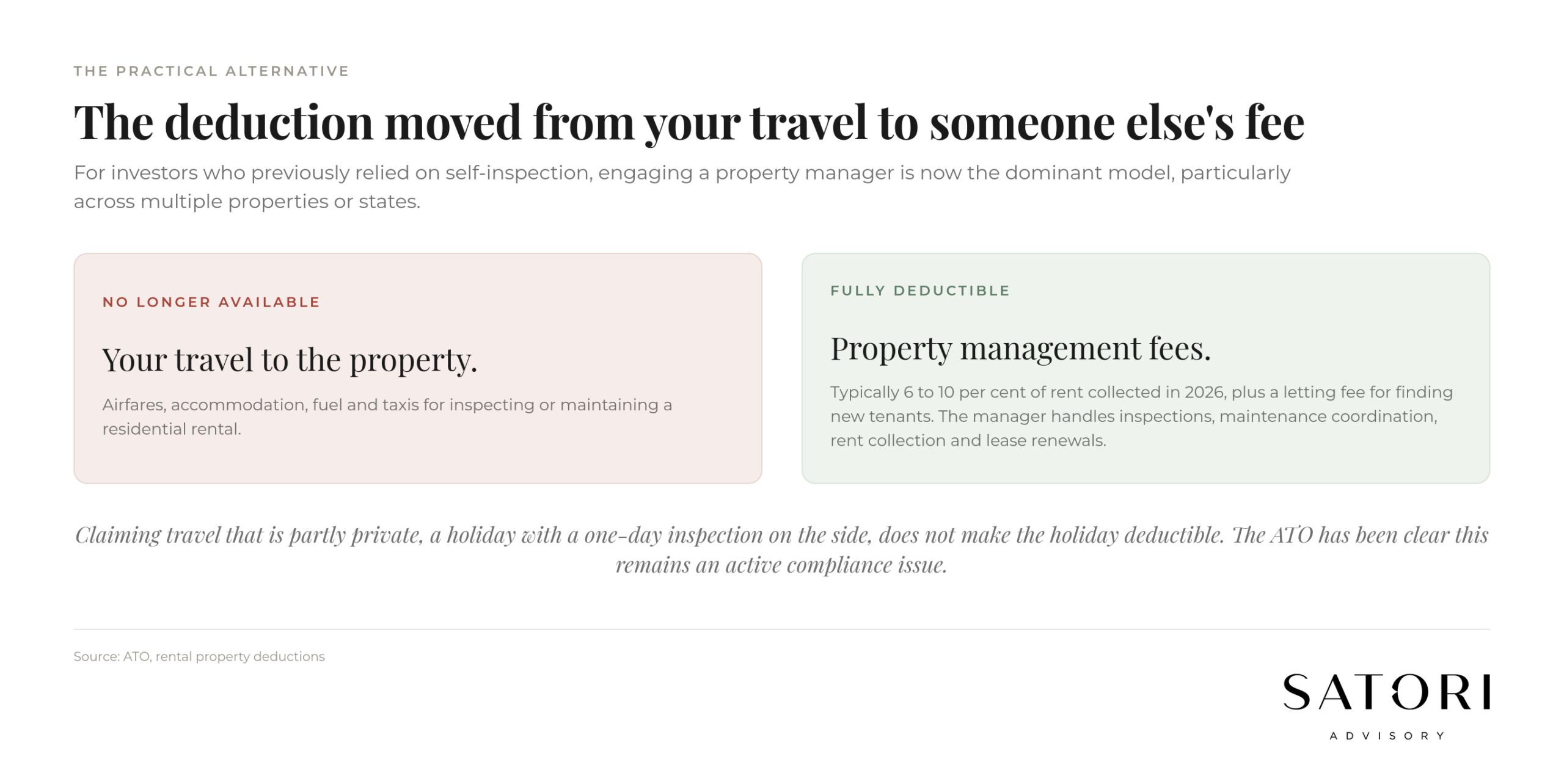
For investors who previously relied on the ability to travel and self-inspect, the practical alternative is to engage a property manager.
Typical property management fees in 2026 are 6 to 10% of rent collected, plus a letting fee for finding new tenants. The fees are fully deductible.
The property manager handles inspections, maintenance coordination, rent collection, and lease renewals. For most investors, the cost is offset by the deduction value and the time saved.
For investors with multiple properties or properties in different states, the property management approach is now the dominant model.
Common compliance mistakes in 2026
The ATO has been clear that residential rental property travel remains an active compliance issue. Common patterns that get flagged:
Claiming travel that pre-dates the property purchase (e.g. travel to inspect before buying, which is a capital cost not an income-producing expense).
Claiming travel that is partly private (a holiday with a one-day property inspection on the side does not make the holiday deductible).
Claiming travel through a company structure incorrectly to circumvent the individual-investor rule.
Claiming travel costs reimbursed by the tenant or insurer.
The amended assessments and penalties on these have been meaningful. The deduction is simply not available for most investors.
If you operate commercial property
The rule applies to residential rental property only. Commercial property travel deductions follow different rules and are often deductible for owners actively involved in managing the property, subject to the usual substantiation requirements.
If you have a mix of residential and commercial investment property, the travel cost apportionment between the two is important and often complex. Get specialised advice.
How Satori works with property investors
We coordinate the investment property tax position with the broader plan: structure, financing, depreciation schedules, capital works claims, CGT timing, and the upcoming 1 July 2027 negative gearing and CGT reforms.
Travel is one of the smaller items, but getting it wrong is one of the more common compliance flags. We help clients understand what is and is not available, then build the wider deduction strategy from there.
What to do next
If you have claimed residential rental property travel in any return since 2017-18, get the position reviewed. An amended assessment is preferable to an ATO-initiated review.
If you are self-managing your investment property and finding the travel restriction frustrating, model the cost of a property manager against the time and friction you save. The fee is deductible.
If your portfolio is large enough that you genuinely operate as a property letting business, get advice on whether you meet the bar for the exception.
How Satori Advisory works
At Satori Advisory we integrate your tax, business, wealth and lending as a prosperity engine, aligned with what matters most to you. With a clear roadmap, informed by data and backed by decades of strategic experience, we simplify the complex. We don’t offer pre-packaged solutions. We deliver tailored, end-to-end advice that reflects your reality and ambitions. You’ll work directly with senior advisers who listen deeply, think boldly and act with purpose. Feel cared for by our trusted team and curated network of financial and business specialists, as we empower you to make smart decisions and realise your potential, powered by numbers.
Frequently asked questions
Can I claim travel to inspect my investment property in Australia in 2026?
No, not for residential rental properties owned by individuals (and most other entities). The deduction was removed from 1 July 2017. Property management fees paid to a real estate agent remain deductible as an alternative.
Why was the investment property travel deduction removed?
Introduced as an integrity measure in 2017 after the ATO found that many taxpayers were either incorrectly apportioning private travel costs or claiming travel that was not genuinely incurred for property purposes.
Who can still claim investment property travel deductions?
Entities in the business of letting rental properties (a high bar; small portfolios typically do not qualify), and excluded entities such as certain companies and public unit trusts.
Are property management fees deductible?
Yes, fully. Property management fees paid to a real estate agent or property manager are deductible. Typical fees in 2026 are 6 to 10% of rent collected, plus a letting fee for finding new tenants.
Can I claim travel for commercial investment property?
Generally yes, subject to the usual substantiation and apportionment rules. The 2017 rule applies to residential rental property only. Commercial property follows different deductibility rules.
What other rental property deductions are available in 2026?
Interest on the loan, council rates, water rates, land tax, body corporate fees, property insurance, repairs (not improvements), depreciation on new assets, capital works deductions on the building, property management fees, advertising for tenants, lease preparation fees.
Ready to talk?
If you would like a calm, no-pressure conversation about how this applies to your specific situation, we are here to help.
Please feel free to get in touch on 1300 925 081 or send an email to [email protected] if you’d like to book in a chat on the above or on other matters.
Disclaimer
This article contains general information only and has been prepared without considering your objectives, financial situation or needs. It is not personal financial advice, taxation advice or legal advice and should not be relied upon when making financial decisions. Before acting on any information, consider its appropriateness to your circumstances and seek professional advice where appropriate.