
Table of Contents
There is no universal right answer to mortgage broker vs bank. The honest framing is: in some situations a broker pays for themselves several times over, and in others they add nothing you could not do in an afternoon.
This is a 2026 lens on when each path makes sense, with the current regulatory landscape (Best Interests Duty, APRA buffer, DTI caps) baked in.
What a mortgage broker actually does
A mortgage broker sits between you and the lenders. Their job is to understand your financial position, scan their panel of lenders, identify the products that fit, and walk you through the trade-offs before you commit.
A reasonable broker panel covers the major banks, several second-tier lenders, and a few non-bank lenders. Ask how many lenders are on their panel and which ones are excluded for you.
Brokers now write the majority of new home loans in Australia. The reason is structural. The lender landscape is complex enough that comparing more than one or two banks yourself, on your time, with your own paperwork, is hard work.
How brokers get paid (and why it matters)
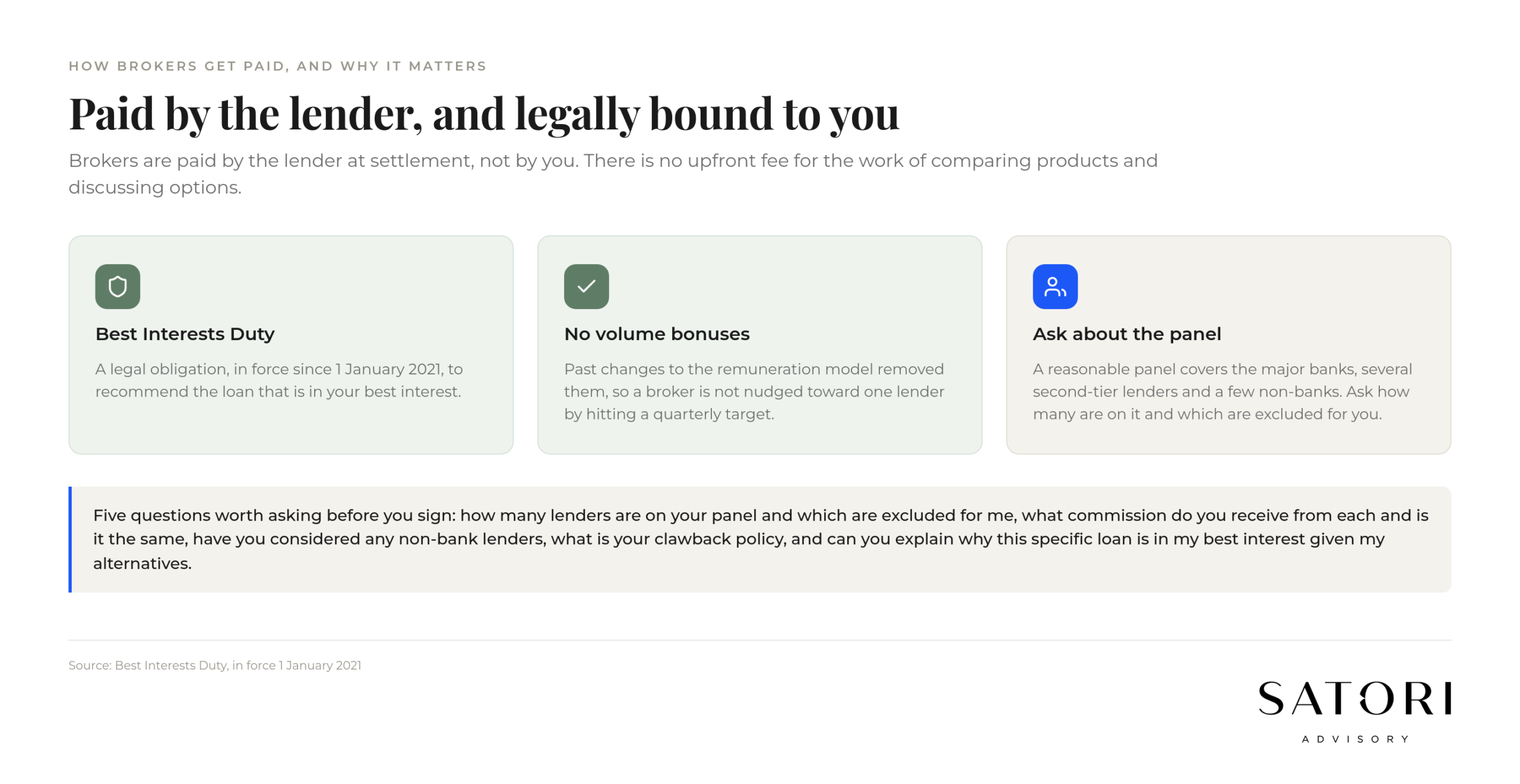
Brokers are usually paid by the lender at settlement, so in most cases there is no upfront fee for the work of comparing products and discussing options. Some brokers do charge a fee directly. If yours does, they have to tell you and give you a written quote that you sign before they start.
Commission structures are not identical across lenders. ASIC’s guidance to consumers is to ask the broker directly how they are paid and whether that payment changes depending on which lender they recommend. A broker who cannot answer that clearly is telling you something.
Brokers also operate under a Best Interests Duty (BID), which is a legal obligation, in force since 1 January 2021, to recommend the loan that is in your best interest, not the most profitable for them. The amount the broker is paid is disclosed in the documentation you sign. Read that disclosure.
When a broker is the right call
A broker earns their value in three situations.
When your income is anything other than long-tenured PAYG
Contractors, self-employed people, business owners, people with multiple income sources, and people whose income is variable all need someone who knows which lenders look kindly on their profile and which do not. A bank tells you what its product allows. A broker tells you which lender’s policy your situation actually fits.
When you want to compare more than one lender without doing the work yourself
The time cost of submitting paperwork to three banks, separately, in sequence, is real. A broker collects your information once and takes it to multiple lenders.
When the loan needs to fit a broader financial picture
If you have an SMSF, a family trust, an investment property strategy, or business cashflow that the home loan needs to coordinate with, a broker who can talk to your accountant and adviser pays for themselves.
When going direct to your bank is fine
Not every borrower needs a broker. If your situation is straightforward, your bank already has your information, and you have done your own rate research, direct-to-bank can work.
The honest cases: long-tenured PAYG employee on a single income, clean deposit and a loan-to-value ratio of 80% or lower, you have compared at least three lenders’ published rates and current promotions yourself, and you do not need the loan to coordinate with other services.
Ticking all four, broker value is lower. Unsure on any one, broker value is real.
The 2026 regulatory landscape that affects you
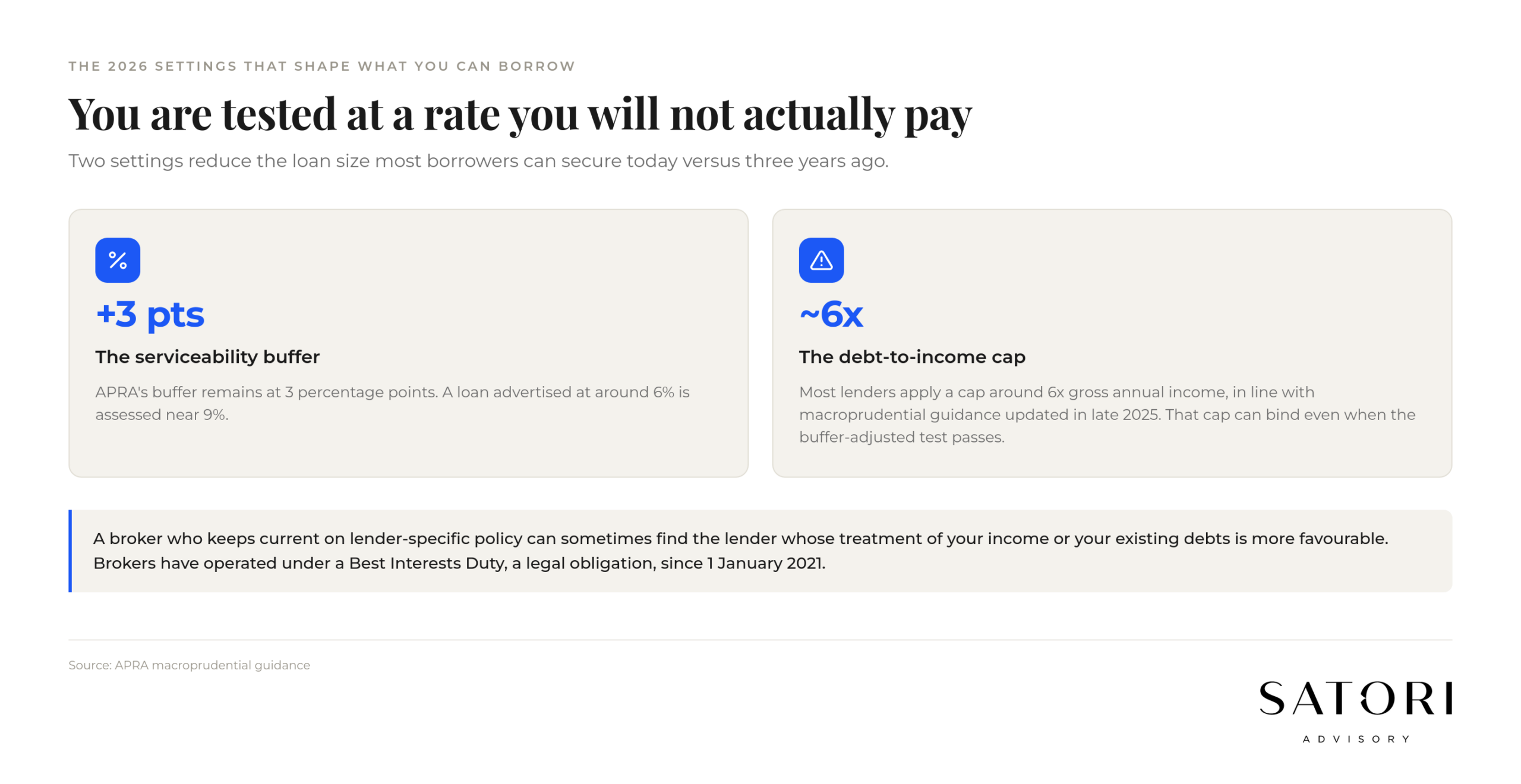
Two settings shape what you can borrow today.
APRA’s serviceability buffer remains at 3 percentage points. When you apply for a loan, the lender tests you at the actual rate plus 3 percentage points. So if your rate is 6.0%, the lender assesses serviceability at 9.0%. APRA has maintained this buffer since late 2021 and has not signalled a change.
APRA also limits high debt-to-income lending, but at portfolio level rather than per borrower. Since 1 February 2026 a bank can write up to 20% of its new mortgage lending at a DTI of 6 or more, applied separately to owner-occupier and investor books. In practice that means a high-DTI application is harder to place, not impossible, and where it lands depends on how much room a given lender has left.
Both settings reduce the loan size most borrowers can secure today versus three years ago. A broker who keeps current on lender-specific policy can sometimes find the lender whose policy interprets your situation more generously inside the same APRA framework.
Questions to ask any broker before you sign
Use these to filter quickly.
How many lenders are on your panel, and which are excluded for me?
What commission do you receive from each lender? Is it the same?
Have you considered any non-bank lenders for my situation? If not, why not?
What is your clawback policy? What happens if I refinance with you in three years?
Can you explain why this specific loan is in my best interest, given my alternatives?
A broker who answers all five clearly is worth their access. A broker who hedges is not.
Red flags
A few signals tell you to walk away.
They show you one or two options only. They recommend a product before fully understanding your circumstances. They cannot explain how they get paid. They pressure you to settle quickly without time to read the disclosure. They steer you toward features you did not ask for and do not need.
None of these are illegal. All of them are reasons to find a different broker.
What to do next
If you are starting a property search, pre-approval with at least one lender (direct or via a broker) gives you a real benchmark for what you can borrow.
If you have a complex income profile or are coordinating across other services, talk to a broker who works with people in your situation.
If your existing loan is more than two years old, a refresh of the rate and structure is usually worth half an hour of your time.
How Satori Advisory works
At Satori Advisory we integrate your tax, business, wealth and lending as a prosperity engine, aligned with what matters most to you. With a clear roadmap, informed by data and backed by decades of strategic experience, we simplify the complex. We don’t offer pre-packaged solutions. We deliver tailored, end-to-end advice that reflects your reality and ambitions. You’ll work directly with senior advisers who listen deeply, think boldly and act with purpose. Feel cared for by our trusted team and curated network of financial and business specialists, as we empower you to make smart decisions and realise your potential, powered by numbers.
Frequently asked questions
Is it better to use a mortgage broker or go directly to a bank?
It depends on your profile. A broker is better when you want access to more than one lender, your income is unusual, or the loan needs to coordinate with other parts of your financial picture. Direct to a bank is fine when you are long-tenured PAYG with a clean deposit and have done your own rate comparison.
How do mortgage brokers get paid in Australia?
Brokers are usually paid by the lender at settlement, and the amount is disclosed in your loan documentation. Commission is not identical across lenders, so ASIC recommends asking your broker how they are paid and whether that changes by lender. Some brokers also charge the client a fee, which has to be disclosed and quoted in writing before they act.
How much does a mortgage broker cost the borrower?
In most cases the borrower pays nothing directly, because the lender pays the broker. Some brokers do charge a fee, and there can be exceptions for complex commercial lending or some non-bank lenders. Any fee has to be disclosed and quoted in writing before you sign.
What is the Best Interests Duty?
A legal obligation, in force since 1 January 2021, that requires Australian mortgage brokers to act in the best interest of the borrower when recommending a loan. It is one of the structural reasons going through a broker today is different from a decade ago.
Why would I use a mortgage broker in 2026?
Three reasons: access to a wider panel of lenders, a single point of contact across multiple lender applications, and someone whose Best Interests Duty obliges them to recommend the loan that suits you. The value is highest when your income is unusual or the loan needs to coordinate with other services.
Do mortgage brokers have access to all lenders?
No. Each broker has a panel. A reasonable panel covers the major banks, several second-tier lenders, and a few non-bank lenders. Ask the broker how many lenders are on their panel and which ones are excluded, before you commit.
What is the APRA serviceability buffer?
A regulatory requirement that lenders test your ability to repay at the actual interest rate plus an additional buffer. The buffer is 3 percentage points and has been in force since late 2021. APRA has maintained this level into 2026.
Ready to talk?
If you would like a calm, no-pressure conversation about how this applies to your specific situation, we are here to help.
Please feel free to get in touch on 1300 925 081 or send an email to [email protected] if you’d like to book in a chat on the above or on other matters.
Disclaimer
This article contains general information only and has been prepared without considering your objectives, financial situation or needs. It is not personal financial advice, taxation advice or legal advice and should not be relied upon when making financial decisions. Before acting on any information, consider its appropriateness to your circumstances and seek professional advice where appropriate.