
Table of Contents
When you apply for a home loan in Australia in 2026, the lender is not just looking at your income. They want a detailed view of your financial history, your habits, and your overall position. They get this by looking at six dimensions, plus the property itself and the purpose of the purchase.
Below is a 2026 lens on what lenders actually assess and how to present each dimension strongly.
Dimension 1: Where does your income come from?
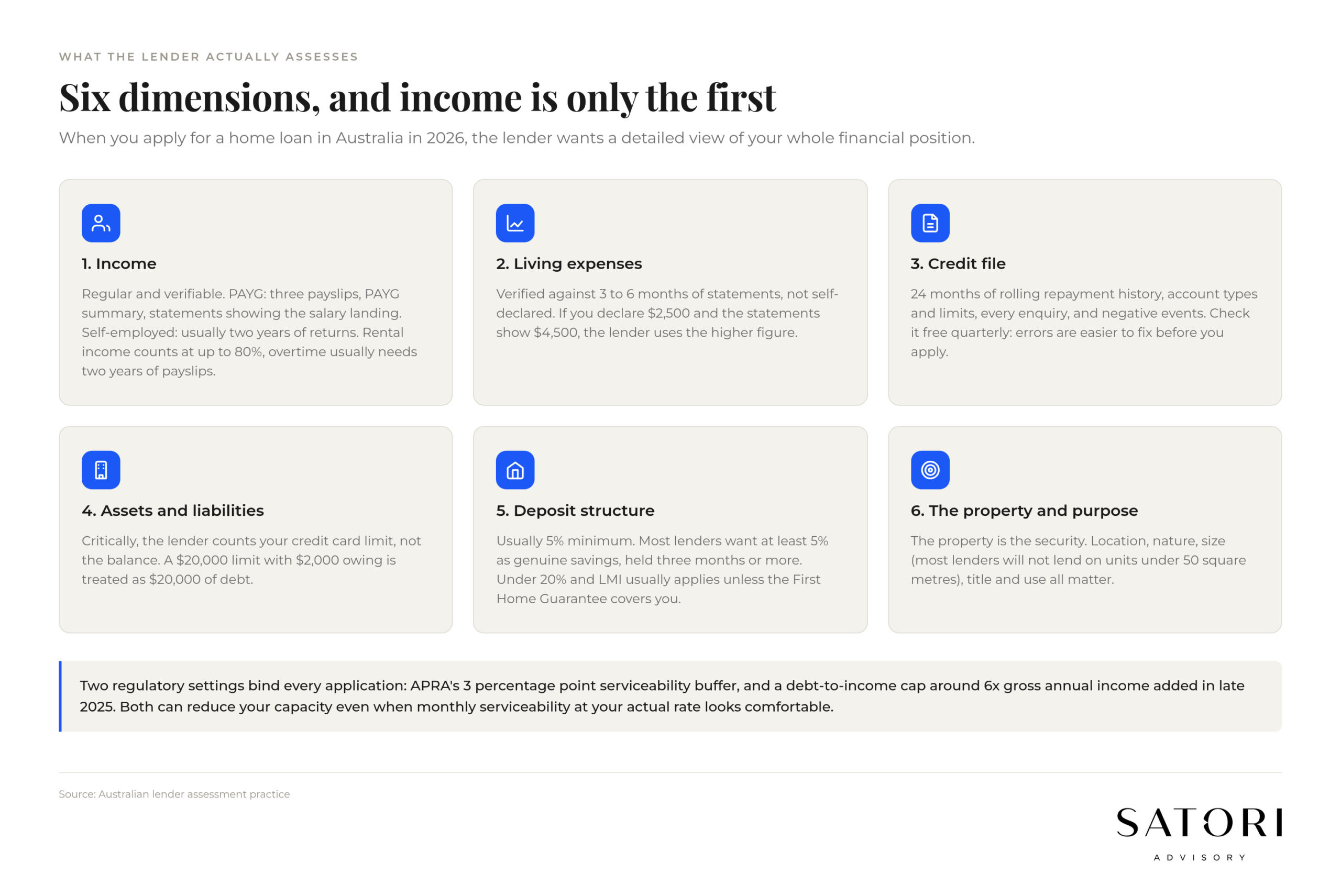
Lenders prefer regular, verifiable income.
For PAYG employees: typically your last three payslips, your most recent PAYG payment summary, and bank statements showing the salary landing. The lender uses this to calculate your average pay.
For self-employed: usually two full years of tax returns and notices of assessment. Some lenders accept one year for ABN holders trading more than two years.
Outside primary employment income, the additional sources lenders typically accept (with apportionment):
Rental income: usually up to 80% of investment property rent counts toward serviceability.
Overtime pay: usually requires two years of payslips to demonstrate consistency.
Centrelink benefits: certain benefits (child support, family tax benefit) are accepted; not all.
Fringe benefits: lenders may accept up to 80% of fringe benefits such as a car allowance or stipend.
Share dividends: some lenders accept a portion of dividend income, especially when consistent over multiple years.
Sources that vary by lender include foreign income, commission income, and bonus income. A broker who works across multiple lenders can identify which lender’s policy fits your specific mix.
Dimension 2: Your actual living expenses
Australian lenders have been required to verify actual living expenses (rather than rely on self-declared figures) since the late 2010s. The verification methods:
Bank statement analysis. Lenders review 3-6 months of your statements and identify discretionary spending categories.
Household Expenditure Measure (HEM) or Henderson Poverty Index. Used as a baseline minimum that the lender applies if your actual spending is below the benchmark for your household composition.
Adjustment upward to actual. If your statements show $4,500 a month of discretionary spend and you declared $2,500, the lender will use the higher figure.
Practical implication: before applying, run your last 3-6 months of statements yourself. Reduce discretionary spend before applying if there is a gap, or accept the borrowing capacity that reflects the real number.
Dimension 3: Your credit file
Australian credit reporting moved to Comprehensive Credit Reporting under the Privacy Amendment Act 2012, in force from 12 March 2014, with mandatory reporting for large ADIs phased across 1 July 2021 and 1 July 2022.
CCR includes:
24 months of rolling repayment history on each credit account.
Account types, credit limits, account opening and closing dates.
Credit enquiries (every application leaves a footprint).
Negative events: defaults of $150+ that are 60+ days overdue, court judgments, bankruptcies, serious credit infringements.
Most Australians can check their credit score for free quarterly via ASIC MoneySmart-listed providers. Errors do happen and are easier to fix before a lender pulls the file.
If you have had credit incidents, some lenders specialise in borrowers with imperfect credit (offering loans to borrowers who have had defaults, writs, judgements, or discharged bankrupts). The broker conversation gets harder but solutions exist.
Dimension 4: Your assets and liabilities
Assets the lender will consider: vehicles you own, shares, superannuation, other properties, business equity. Each strengthens your position.
Liabilities the lender will count:
Credit cards: critically, the lender uses the credit limit (not the balance) as the assumed debt. A $20,000 card limit with $2,000 owing counts as $20,000 of debt at an assumed minimum repayment rate (typically 3% per month).
Personal loans, car loans, BNPL balances.
HECS/HELP debts.
Practical implication: lower credit card limits on cards you keep, cancel cards you do not use, pay down small loans before applying. Each move lifts borrowing capacity meaningfully.
Dimension 5: Your deposit structure
Lenders want to see a deposit because it demonstrates financial discipline and reduces lender risk. The structural rules:
Minimum deposit: usually 5% (except special cases). With less than 20%, Lenders Mortgage Insurance (LMI) usually applies and can add tens of thousands to the cost of the loan.
Genuine savings: most lenders want to see at least 5% of the deposit as genuine savings (money in your account for 3 months or more, demonstrating saving discipline). Gifts, financial windfalls, and inheritances can form part of the deposit but the genuine savings test usually applies in addition.
The federal First Home Guarantee from 1 October 2025: no income caps, no place limits, no LMI on a 5% deposit. Owner-occupier only. 10-year first-home buyer lookback.
Family guarantor: a close family member (usually a parent) offers their home as additional security. This can eliminate the need for a 20% deposit. The risk to the guarantor is real and a limited guarantee structure is strongly preferred over an unlimited one.
Dimension 6: The property and the purpose
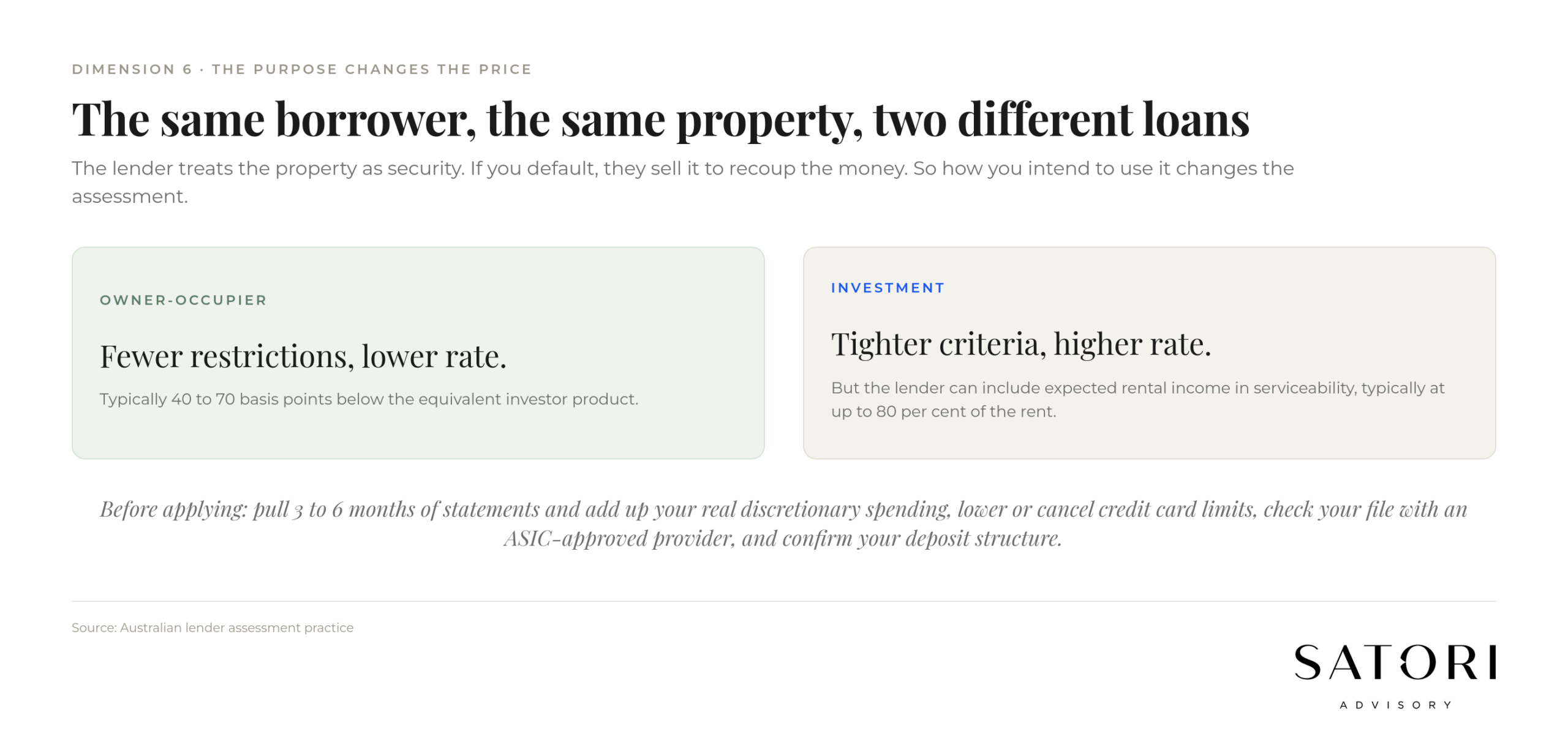
The lender treats the property as security for the loan. If you default, the lender sells the property to recoup the money. So they assess the property characteristics carefully.
Location: some lenders restrict lending in specific postcodes (some rural areas, mining-dependent towns, oversupplied apartment areas).
Nature: lenders typically have tighter criteria for units than for houses.
Size: most lenders will not lend on units under 50 square metres.
Title: freehold or strata title without encumbrances. Anything more complex (some leasehold structures, Strata company titles in certain states) attracts tighter assessment.
Use: rural property must not be used for commercial farming under most residential loan products.
Purpose:
Owner-occupier: fewer restrictions, lower rate (about 17 basis points below the equivalent investor product on RBA data for new loans in May 2026).
Investment: tighter lending criteria, higher rate, but lenders can include expected rental income in serviceability (typically up to 80% of expected rent).
APRA serviceability and DTI: the binding tests
Two regulatory settings affect every application in 2026.
APRA serviceability buffer: 3 percentage points. The lender tests you at your rate plus 3% to confirm you can afford the loan if rates rise.
DTI cap: most lenders apply a cap of roughly 6x gross annual income (added late 2025 in line with APRA macroprudential guidance).
Both can affect your borrowing capacity even when monthly serviceability at your actual rate looks comfortable. Worth confirming with a broker before falling in love with a property.
How Satori works with first home buyers
Through our lending team we coordinate the home buyer application with the broader plan. We pull the credit file, model serviceability under current APRA settings, identify which lender’s policy fits your specific profile, and structure the application strongly.
The goal is the right property, financed in the right way for your broader plan, not the first property a lender will let you buy.
What to do next
Pull 3-6 months of bank statements and add up your real discretionary spending.
Review credit card limits and lower or cancel cards you do not need.
Check your credit file via an ASIC-approved provider.
Confirm your deposit structure (savings, family equity, First Home Guarantee eligibility) before applying.
Get pre-approved before falling in love with a specific property.
How Satori Advisory works
At Satori Advisory we integrate your tax, business, wealth and lending as a prosperity engine, aligned with what matters most to you. With a clear roadmap, informed by data and backed by decades of strategic experience, we simplify the complex. We don’t offer pre-packaged solutions. We deliver tailored, end-to-end advice that reflects your reality and ambitions. You’ll work directly with senior advisers who listen deeply, think boldly and act with purpose. Feel cared for by our trusted team and curated network of financial and business specialists, as we empower you to make smart decisions and realise your potential, powered by numbers.
Frequently asked questions
What do lenders look at when assessing a home loan in Australia?
Six dimensions: where your income comes from, your actual living expenses (verified from bank statements), your credit file under CCR, your assets, your liabilities (especially credit card limits), and your deposit structure. They also assess the property itself and the purpose (owner-occupier vs investment).
How do lenders calculate my borrowing capacity in 2026?
They test serviceability at your actual rate plus APRA’s 3 percentage point buffer, and most lenders apply their own DTI policy, commonly around 6x gross annual income. APRA also limits banks to no more than 20% of new mortgage lending at a DTI of 6 or more, since 1 February 2026. Your real borrowing capacity reflects both tests.
Do credit card limits affect my borrowing capacity?
Yes. Lenders treat the credit limit as available debt regardless of the balance. A $20,000 card limit with $2,000 owing counts as $20,000 of debt at an assumed minimum repayment rate. Lowering limits or cancelling unused cards lifts borrowing capacity.
What is genuine savings?
Money in your account for 3 months or more, demonstrating saving discipline. Most lenders want at least 5% of the deposit as genuine savings. Gifts and inheritances can form part of the deposit but the genuine savings test usually applies in addition.
What is the First Home Guarantee in 2026?
A federal scheme that waives LMI for eligible first home buyers with deposits as low as 5%. From 1 October 2025: no income caps, no place limits. Owner-occupier only, 10-year first home buyer lookback.
Why do investors pay higher rates than owner-occupiers?
APRA’s macroprudential settings since 2017-2018 effectively made investor lending more expensive for banks to write. Lenders pass through the cost as a higher headline rate. On RBA data for new loans in May 2026 that premium was about 17 basis points.
Ready to talk?
If you would like a calm, no-pressure conversation about how this applies to your specific situation, we are here to help.
Please feel free to get in touch on 1300 925 081 or send an email to [email protected] if you’d like to book in a chat on the above or on other matters.
Disclaimer
This article contains general information only and has been prepared without considering your objectives, financial situation or needs. It is not personal financial advice, taxation advice or legal advice and should not be relied upon when making financial decisions. Before acting on any information, consider its appropriateness to your circumstances and seek professional advice where appropriate.