
Table of Contents
Plenty of Australians could be saving meaningful money on their home loan and are not, because they believe refinancing is too hard, not worth it, or beyond their equity profile. None of those are true today as default rules.
Below are the four most common refinancing myths, the 2026 math behind each, and a five-minute test you can run yourself before deciding.
Myth 1: Refinancing takes a lot of time and effort
It used to. Current loan processes are closer to a few hours of your time than a few weeks.
Step one is the conversation. Have your current loan balance, your interest rate (fixed or variable), your remaining term, and your repayment frequency to hand. The lender will also need a snapshot of your income, employment, monthly expenses, and any debt including credit card limits.
Step two is the application. Most lenders ask for two recent payslips, the last year’s PAYG summary, six months of statements on the loan being refinanced, and, if you are self-employed, two years of tax returns. If the loan is on an investment property, they want the most recent rental statement or last year’s tax return for the property.
Step three is approval and settlement. The new lender contacts your existing lender to discharge the old loan. If you are the only party to the loan and your current lender’s discharge process is not unusually slow, you can be enjoying the savings within four to six weeks.
Myth 2: Refinancing is not worth the trouble or expense
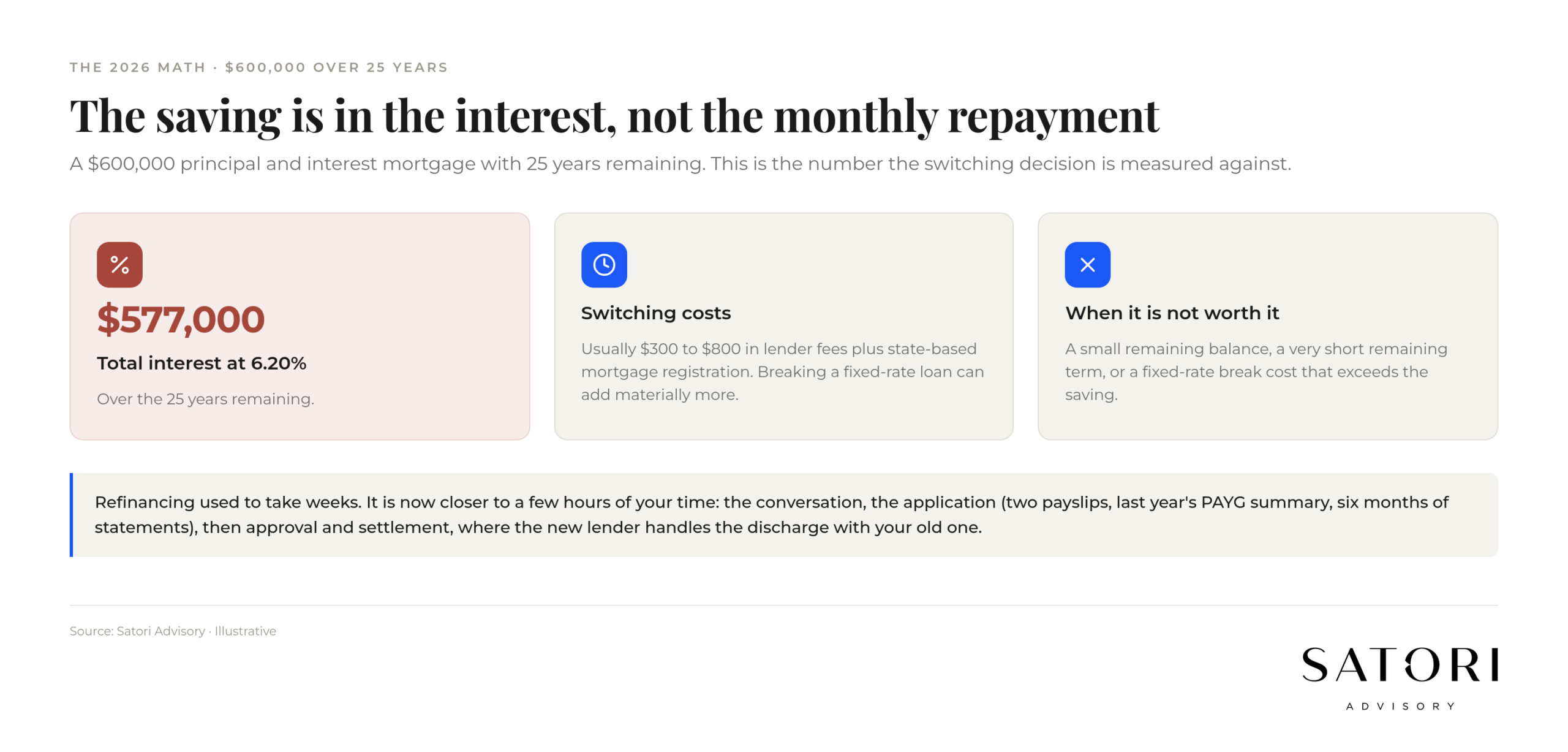
The 2026 math disproves this for most borrowers.
Consider a $600,000 principal and interest mortgage with 25 years remaining. At 6.20%, total interest paid over 25 years is roughly $577,000. At 5.95%, that drops to roughly $551,000, a saving of about $26,000 over the remaining term, for a 0.25 percentage-point reduction.
The costs to add up are your current lender’s discharge fee, the new lender’s application or settlement fees, and state mortgage registration. If you break a fixed-rate loan there can also be a break cost, which can be material. Get each one quoted before you commit: they vary a lot by lender and by state.
The cases where it is not worth refinancing: small remaining balance, very short remaining term, a fixed-rate break cost that exceeds the saving, or a rate environment where the rate gap does not justify the friction.
Myth 3: I do not have enough equity in my home to refinance
Most lenders prefer at least 20% equity, which is a loan-to-value ratio (LVR) of 80% or lower. Better LVR usually means a better rate.
House prices in your area may have moved (in either direction) since your original loan, so it is worth getting a fresh valuation before assuming you do or do not qualify. A desktop valuation by the new lender is quick and free, and gives you a clearer picture before you commit time to a full application.
If your LVR is above 80%, you can still refinance, but Lenders Mortgage Insurance (LMI) may apply again, which can erode the saving. Run that calculation carefully.
Myth 4: It is too difficult to change banks
Switching banks for your home loan does not require closing all other accounts with that bank. Most borrowers keep their everyday banking where it is and just move the home loan.
If you have a long list of direct debits and payees stored in your old bank’s online portal, that is the only real friction, and it is solved by keeping the transaction account open during the move.
The five-minute refinancing math
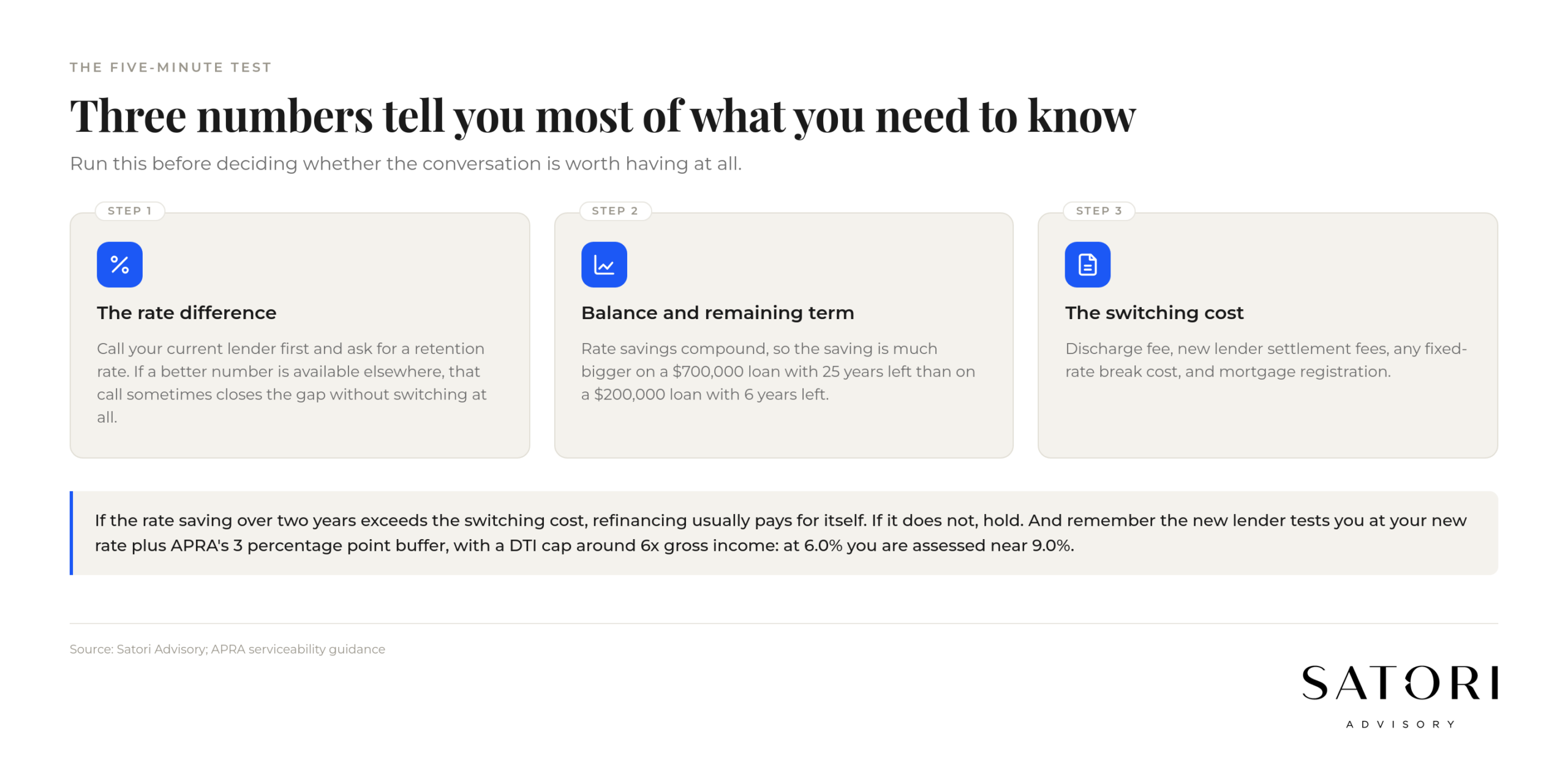
Three numbers tell you most of what you need to know.
Number one: the rate difference. Call your current lender first and ask for a retention rate. If a better number is available elsewhere, the gap is your real saving target.
Number two: your remaining loan balance and term. Rate savings compound, so the saving is much bigger on a $700,000 loan with 25 years left than on a $200,000 loan with 8 years left.
Number three: the switching cost. Add your current lender’s discharge fee, the new lender’s settlement fees, any fixed-rate break cost, and any LMI if your LVR has slipped above 80%.
If the rate saving over two years exceeds the switching cost, refinancing usually pays for itself. If it does not, hold.
What the APRA serviceability buffer means for you
When you apply to refinance, the new lender tests your repayment capacity at your new rate plus 3 percentage points. APRA’s serviceability buffer is 3 percentage points and has been in force since late 2021.
If your new rate would be 6.0%, the lender assesses serviceability at 9.0%. Since 1 February 2026 APRA also caps high debt-to-income lending at portfolio level: up to 20% of a bank’s new mortgage lending at a DTI of 6 or more. That is a limit on the lender’s book, not a hard ceiling on you, but it does make a high-DTI refinance harder to place.
Both settings can affect whether your refinance application approves at the loan size you want. Worth checking before you commit time to the application.
When refinancing is a bad idea
Two situations where it is the wrong call.
First, when you have only one or two years left on the loan and the saving will not cover the switching cost. The math does not work.
Second, if you are about to need a new loan within six months (a top-up, a renovation loan, or a separate investment loan). Lenders prefer to see stability in your borrowing history, and the timing of multiple credit enquiries can affect serviceability assessments. Sometimes the right move is to package the refinance and the new lending together.
How Satori Advisory works
At Satori Advisory we integrate your tax, business, wealth and lending as a prosperity engine, aligned with what matters most to you. With a clear roadmap, informed by data and backed by decades of strategic experience, we simplify the complex. We don’t offer pre-packaged solutions. We deliver tailored, end-to-end advice that reflects your reality and ambitions. You’ll work directly with senior advisers who listen deeply, think boldly and act with purpose. Feel cared for by our trusted team and curated network of financial and business specialists, as we empower you to make smart decisions and realise your potential, powered by numbers.
Frequently asked questions
When should I refinance my home loan in Australia in 2026?
When the rate you can secure elsewhere is at least 0.25 percentage points lower than your current rate, you have at least 20% equity, you plan to keep the loan for more than two years, and the switching costs do not exceed the saving over that period.
How much does it cost to refinance a home loan in Australia?
Your current lender’s discharge fee, the new lender’s application or settlement fees, and any state mortgage registration cost. If you break a fixed-rate loan there can also be a break cost, which can be material. If your LVR has slipped above 80%, LMI may apply again. Ask for each figure in writing before you commit, because they vary a lot by lender and by state.
How long does it take to refinance a home loan?
Usually inside four to six weeks from a clean application going in, assuming a cooperative existing lender. Some discharges run longer; we warn clients to plan for six weeks worst case.
What is the APRA serviceability buffer in 2026?
3 percentage points, in force since late 2021. The new lender tests your repayment capacity at your actual rate plus 3 percentage points. Separately, since 1 February 2026 APRA caps high debt-to-income lending at portfolio level: up to 20% of a bank’s new mortgage lending at a DTI of 6 or more.
What is the RBA cash rate in 2026?
4.35% as of May 2026. The RBA raised the cash rate 25 basis points on 5 May 2026, from 4.10% to 4.35%.
Do I need to close my old bank account when I refinance?
No. The refinance only moves the home loan. You can keep your everyday banking with your old bank for as long as you like.
Ready to talk?
If you would like a calm, no-pressure conversation about how this applies to your specific situation, we are here to help.
Please feel free to get in touch on 1300 925 081 or send an email to [email protected] if you’d like to book in a chat on the above or on other matters.
Disclaimer
This article contains general information only and has been prepared without considering your objectives, financial situation or needs. It is not personal financial advice, taxation advice or legal advice and should not be relied upon when making financial decisions. Before acting on any information, consider its appropriateness to your circumstances and seek professional advice where appropriate.