
Table of Contents
If you map out the professionals involved in the typical Australian household’s financial life, the list usually includes an accountant, possibly a financial planner, a mortgage broker if there is a home loan, an SMSF auditor if there is an SMSF, and increasingly a property adviser or insurance broker. Sometimes the list extends further.
Each one does good work in their lane. Most of the value is lost in the gaps between them. Integrated advice is the model that closes those gaps.
Why siloed advice loses value
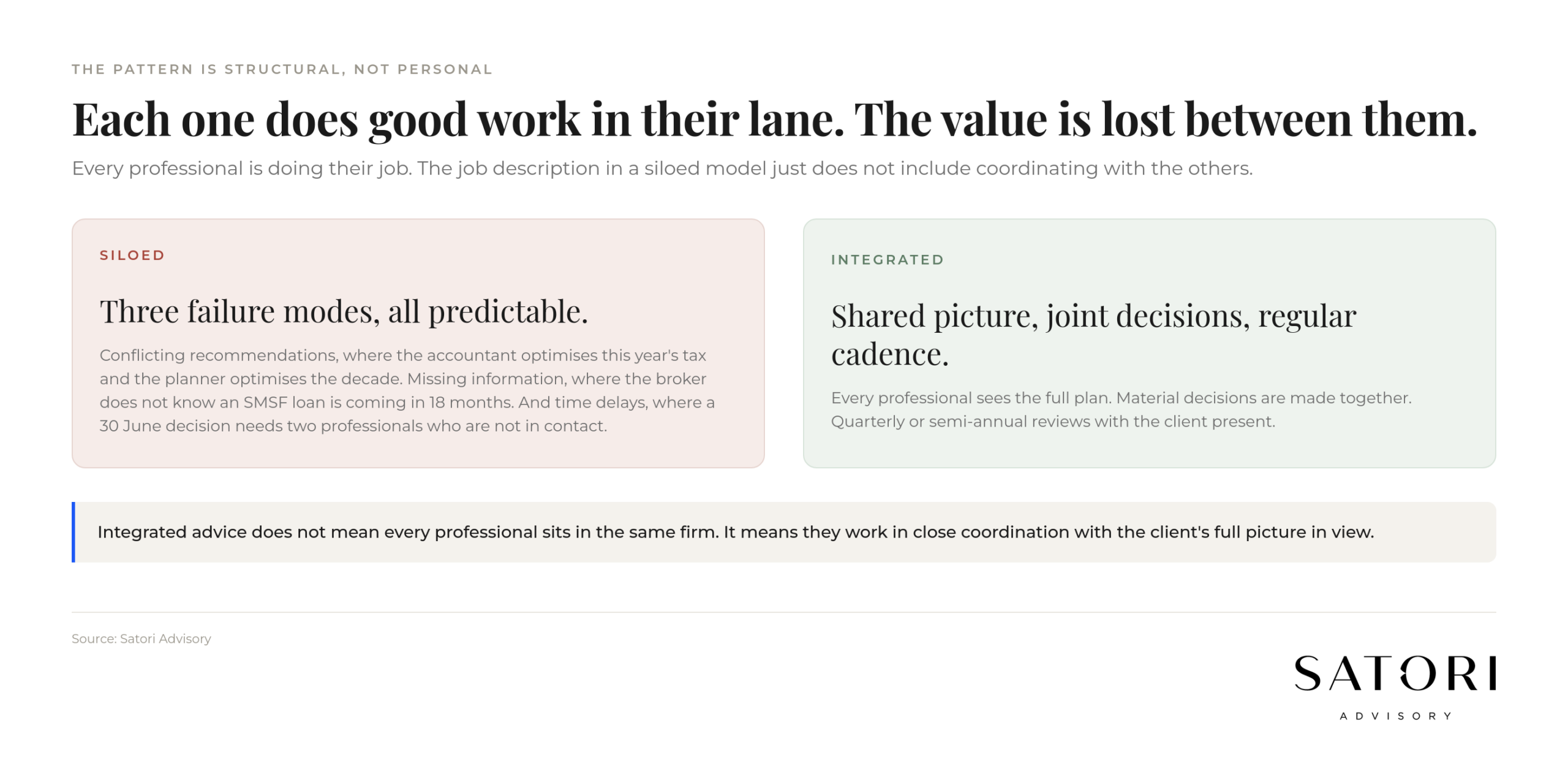
Three failure modes we see consistently.
Conflicting recommendations. The accountant says ‘maximise concessional super contributions to reduce this year’s tax’ while the financial planner is building wealth outside super for a specific purpose. Both are reasonable in isolation. Together they need to be reconciled.
Missing information. The mortgage broker doesn’t know that the borrower is about to set up an SMSF that will need an investment loan in 18 months. The lending choice today affects what is available then.
Time delays. A decision needs to be made by 30 June (super contribution, asset sale, structure change) and the professionals are not in contact through the year. By the time everyone has weighed in, the window has closed.
The pattern is structural, not personal. Each professional is doing their job. The job description in a siloed model just does not include coordinating with the others.
What integrated advice actually looks like
Three working features of integrated advice.
Shared client picture. Every professional has visibility into the full plan, not just their slice. The accountant knows the lending position; the broker knows the tax position; the planner knows both.
Joint decisions on high-stakes moves. Material decisions (sale of a business, retirement transition, large CGT event, structure restructure) are made with all relevant professionals in the conversation, not sequentially.
Regular coordination cadence. Quarterly or semi-annual reviews where the team comes together to look at the full picture, with the client present where useful.
Importantly, integrated advice does not mean every professional is on staff at the same firm. It does mean they work in close coordination with the discipline to talk to each other before decisions are made.
Where integrated advice adds the most value
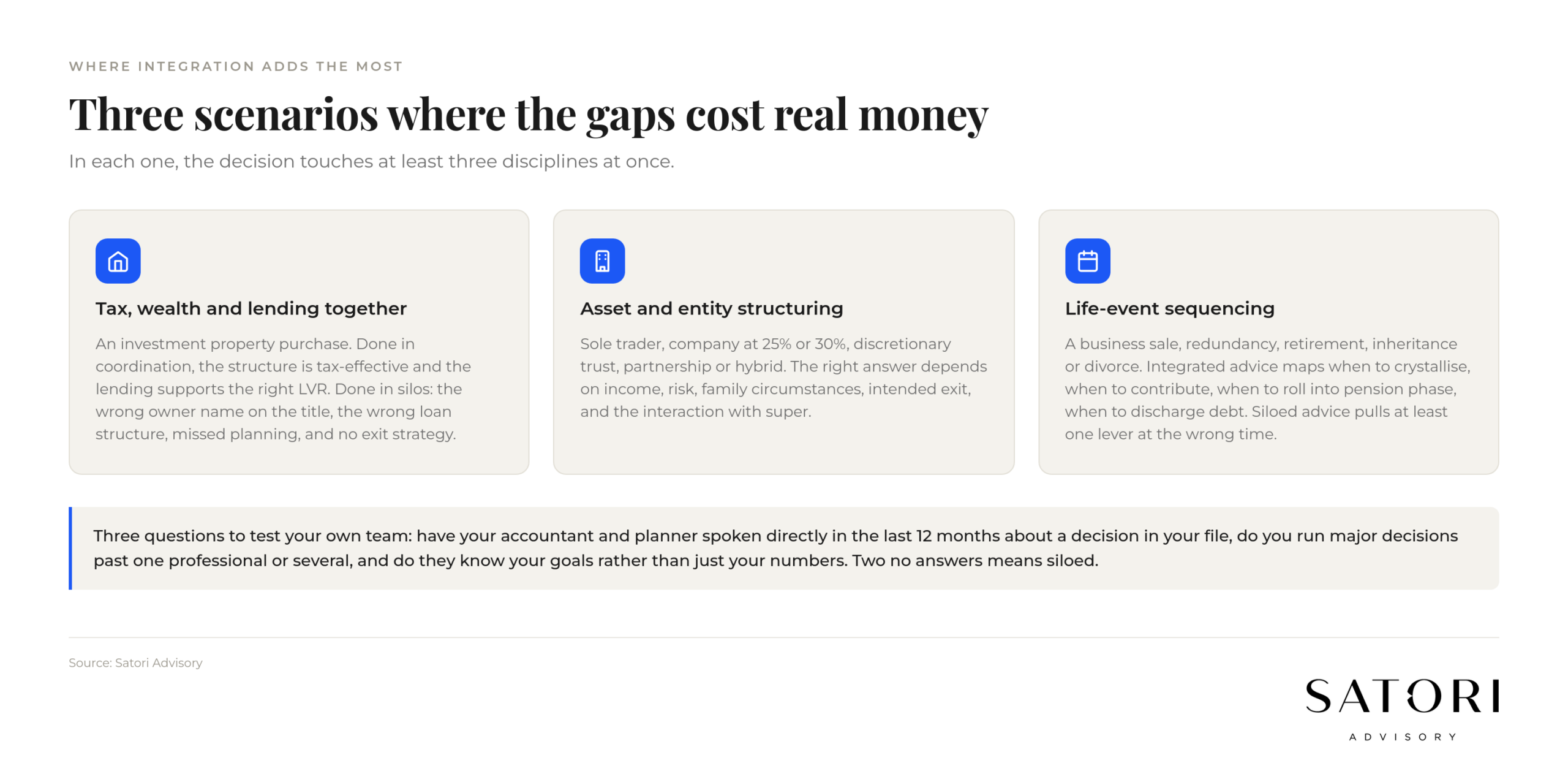
Three high-value scenarios.
Tax-wealth-lending coordination
The classic example: an investment property purchase. The financial planner sets the wealth strategy. The tax accountant advises on structure (sole name, joint, trust, SMSF). The mortgage broker arranges the lending. The conveyancer settles. All four decisions interact.
Done in coordination, the property purchase fits the plan, the structure is tax-effective, the lending supports the right LVR and serviceability, and the CGT timing is built in.
Done in silos, common results include the wrong owner name on the title, the wrong loan structure, missed tax planning opportunities, and no exit strategy.
Asset and entity structuring
Choosing between sole trader, company (25% or 30% tax), discretionary trust, partnership, or hybrid structures is one of the higher-stakes recurring decisions for business owners and investors.
The right structure depends on income level, risk profile, family circumstances, intended exit, and the interaction with super and personal investment.
Done in coordination across accountant and financial planner, the structure decision is made with full visibility. Done in isolation, structures get set up that work for tax but undermine the wealth plan, or vice versa.
Life-event sequencing
Major life events (sale of a business, redundancy, retirement, inheritance, divorce) typically have tax, wealth, lending, and super implications that all need to land in the right order.
Integrated advice maps the full sequence: when to crystallise, when to contribute to super, when to roll into pension phase, when to discharge debt, when to set up new structures.
Siloed advice on a major life event usually means at least one of the levers gets pulled at the wrong time, and the consequence is locked in.
The deductibility of integrated advice fees
Where financial advice fees relate to managing income-producing investments, they are typically deductible. This includes ongoing advice fees, investment management fees, and the portion of integrated advice attributable to managing investments.
Initial advice fees (the cost of setting up an initial plan) are usually capital in nature and not immediately deductible.
Talk to your accountant about apportioning the integrated advice fee correctly. Most practices that offer integrated advice also handle the deductibility of their own fees as part of the relationship.
How to test whether your current advice is genuinely integrated
Three questions.
Have your accountant and financial planner spoken to each other directly in the last 12 months about a decision in your file?
When you make a major financial decision, do you usually run it past one professional or multiple?
Do your professionals know your goals (not just your numbers) and reference them when discussing recommendations?
Two no answers means your advice is siloed. Two yes answers means it is integrated. Most Australian households we see are closer to siloed than they realise.
How Satori delivers integrated advice
Satori was built around the integrated model. Our financial planning, accounting, mortgage broking, SMSF, and property specialists work under one roof. Decisions are made together when they need to be.
Clients work directly with senior advisers who listen deeply, think boldly and act with purpose. The work is supported by a curated network of specialists that extends beyond our own team where needed.
The value compounds across years, not in any single quarter.
What to do next
Run the three-question test on your current professional team.
If the advice is siloed, decide whether to either ask your current professionals to coordinate more deliberately, or consolidate into an integrated practice.
Either way, do not let major financial decisions be made by one professional in isolation when they touch multiple disciplines.
How Satori Advisory works
At Satori Advisory we integrate your tax, business, wealth and lending as a prosperity engine, aligned with what matters most to you. With a clear roadmap, informed by data and backed by decades of strategic experience, we simplify the complex. We don’t offer pre-packaged solutions. We deliver tailored, end-to-end advice that reflects your reality and ambitions. You’ll work directly with senior advisers who listen deeply, think boldly and act with purpose. Feel cared for by our trusted team and curated network of financial and business specialists, as we empower you to make smart decisions and realise your potential, powered by numbers.
Frequently asked questions
What is integrated financial advice?
An advice model where your accountant, financial planner, mortgage broker, SMSF auditor and other specialists work in coordination with full visibility into each other’s recommendations. Decisions on tax, wealth, lending and super are made together rather than in isolation.
Do my accountant and financial planner need to work together?
For households with any complexity (business income, SMSF, investment property, life event), yes. Siloed advice consistently leads to conflicting recommendations, missed planning opportunities, and decisions that work in one area but undermine another.
Is integrated advice more expensive?
Sometimes the headline fee is higher, but the dollar value typically outweighs the difference many times over through coordinated tax-wealth-lending decisions. Most clients with any complexity find the integrated model more cost-effective over the long run.
Can financial advice fees be tax deductible in Australia?
Generally yes where the advice relates to managing income-producing investments. Initial advice fees (setting up a plan) are usually capital and not immediately deductible. Ongoing advice fees and investment management fees are often deductible. Apportion correctly and confirm with your accountant.
How do I test if my current advice is integrated?
Three questions. Have your accountant and financial planner spoken directly about a decision in your file in the last 12 months? When you make a major financial decision, do you run it past one professional or multiple? Do your professionals reference your goals when discussing recommendations? Two no answers means siloed.
What happens if my professionals do not coordinate?
Common failure modes: conflicting recommendations (tax strategy clashes with wealth strategy), missing information (one professional unaware of another’s plan), and time delays (decision windows close while professionals discuss sequentially). The cost shows up as missed planning opportunities and locked-in suboptimal decisions.
Ready to talk?
If you would like a calm, no-pressure conversation about how this applies to your specific situation, we are here to help.
Please feel free to get in touch on 1300 925 081 or send an email to [email protected] if you’d like to book in a chat on the above or on other matters.
Disclaimer
This article contains general information only and has been prepared without considering your objectives, financial situation or needs. It is not personal financial advice, taxation advice or legal advice and should not be relied upon when making financial decisions. Before acting on any information, consider its appropriateness to your circumstances and seek professional advice where appropriate.