
Table of Contents
SMSF diversification is one of the few areas where the regulatory rule and the investment principle point in the same direction. The Superannuation Industry (Supervision) Act requires trustees to consider diversification in the fund’s investment strategy. Modern portfolio theory says diversification is the closest thing to a free lunch in investing. The two rarely conflict.
But the gap between ‘consider diversification’ and ‘be diversified’ creates a grey zone that some SMSF trustees fall into, especially those who hold a single direct property or a concentrated share portfolio inside the fund.
Below is a 2026 lens on what the rules actually require, what the ATO watches for, and how trustees should document their thinking.
What the SIS Act actually requires
Section 52B of the Superannuation Industry (Supervision) Act requires SMSF trustees to formulate, regularly review and give effect to an investment strategy that takes into account the whole of the fund’s circumstances.
Six factors the strategy must address:
The risk involved in making, holding, and realising the fund’s investments.
The likely return from the fund’s investments, having regard to its objectives and cashflow requirements.
The composition of the investments as a whole, including the extent to which they are diverse, or expose the fund to the risks of inadequate diversification.
The liquidity of the investments, having regard to the fund’s expected cashflow requirements.
The ability of the fund to discharge its existing and prospective liabilities.
Whether the trustees of the fund should hold insurance cover for one or more members.
The 90% concentration threshold
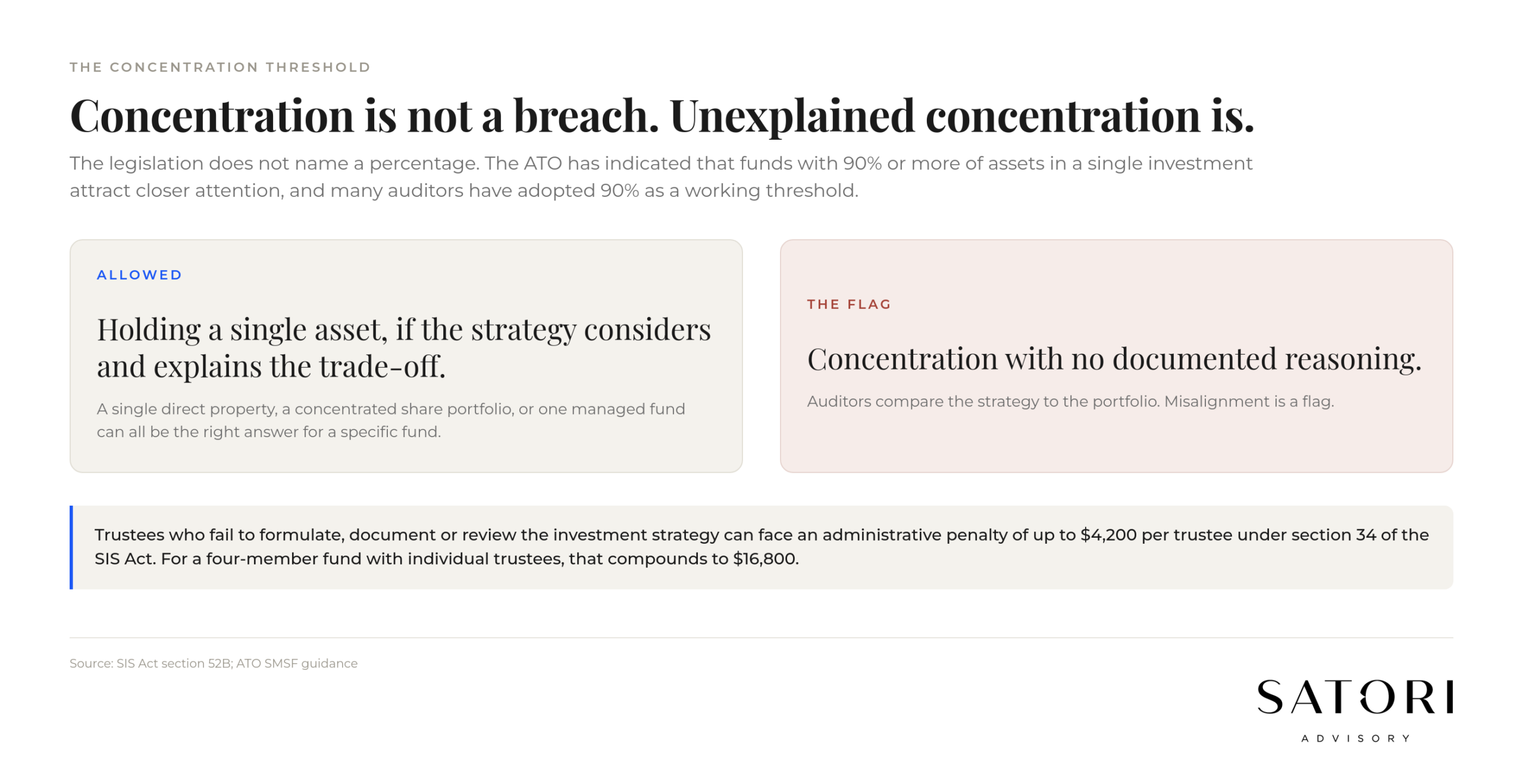
The legislation does not name a specific concentration percentage. The ATO has indicated that funds with 90% or more of assets in a single investment or single asset class will be subject to closer audit attention.
Many SMSF auditors have adopted the 90% mark as a working threshold. If your fund has more than 90% in one asset (a single property, one share holding, one managed fund), the auditor will be looking carefully at the strategy document to see how the trustees considered diversification and what reasoning supported the concentration.
Concentration is not automatically a breach. Trustees can hold a single asset if the strategy considers and explains the trade-off. But unexplained concentration is the risk.
The penalty for getting it wrong
Trustees who fail to formulate, document, or review the investment strategy can face an administrative penalty of up to $4,200 per trustee under section 34 of the SIS Act.
For a four-member SMSF with four individual trustees, that potentially compounds to $16,800. For a corporate trustee, the penalty applies to the trustee company.
Real penalties for strategy failures are not common, but the cost-benefit equation is poor: a few hours of documentation work against thousands of dollars of exposure.
How to actually satisfy the requirement
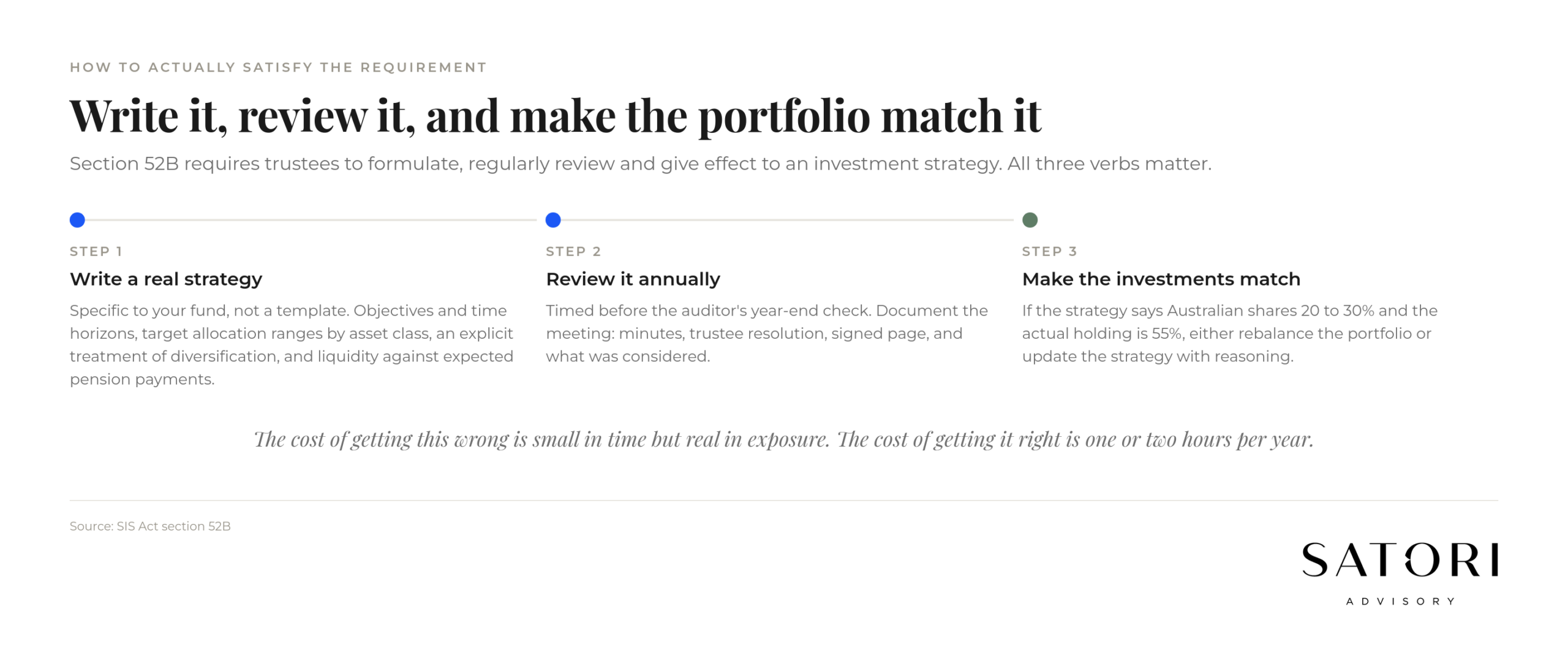
Three practical moves.
Write a real strategy document
The strategy should be specific to your fund, not a generic template. It needs to:
Identify the fund’s objectives (capital growth, income, both) and time horizons (accumulation vs pension).
Set target asset allocation ranges by asset class (e.g., Australian shares 20-30%, international shares 15-25%, property 10-30%, fixed interest 10-20%, cash 5-15%).
Explicitly address diversification: if the fund is concentrated in any one asset or class, the document should explain why that concentration is appropriate, what risks it creates, and how the trustees are managing those risks.
Address liquidity: the fund must be able to meet pension payments and member benefits as they fall due. If most of the fund is illiquid (a direct property), the strategy needs to explain how cashflow will be met.
Review the strategy regularly (and document the review)
Annual review is the working standard. The review should be timed before the auditor’s year-end check.
Document the review meeting (minutes, trustee resolution, signed page) and what was considered. If the strategy needs an update because the portfolio drifted or member circumstances changed, capture the change.
Make actual investments match the strategy
The strategy and the actual portfolio need to line up. If your strategy says Australian shares 20-30% and the actual holding is 55%, either rebalance the portfolio or update the strategy with a documented reason.
Auditors will compare the strategy to the portfolio. Misalignment is a flag.
Where SMSF concentration commonly happens (and what to do about it)
Three common concentration patterns:
Single direct property. Many SMSFs hold one investment property worth more than 90% of fund assets. This is allowed, but the strategy needs to document the cashflow plan for pension payments and the risk of single-asset exposure. Talk to your adviser if you are approaching pension phase with most of the fund in one property.
Concentrated share portfolio. An SMSF holding three or four large positions in the same sector (often bank shares for older trustees) can fail the diversification test even though the assets are listed. Sector concentration counts.
Single managed fund. A fund that holds 95% in one balanced managed fund is technically diversified inside the fund, but the strategy still needs to explain the choice and the manager risk.
How Satori works with SMSF clients on diversification
For our SMSF clients, the investment strategy is reviewed annually as part of the broader plan, not as a compliance afterthought. The strategy is specific to the fund’s members, objectives, and life stage. The trustee meeting documentation is kept current.
Concentration is sometimes the right answer for a specific fund (single property, single business holding) but it is always documented as a deliberate decision with the trade-offs explained, not an accident.
The cost of getting this wrong is small in time but real in exposure. The cost of getting it right is one or two hours per year.
What to do next
Pull your SMSF investment strategy. Check the date of the last review.
If the strategy is more than 12 months old, schedule a trustee meeting to review it.
If your fund has more than 90% in any one asset or asset class, confirm the strategy document explains the concentration and the management of the related risks.
If you are unsure whether your current documentation would satisfy an auditor, get it reviewed before the next audit.
How Satori Advisory works
At Satori Advisory we integrate your tax, business, wealth and lending as a prosperity engine, aligned with what matters most to you. With a clear roadmap, informed by data and backed by decades of strategic experience, we simplify the complex. We don’t offer pre-packaged solutions. We deliver tailored, end-to-end advice that reflects your reality and ambitions. You’ll work directly with senior advisers who listen deeply, think boldly and act with purpose. Feel cared for by our trusted team and curated network of financial and business specialists, as we empower you to make smart decisions and realise your potential, powered by numbers.
Frequently asked questions
What does the SIS Act require for SMSF investment strategies?
Trustees must formulate, regularly review, and give effect to an investment strategy that considers risk, return, composition (including diversification), liquidity, the fund’s ability to meet liabilities, and the question of insurance cover for members. The strategy must be specific to the fund’s circumstances.
Is SMSF diversification compulsory in Australia?
No. The law requires trustees to consider diversification and document that consideration. It does not require the fund to be diversified. A concentrated fund is permissible if the strategy explains the concentration and the trustees’ management of the resulting risks.
What is the ATO 90% concentration threshold for SMSFs?
An informal benchmark the ATO has flagged. Funds holding 90% or more of assets in a single investment or single asset class are subject to closer audit scrutiny. Auditors look carefully at the strategy document for evidence the trustees considered the concentration.
What is the penalty for failing the SMSF investment strategy requirement?
Up to $4,200 per trustee under section 34 of the SIS Act. For a fund with multiple individual trustees, the total exposure can compound. The penalty applies for failure to formulate, document, or regularly review the strategy.
How often should I review my SMSF investment strategy?
Annually is the working standard. The review should be timed before the auditor’s year-end check and should be documented through trustee minutes. Update the strategy if the portfolio has drifted or member circumstances have changed.
Can my SMSF hold just one property?
Yes, if the investment strategy explains the choice, the liquidity arrangements to fund member benefits, and the risk management approach. Many single-property SMSFs are compliant. The unexplained ones are the audit risk.
What are the six factors an SMSF investment strategy must address?
Risk, return, composition (including diversification), liquidity, the fund’s ability to meet liabilities, and the question of whether to hold insurance cover for members. These come directly from section 52B of the SIS Act.
Ready to talk?
If you would like a calm, no-pressure conversation about how this applies to your specific situation, we are here to help.
Please feel free to get in touch on 1300 925 081 or send an email to [email protected] if you’d like to book in a chat on the above or on other matters.
Disclaimer
This article contains general information only and has been prepared without considering your objectives, financial situation or needs. It is not personal financial advice, taxation advice or legal advice and should not be relied upon when making financial decisions. Before acting on any information, consider its appropriateness to your circumstances and seek professional advice where appropriate.