
Table of Contents
Choosing a business structure is one of the few decisions that touches everything: how you are taxed, what you own personally, what protection you have if something goes wrong, and how easily you can grow or exit.
Most Australian business owners we work with end up in one of four structures. Sole trader. Partnership. Family trust (usually discretionary). Or company. Each carries a different trade-off between cost, complexity, tax treatment, and risk.
Below we walk through each one with the 2026 numbers, the situations where they earn their place, and the situations where they cost more than they save.
What a business structure actually decides
Your structure is the legal and tax wrapper around how you trade. It decides three things at once.
Who is liable if something goes wrong. Whether your personal assets are exposed, or only the business assets.
How your income and expenses are taxed. Whether you pay tax at your personal marginal rate (up to 47% including Medicare in 2025-26) or at the company rate (25% or 30%).
How flexible you are when your circumstances change. Whether you can split income across family members, retain profits inside the business, or move assets around as the business evolves.
The choice matters from day one. Restructuring later is harder and more expensive than starting in the right wrapper.
Sole trader or trading in your personal name
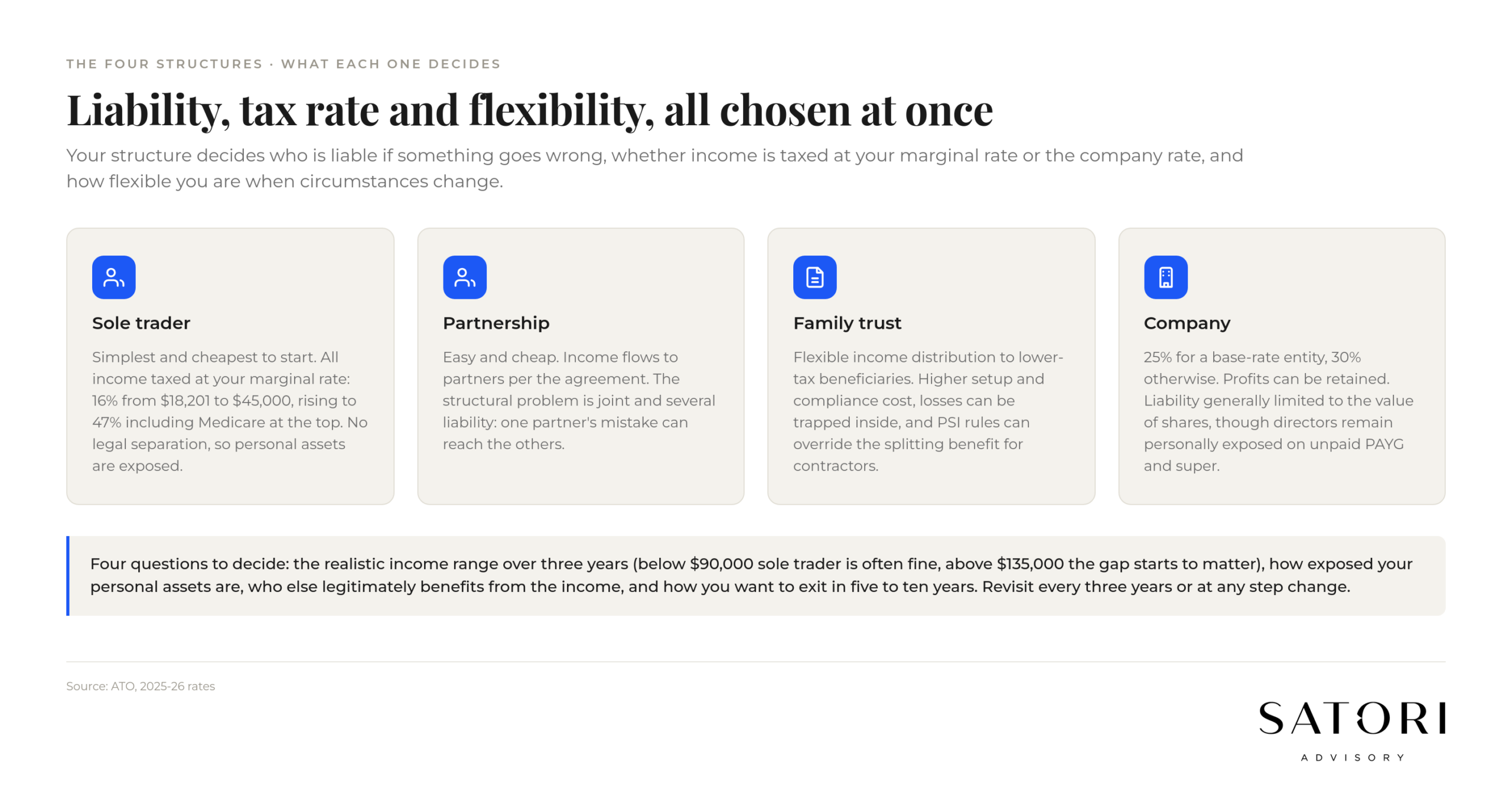
Trading as a sole trader is the simplest and cheapest way to start. Setup costs are low. Ongoing compliance is light. You keep full control.
All income flows to your personal name and is taxed at your marginal rate. In 2025-26 that means 16% on income from $18,201 to $45,000 in 2025-26, 30% from $45,001 to $135,000, 37% from $135,001 to $190,000, and 45% above $190,000. Add 2% Medicare. The top combined rate is 47%.
Sole trader works well for lower-income, lower-risk activities. The simplicity outweighs the missed tax planning opportunities.
Where sole trader stops working
Liability is the big one. There is no legal separation between you and the business. If the business is sued, your personal assets are exposed. As soon as your activity has real exposure (clients, contracts, employees, premises), the sole trader structure starts costing more than it saves.
Income tax becomes a drag too. Above roughly $135,000 in business income, the marginal rate gap between sole trader (37 to 47%) and company (25 to 30%) becomes meaningful enough to consider a different wrapper.
Partnership
A partnership is two or more people trading together. Easy and cheap to set up. Income flows to the partners according to the partnership agreement, and each partner is taxed at their marginal rate on their share. The partnership itself files a tax return but pays no tax.
Where partnership stops working
Shared liability is the structural problem. Partners are jointly and severally liable for each other’s actions. One partner’s mistake can pull every other partner into the consequence. That is a meaningful risk for any business with real exposure.
For advisory-grade clients, partnerships are now rare. The same flexibility, with proper liability protection, is usually delivered through a company or trust.
Family trust (discretionary trust)
A discretionary family trust holds the business assets. The trustee distributes income to beneficiaries each year, within the rules of the trust deed.
The flexibility is what makes it attractive. Income can be distributed to lower-tax beneficiaries to reduce the overall family tax bill. With a corporate trustee, the trust adds asset protection, because the corporate trustee carries the liability rather than you personally.
Where the trust trade-offs show up
Set-up and ongoing costs are higher than a sole trader. Compliance is more involved.
Losses can be trapped inside the trust rather than offset against your other income.
Contractors need to watch the personal services income (PSI) rules. PSI can override the income-splitting benefit when most of the income is for personal services.
The trust generally must distribute all net income each year, or pay tax on the undistributed portion at the highest marginal rate.
Company (Pty Ltd)
A company is a separate legal person. It pays company tax on its profits. In 2025-26 the rate is 25% if the company is a base-rate entity (aggregated turnover under $50 million and passive income under 80% of total income), or 30% for other companies.
Profits not distributed as dividends can be retained inside the company. That gives you tax-rate certainty and flexibility on when to draw the money out.
Shareholders’ liability is generally limited to the value of their shares. That protects personal assets if the company is sued.
Where the company structure costs you
Setup, maintenance, and wind-up costs are higher. Reporting requirements are heavier.
Directors can be held personally liable if they fail their legal duties. Unpaid PAYG and superannuation are common areas where the corporate veil does not protect a director.
PSI rules apply when the company is used to provide your personal services. The split between active and passive income matters for base-rate entity eligibility.
How to actually decide
Start with four questions.
What is the realistic income range over the next three years? Below $90,000, sole trader is often fine. Above $135,000, the gap between personal and company rates starts mattering.
How exposed are you, and your personal assets, if the business is sued? Real exposure means liability protection is real value.
Who else legitimately benefits from the business income? If a spouse or adult children are in lower brackets, a discretionary trust can earn its keep.
How do you want to exit, sell, or transition this in five to ten years? Companies are usually easier to sell than trusts.
When to revisit your structure
Structures do not stay right forever. Tax rates, company tax thresholds, and small-business concessions move. Your circumstances move.
A good rule of thumb is to revisit every three years, or whenever there is a step change: a jump in income, a new partner, taking on staff, buying property inside the business, or a planned sale or succession.
The cost of staying in the wrong structure compounds. Pay the modelling fee once every few years to confirm you are still in the right wrapper.
What to do next
If you are starting a business, model the four structures against your real numbers before you register an ABN.
If you have been operating in the same structure for more than three years, get it reviewed. Tax law, your income, and your risk profile have all moved.
If you are about to do something material (a sale, a property purchase inside the business, taking on a partner), model the structure question before you commit.
How Satori Advisory works
At Satori Advisory we integrate your tax, business, wealth and lending as a prosperity engine, aligned with what matters most to you. With a clear roadmap, informed by data and backed by decades of strategic experience, we simplify the complex. We don’t offer pre-packaged solutions. We deliver tailored, end-to-end advice that reflects your reality and ambitions. You’ll work directly with senior advisers who listen deeply, think boldly and act with purpose. Feel cared for by our trusted team and curated network of financial and business specialists, as we empower you to make smart decisions and realise your potential, powered by numbers.
Frequently asked questions
What is a business structure?
A business structure is the legal and tax wrapper around how you trade. It decides who is liable, how income is taxed, and how flexible you are if circumstances change. In Australia the four most common are sole trader, partnership, family trust, and company.
What are the 4 types of business structures in Australia?
Sole trader (trading in your personal name), partnership (two or more people), discretionary or family trust (held by a trustee, distributing to beneficiaries), and company (a separate legal entity). Each has a different tax, liability and compliance profile.
What is the company tax rate in Australia in 2025-26?
25% for base-rate entities, defined as companies with aggregated turnover under $50 million and passive income making up less than 80% of total income. All other companies pay 30%. These rates have been locked since the 2024-25 income year.
Is it better to be a sole trader or a company in Australia?
It depends on income, risk, and growth plans. Sole trader is cheaper and simpler, and is often fine for low-income, low-risk work. A company gives you asset protection and a flat tax rate (25% or 30%), but costs more to run. Above roughly $135,000 in steady business income, the company structure often starts to make sense.
Does a family trust save tax?
It can. A discretionary trust lets the trustee distribute income to beneficiaries each year, which reduces the overall family tax bill if some beneficiaries are in lower tax brackets. The trade-offs are cost, complexity, the rules around personal services income (PSI), and the requirement to distribute all net income each year.
How often should I review my business structure?
Every three years, or whenever there is a step change: a jump in income, a new partner, taking on staff, buying property in the business, or a planned sale or succession. The cost of staying in the wrong structure compounds.
Can I change my business structure later?
Yes, but it is harder and more expensive than starting with the right one. Restructuring can trigger capital gains tax, stamp duty, and GST consequences. Some small-business rollover concessions can reduce the cost when eligibility is met.
Ready to talk?
If you would like a calm, no-pressure conversation about how this applies to your specific situation, we are here to help.
Please feel free to get in touch on 1300 925 081 or send an email to [email protected] if you’d like to book in a chat on the above or on other matters.
Disclaimer
This article contains general information only and has been prepared without considering your objectives, financial situation or needs. It is not personal financial advice, taxation advice or legal advice and should not be relied upon when making financial decisions. Before acting on any information, consider its appropriateness to your circumstances and seek professional advice where appropriate.