
Table of Contents
Cryptocurrency tax in Australia became less mysterious over the last few years, but it did not become simpler. The 2026 picture has three big features: the ATO’s investor-vs-trader test, the well-established CGT regime that applies to investors, and the upcoming 1 July 2027 reforms announced in the 2026 Federal Budget that will replace the 50% CGT discount for individuals, trusts and partnerships.
Below is a 2026 lens on how the ATO actually treats crypto, the practical tax events most holders trigger without realising, and what to do before the regime changes in mid-2027.
How the ATO classifies crypto holders
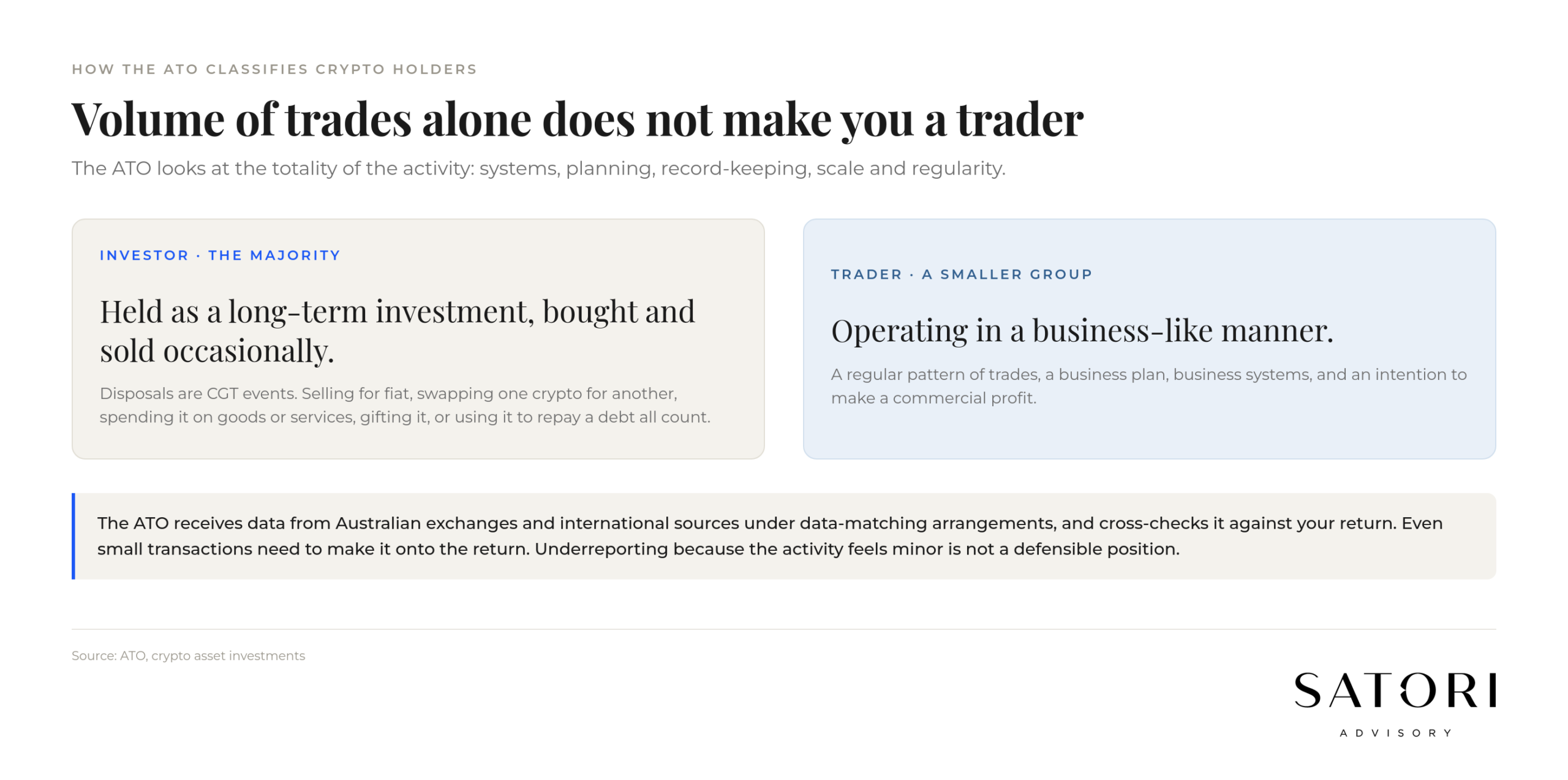
The tax treatment depends on whether you are an investor or a trader.
Investor (the majority of Australians who hold crypto). You hold crypto as a long-term investment, you buy and sell occasionally, your activity does not look like a business. Tax treatment: capital gains tax (CGT) on each disposal. If you held the asset for more than 12 months, the 50% CGT discount applies for individuals, trusts and partnerships in 2025-26.
Trader (a smaller group). You operate in a business-like manner: regular pattern of trades, business plan, business systems, intention to make a commercial profit. Tax treatment: crypto is trading stock, profits are ordinary income, full business deductions available, no 50% CGT discount.
Note: simple volume of trades alone does not make you a trader. The ATO looks at the totality of the activity (systems, planning, record-keeping, scale, regularity, business intent).
What counts as a CGT event for crypto
Each of the following is a CGT event for an investor:
Selling crypto for AUD or another fiat currency.
Swapping one crypto for another (e.g. ETH for BTC).
Spending crypto on goods or services.
Gifting crypto to anyone other than your spouse (in some cases).
Using crypto to repay a debt.
The ATO calculates the gain or loss in AUD at the time of each event, based on the market value of the crypto in AUD. The cost base includes the AUD value at acquisition plus eligible costs.
The 50% CGT discount (2025-26)
For 2025-26, individuals, discretionary trusts, and partnerships that hold a crypto asset for more than 12 months before disposing of it can apply a 50% CGT discount to the gain. Companies do not get the discount.
Example: an individual buys 1 BTC for AUD $50,000, holds it for 18 months, sells for AUD $80,000. Gross gain $30,000. 50% discount = $15,000 taxable gain at marginal rate.
The discount applies per asset and per holding period. It is one of the most valuable features of the current regime for long-term investors.
What changes from 1 July 2027 (announced in the 2026 Federal Budget)
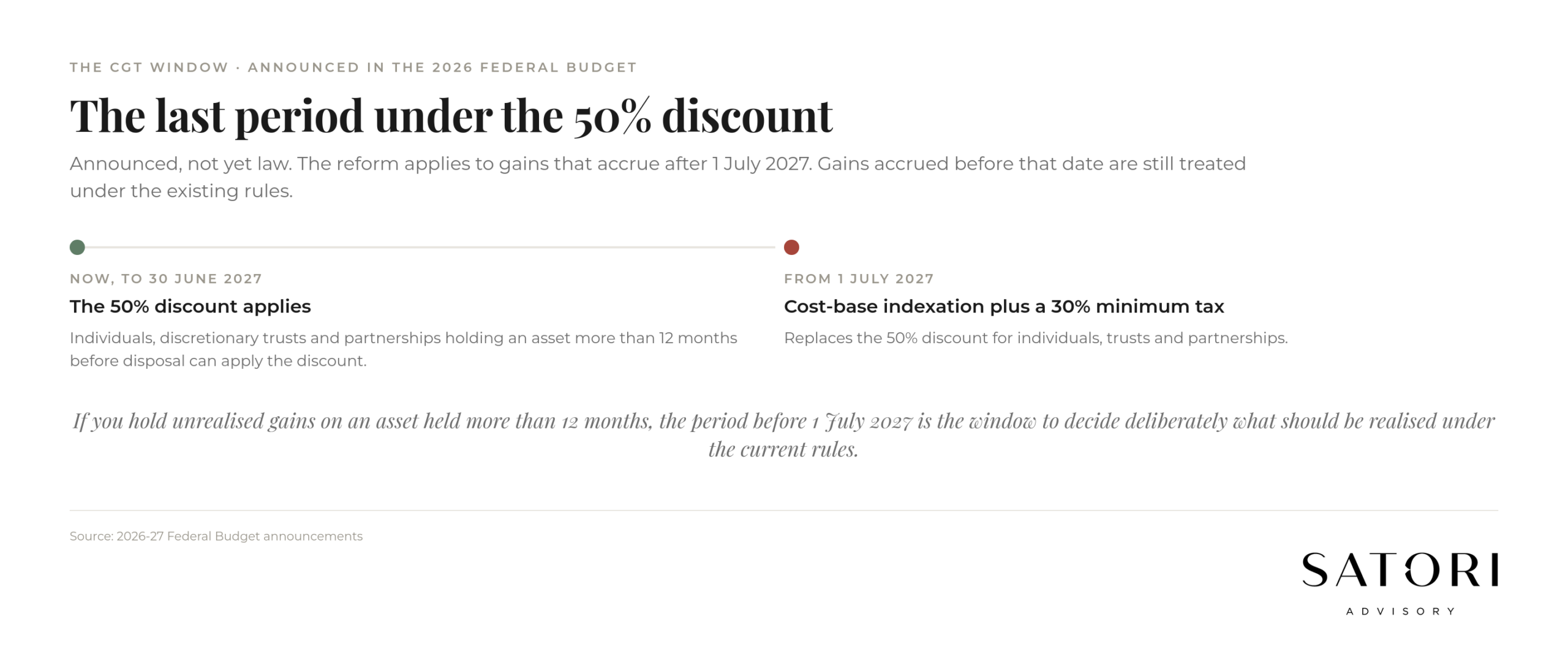
The 2026 Federal Budget announced sweeping reforms to negative gearing and capital gains tax. The relevant changes for crypto investors:
From 1 July 2027, the 50% CGT discount for individuals, trusts and partnerships is replaced with cost-base indexation plus a 30% minimum tax rate on capital gains.
The CGT reform applies to gains that accrue after 1 July 2027. Gains accrued before that date are still treated under the existing 50% discount rules.
Practical implication: if you have unrealised crypto gains and you have held the asset for more than 12 months, the period before 1 July 2027 is the last window under the current 50% discount regime. Whether to realise before that date depends on your individual situation. Talk to your accountant well ahead of the change.
Crypto losses
Capital losses can offset capital gains in the same year or carry forward indefinitely.
Capital losses cannot offset ordinary income. So a crypto loss does not reduce your salary tax.
Wash sale rules apply. Selling a crypto asset to realise a loss and then buying it back shortly afterwards can be challenged by the ATO. Get the timing right or accept a meaningful gap before re-entering.
DeFi, staking, airdrops, NFTs
DeFi income (yield from lending protocols, liquidity pool rewards) is generally treated as ordinary income at the AUD value when received.
Staking rewards are generally ordinary income at the AUD value when received. The cost base of the staked coins is the AUD value at the time of receipt.
Airdrops are ordinary income at the AUD value when received, except in narrow circumstances.
NFTs are treated similarly to other crypto: a disposal is a CGT event for an investor, and ordinary income for a trader.
Each of these has nuances. If you have material DeFi or NFT activity, get specialised tax advice before EOFY.
Record keeping (five years)
The ATO requires you to keep records for at least five years from the date of each transaction. For the 2025-26 tax year, that means records must be kept until at least 2031.
What to keep:
Date of each transaction.
AUD value at the time (and the source of that valuation).
What the transaction was for.
The other party (or address).
Fees and commissions paid.
Most Australian crypto investors use a portfolio tracking tool (Koinly, CoinTracker, CoinLedger, Crypto Tax Calculator) that integrates with exchanges and produces ATO-compliant reports. The cost is usually less than the time spent reconstructing records manually.
The ATO is data-matching
The ATO receives data from Australian exchanges and from international sources under data-matching arrangements. They cross-check that data against your tax return.
If you have not reported crypto activity that the ATO can see, the consequence is amended assessments plus penalties. The amnesty for unreported crypto closed years ago.
Practical implication: even small crypto transactions need to make it onto the return. Underreporting because the activity feels minor is not a defensible position.
What to do before EOFY 2026
Pull a transaction history from each exchange or wallet you used during 2025-26.
Reconcile against any portfolio tracker you use. Investigate gaps before they become tax-return discrepancies.
Identify any unrealised losses worth crystallising to offset realised gains in the same financial year.
If you are approaching the 12-month holding threshold on a position you intend to sell, the timing matters for the 50% discount.
Get specialised advice before the 1 July 2027 CGT reform takes effect, especially for material long-term positions.
How Satori Advisory works
At Satori Advisory we integrate your tax, business, wealth and lending as a prosperity engine, aligned with what matters most to you. With a clear roadmap, informed by data and backed by decades of strategic experience, we simplify the complex. We don’t offer pre-packaged solutions. We deliver tailored, end-to-end advice that reflects your reality and ambitions. You’ll work directly with senior advisers who listen deeply, think boldly and act with purpose. Feel cared for by our trusted team and curated network of financial and business specialists, as we empower you to make smart decisions and realise your potential, powered by numbers.
Frequently asked questions
How is crypto taxed in Australia in 2026?
Most holders are treated as investors, so each disposal is a CGT event. Gains held for more than 12 months attract a 50% CGT discount in 2025-26. Traders (running a crypto trading business) are taxed on ordinary income with full deductions but no CGT discount.
Do you pay tax on crypto in Australia?
Yes, on each disposal. Selling crypto for AUD, swapping one crypto for another, spending crypto on goods or services, and gifting crypto can all be CGT events. Holding crypto is not a taxable event by itself.
What is the 50% CGT discount on crypto?
For individuals, trusts and partnerships that hold a crypto asset for more than 12 months before disposing of it, only 50% of the gain is taxable. The discount is one of the most valuable features of the current 2025-26 regime.
When does the CGT discount change in Australia?
From 1 July 2027, the 50% CGT discount for individuals, trusts and partnerships will be replaced with cost-base indexation plus a 30% minimum tax rate on capital gains, under the reforms announced in the 2026 Federal Budget. The change applies to gains accruing after 1 July 2027.
How long do I have to keep crypto records for the ATO?
At least five years from the date of each transaction. Records for the 2025-26 tax year must be kept until at least 2031.
Can crypto losses offset my salary?
No. Capital losses can only offset capital gains, not ordinary income. Unused capital losses carry forward indefinitely until you have capital gains to offset them against.
Are DeFi yields taxable in Australia?
Yes, generally as ordinary income at the AUD value at the time of receipt. The same applies to staking rewards and most airdrops. Each has nuances worth confirming with a specialised tax adviser for material activity.
Ready to talk?
If you would like a calm, no-pressure conversation about how this applies to your specific situation, we are here to help.
Please feel free to get in touch on 1300 925 081 or send an email to [email protected] if you’d like to book in a chat on the above or on other matters.
Disclaimer
This article contains general information only and has been prepared without considering your objectives, financial situation or needs. It is not personal financial advice, taxation advice or legal advice and should not be relied upon when making financial decisions. Before acting on any information, consider its appropriateness to your circumstances and seek professional advice where appropriate.