
Table of Contents
There is a meaningful gap between getting your tax return lodged and actually planning your tax. Most Australians get the first. Fewer get the second. The dollar value of the gap, for clients with any complexity, is usually large.
Below is a 2026 lens on the distinction, when it matters most, and what a real planning conversation looks like.
What tax preparation (compliance) actually is
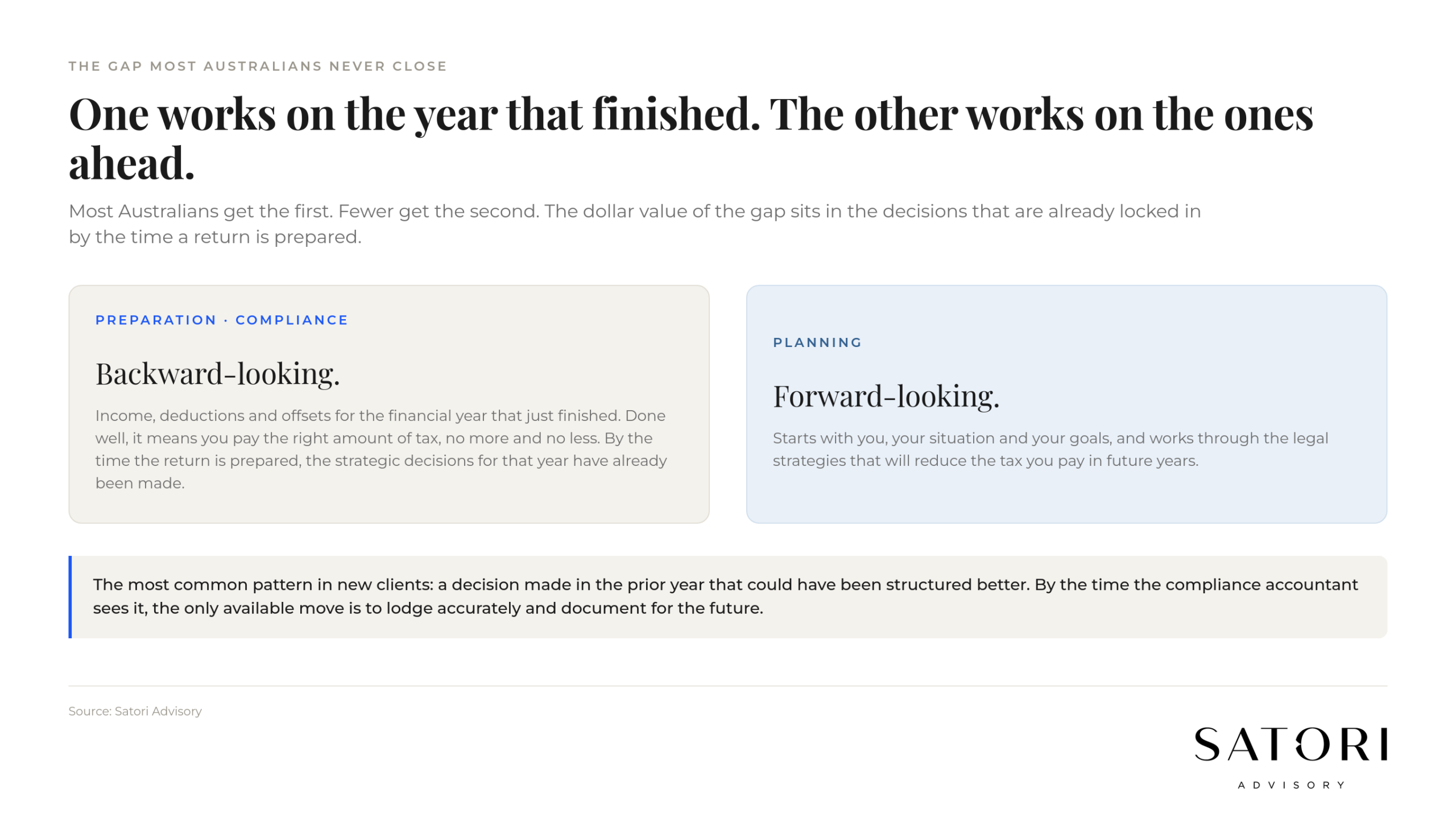
Tax compliance is the necessary work to lodge your individual tax return. It covers your income (wages, business income, investment property, sole trader activity, foreign income), your deductions (work-related, investment property, donations, super contributions where applicable), and any tax offsets you qualify for.
The accountant or tax agent who does compliance well makes sure all available deductions and offsets have been claimed, the return is internally consistent, and you pay the right amount of tax, not a cent more.
Compliance is fundamentally backward-looking. It works on the financial year that just finished. By the time the return is being prepared, the strategic decisions for that year have already been made (or missed).
What tax planning actually is
Tax planning is forward-looking. It starts with you, your situation and your goals, and works through the legal strategies that will reduce the tax you pay in future years.
A real planning conversation covers:
Income timing and bracket management. Whether to bring forward or defer income across financial years to smooth across brackets.
Entity structure. Sole trader (taxed at marginal rates up to 47%), company (25% base-rate entity if turnover under $50M and passive income under 80%, 30% otherwise), trust, partnership. The right structure can save tens of thousands of dollars per year on the same income.
Concessional super. Using the $32,500 cap and any carry-forward (TSB under $500,000 at 30 June 2026) to shift income from marginal rate (up to 47%) to the 15% super contribution tax rate.
Salary packaging. Pre-tax structures around vehicles (eligible EVs under the FBT exemption), super, and other approved items.
Asset positioning. Holding period before sale, ownership entity, location (super vs personal name vs trust).
Capital event planning. Timing the sale of a business, an investment property, or a large share position to minimise the tax bill.
Legislative awareness. Adjusting for changes (the 1 July 2027 CGT 50% discount reform, Division 296, in force since 1 July 2026, the legislated first-bracket step down from 16% to 15% from 1 July 2026, which should be confirmed at ato.gov.au).
When tax planning is worth the fee
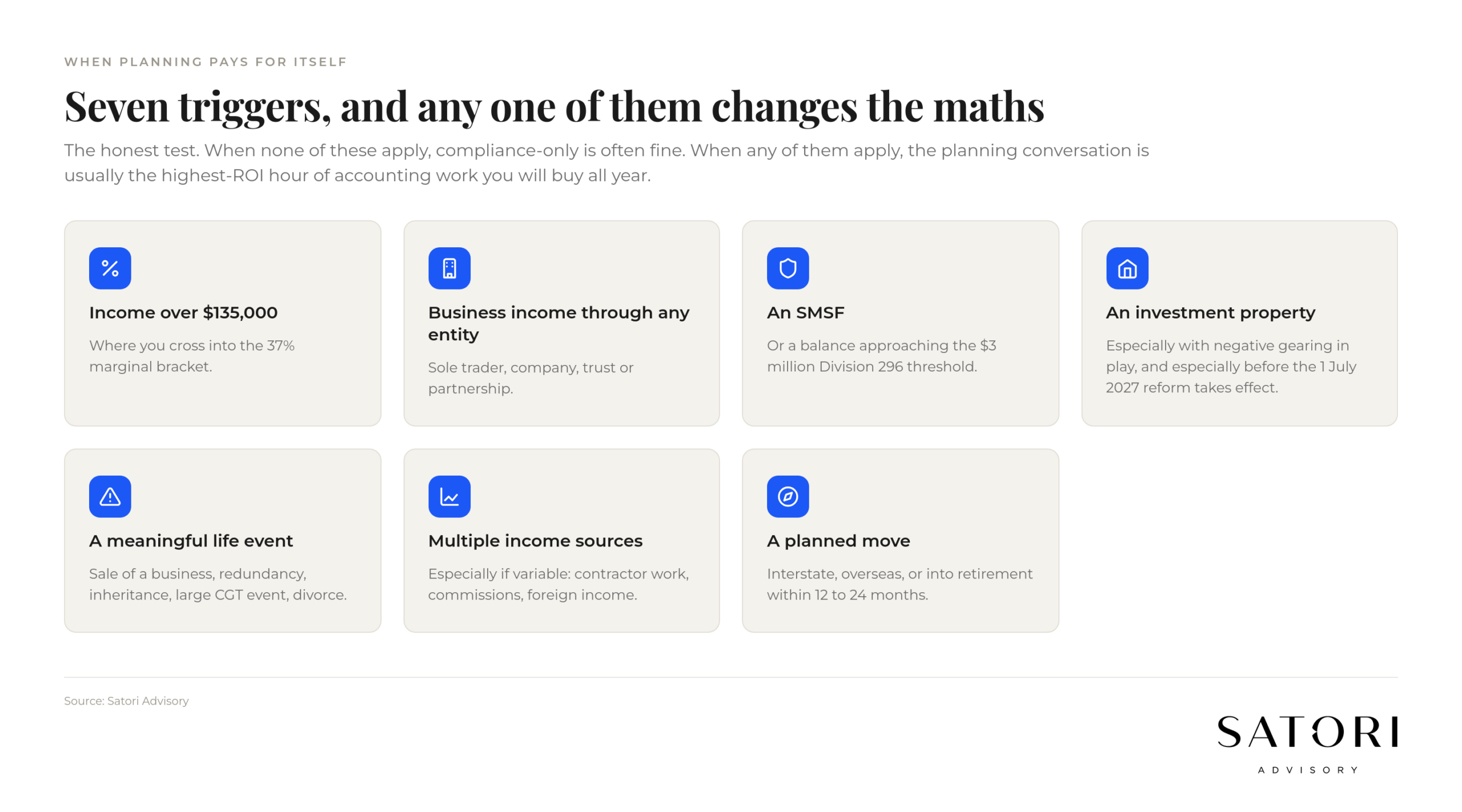
The honest test: if your situation has any of the following, planning typically pays for itself many times over.
Annual income over $135,000 (where you cross into the 37% marginal bracket).
Business income through any entity.
An SMSF (or a balance approaching the $3M Division 296 threshold).
An investment property, especially with negative gearing in play (and especially before the 1 July 2027 negative gearing reform takes effect).
A meaningful life event in the year: sale of a business, redundancy, inheritance, large CGT event, divorce.
Multiple income sources, especially if variable (contractor work, commissions, foreign income).
A planned move (interstate, overseas, into retirement) within 12 to 24 months.
When none of these apply, compliance-only is often fine. When any of them apply, the planning conversation is usually the highest-ROI hour of accounting work you will buy all year.
The ‘oh I wish I had known that earlier’ problem
The single most common pattern we see in new clients: a decision was made in the prior year (a property sold without timing the CGT, a bonus taken without topping up concessional super, a structure left in place beyond its useful life) that, with planning, would have saved tens of thousands of dollars.
By the time the compliance accountant prepares the return, the decision is locked in. The only available move is to lodge accurately and document for the future.
Planning is the work that prevents that conversation. It costs an hour or two per year. It saves much more than that for the right client.
How a real planning conversation runs
Three meetings is the typical shape.
Meeting one: discovery. Income, assets, structure, goals, timeline. The adviser asks more than they tell.
Meeting two: strategy. The adviser maps out the planning levers available given your situation, the dollar impact of each, and which to prioritise.
Meeting three: implementation and ongoing. Specific actions for the next 30, 60, 90 days. Then quarterly or semi-annual reviews to adjust as legislation, markets, and your circumstances move.
Fees for the planning piece are deductible the following year, which moves the effective cost closer to break-even with the dollar saving from the very first identified strategy.
How Satori delivers tax planning
We run tax planning as part of the integrated advice conversation, not as an isolated tax exercise. Decisions on super, lending, investment portfolio, and business activity all interact, and the right plan coordinates them.
Our tax team has visibility into the wealth and lending picture (and vice versa), so a recommendation in one area gets stress-tested against the other two before it is made.
What to do next
If you have not had a forward-looking tax planning conversation in the last 12 months, book one before EOFY.
If you have a step-change event coming up (sale, retirement, big bonus, inheritance), book one now.
If you currently only get compliance-only work from your accountant, ask whether they offer planning. If they do not, get a second opinion from someone who does.
How Satori Advisory works
At Satori Advisory we integrate your tax, business, wealth and lending as a prosperity engine, aligned with what matters most to you. With a clear roadmap, informed by data and backed by decades of strategic experience, we simplify the complex. We don’t offer pre-packaged solutions. We deliver tailored, end-to-end advice that reflects your reality and ambitions. You’ll work directly with senior advisers who listen deeply, think boldly and act with purpose. Feel cared for by our trusted team and curated network of financial and business specialists, as we empower you to make smart decisions and realise your potential, powered by numbers.
Frequently asked questions
What is the difference between tax preparation and tax planning?
Tax preparation (compliance) is backward-looking: lodging the return for the year that just finished. Tax planning is forward-looking: structuring your affairs so future years’ bills are lower through legal strategies on entity structure, super contributions, salary packaging, and timing of capital events.
Who needs tax planning in Australia?
Anyone with annual income over $135,000, business income, an SMSF, investment property, a meaningful life event in the year, multiple income sources, or a planned move within 12-24 months. For simpler situations, compliance-only is often fine.
Is a tax agent the same as a tax planner?
Not necessarily. A tax agent focuses on compliance and lodgement. A tax planner (often a specialist accountant or part of an integrated advice firm) does the forward-looking strategy work. Many practitioners use the terms loosely; the substantive test is whether they look forward or only backward.
How much does tax planning cost in Australia?
Typically $500 to $3,000 for a one-off planning engagement, depending on complexity. Ongoing tax planning is usually built into a broader advice fee. Fees are deductible the following year, and the planning typically pays for itself many times over for the right client.
When should I do tax planning?
Ideally before EOFY (most planning levers need to be implemented before 30 June). At minimum, when you have a step-change event coming up: sale of a business or property, retirement transition, large bonus, inheritance, redundancy.
What are the main tax planning levers in Australia 2026?
Concessional super contributions inside the $32,500 cap (plus carry-forward), entity structure (sole trader vs company at 25%/30%), salary packaging, asset positioning before sale, timing of large capital events, and legislative awareness around the 1 July 2027 CGT reform and Division 296.
Ready to talk?
If you would like a calm, no-pressure conversation about how this applies to your specific situation, we are here to help.
Please feel free to get in touch on 1300 925 081 or send an email to [email protected] if you’d like to book in a chat on the above or on other matters.
Disclaimer
This article contains general information only and has been prepared without considering your objectives, financial situation or needs. It is not personal financial advice, taxation advice or legal advice and should not be relied upon when making financial decisions. Before acting on any information, consider its appropriateness to your circumstances and seek professional advice where appropriate.