
Table of Contents
Australian investment property lending has shifted noticeably since the late 2010s. APRA’s serviceability buffer, the introduction of the Best Interests Duty for brokers, debt-to-income caps, and increased scrutiny of lifestyle expenses all mean that lenders look much harder at your real financial life than they used to.
If you are buying your first investment property in 2026, the five things below are what lenders are actually looking at. Get each one right and your application becomes a different conversation.
Thing 1: Your verifiable income
PAYG income is the easiest to evidence. Lenders typically want two recent payslips, a year-to-date payment summary, and bank statements that show the salary landing.
Self-employed income takes more work. Lenders usually want two full years of tax returns plus the related notices of assessment. Some lenders accept one year of returns for ABN holders who have been trading for more than two years.
Variable income (commissions, bonuses, overtime) is usually averaged or partially discounted. The discount varies by lender.
Multiple income sources can help or hurt. A second salary from a stable employer helps. A second income from gig work or short-term contracting helps less, because lenders treat it as less reliable.
Thing 2: Your actual lifestyle expenses
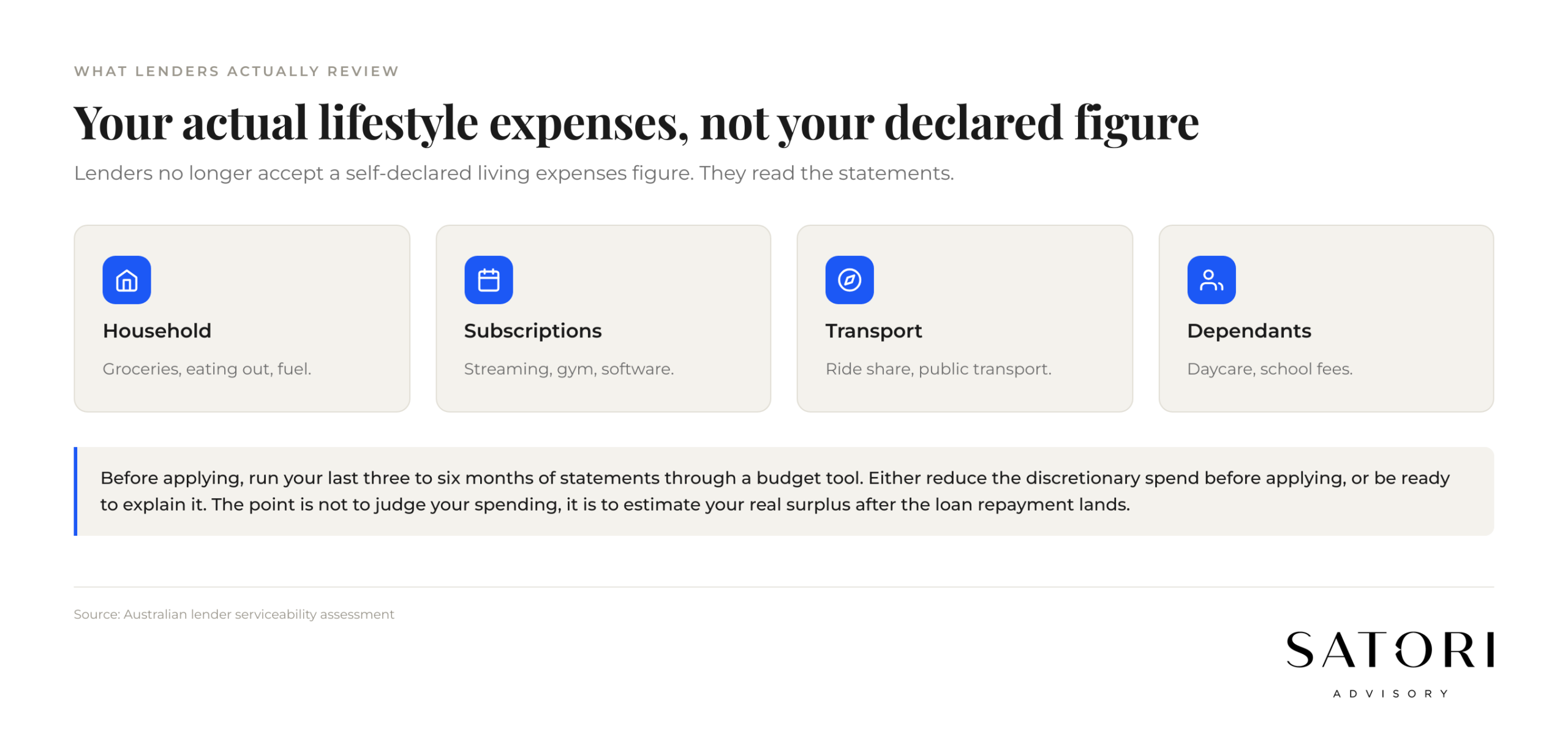
This is where the conversation has changed most since 2018. Lenders no longer accept your self-declared ‘living expenses’ figure on the application form at face value. They check the bank statements.
What they look at: groceries, eating out, subscriptions (streaming, gym, software), ride share, public transport, fuel, daycare, school fees, regular charitable giving, holidays, online shopping.
The point is not to judge your spending. The point is to estimate your real surplus after the loan repayment lands. If your statements show $4,500 a month of discretionary spend and you declared $2,500, the lender will use the higher figure.
Practical tip: before applying, run your last three to six months of statements through a budget tool. Either reduce the discretionary spend before applying, or accept that your borrowing capacity will reflect the real number.
Thing 3: Your credit card limits (not balances)
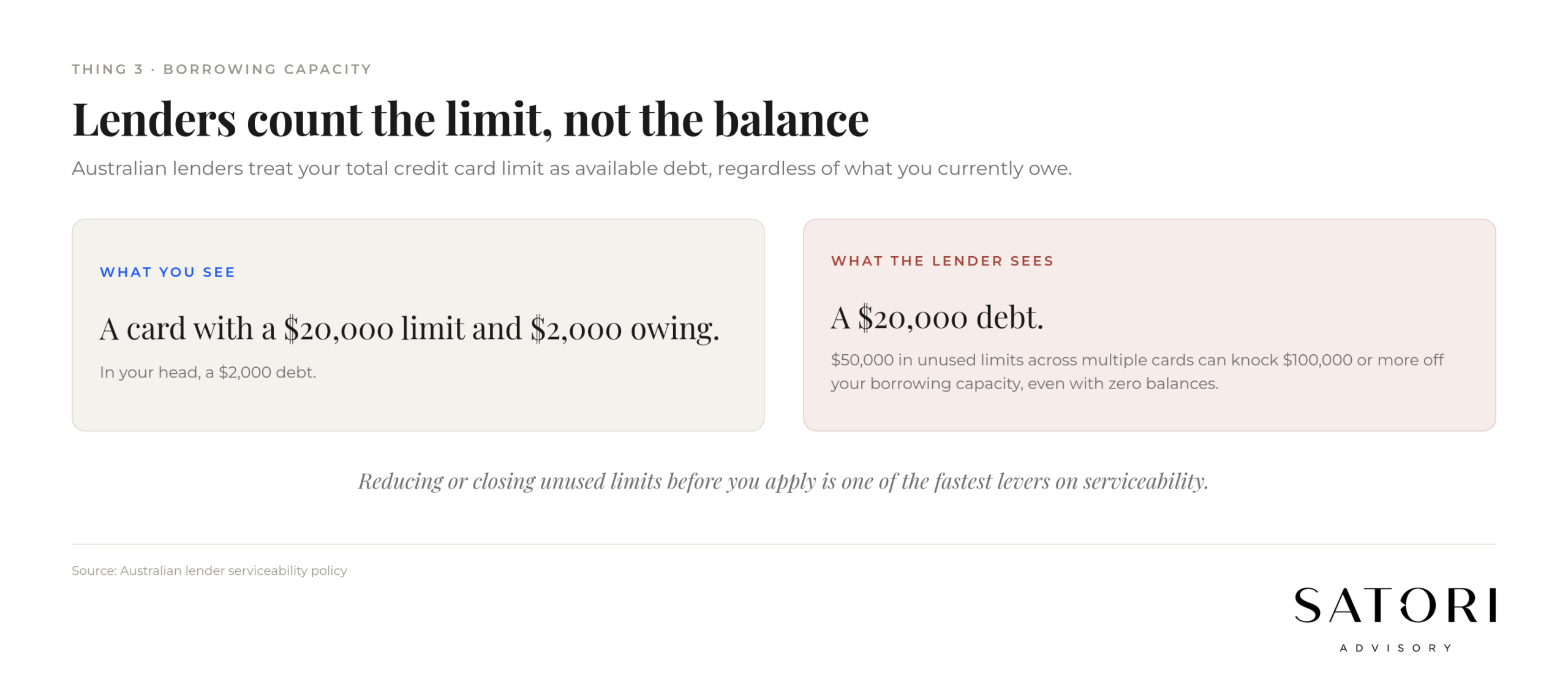
Australian lenders treat your total credit card limit as available debt, regardless of the current balance. A card with a $20,000 limit and $2,000 owing is treated as $20,000 of debt at the lender’s assumed minimum repayment rate (typically 3% per month).
If you have $50,000 in unused credit card limits across multiple cards, that can knock $100,000 or more off your borrowing capacity, even with zero balances.
Two practical moves before applying: lower the credit limit on cards you keep (call the bank, it takes 10 minutes), or cancel cards you do not use. Both reduce the assumed monthly debt commitment the lender bakes into your serviceability.
Thing 4: How your deposit is structured
Three options.
Genuine savings. The cleanest path. Most lenders want to see at least 5% of the deposit as genuine savings, money in your account for three months or more, demonstrating financial discipline.
Family equity (guarantor). A family member pledges a portion of their property as additional security against your loan. This can remove the LMI trigger and lift your borrowing capacity. Use a limited guarantee to bound the parent’s exposure. Treat it as a formal arrangement with a loan agreement.
First Home Guarantee scheme. From 1 October 2025, the federal scheme has no income caps, no place limits, and waives LMI on deposits as low as 5%. However, the scheme is for owner-occupier first home buyers, so it does not apply to a pure investment property purchase. Worth knowing in case your first purchase is going to be owner-occupied and you plan to convert to an investment later.
Thing 5: Whether the property cashflow stacks up at the buffer rate
Lenders model the investment property at your actual rate plus the APRA 3% buffer. They then add a sensible rental income assumption (often a slight haircut to the agent’s quoted rent).
If the property cashflow at the buffer rate plus your living expenses exceeds your verifiable income, the application will not approve at the loan size you want, regardless of how comfortable the numbers look at your actual rate.
Practical implication: when you are shopping for your first investment property, do the serviceability check yourself at rate plus 3% before falling in love with a property. That avoids the awkward conversation later.
Three mistakes that kill first-investor applications
Applying to multiple lenders simultaneously. Each application triggers a credit enquiry. Three or four enquiries in the same month can damage the credit score and prompt the lender to ask why.
Overstating living expenses. Lenders cross-check against statements anyway. The right move is to know your real number before applying.
Treating the broker as just a rate negotiator. A good broker can tell you which lender’s policy fits your profile (income mix, deposit structure, dependents). That is usually more valuable than a 0.10% rate difference.
How Satori works with first-time investors
We start by mapping the cashflow picture across your full financial life: PAYG and any other income, current commitments, lifestyle spend, super contributions, and any other lending in place.
From there, we set up the application in the right structure (broker selection, loan structure, deposit composition) and walk you through the conversation with the lender so the first application is the strong one.
The goal is the right property, financed in the right way for your broader plan, not the first property a lender will let you buy.
What to do next
Pull your last three months of bank statements and add up your real discretionary spend. Compare it to what you would self-declare. The gap is what you need to close before applying.
Review your credit card limits. Lower or cancel cards you do not use.
Decide whether your deposit structure will use savings, family equity, or a combination.
Talk to a broker who works with first-time investors before falling in love with a specific property.
How Satori Advisory works
At Satori Advisory we integrate your tax, business, wealth and lending as a prosperity engine, aligned with what matters most to you. With a clear roadmap, informed by data and backed by decades of strategic experience, we simplify the complex. We don’t offer pre-packaged solutions. We deliver tailored, end-to-end advice that reflects your reality and ambitions. You’ll work directly with senior advisers who listen deeply, think boldly and act with purpose. Feel cared for by our trusted team and curated network of financial and business specialists, as we empower you to make smart decisions and realise your potential, powered by numbers.
Frequently asked questions
Can I get an investment property loan as a first-time investor in Australia in 2026?
Yes, but the lender will look harder at your verifiable income, your actual lifestyle expenses, your credit card limits, and the property cashflow at APRA’s serviceability buffer. The application is more disciplined than it was a decade ago, but very achievable for a well-prepared first investor.
How much can I borrow for an investment property?
Lenders test you at your actual rate plus APRA’s 3 percentage point buffer, and most apply their own DTI policy, commonly around 6x gross annual income. APRA also limits banks to no more than 20% of new mortgage lending at a DTI of 6 or more, since 1 February 2026. Your real borrowing capacity reflects both tests. Run the serviceability check at rate plus 3% before falling in love with a property.
Do credit card limits affect my borrowing capacity?
Yes, more than most borrowers realise. Lenders treat the credit card limit as available debt regardless of the balance. A $20,000 card limit with $2,000 owing is treated as $20,000 of debt at an assumed monthly minimum repayment. Reducing or cancelling unused cards lifts borrowing capacity.
What is a guarantor home loan in Australia?
A loan structure where a family member (usually a parent) pledges a portion of their property as additional security against your loan. The combined security can bring the effective LVR under 80%, removing the LMI trigger. Use a limited guarantee to bound the parent’s exposure.
Why do lenders look at my actual living expenses?
Since the late 2010s, Australian lenders are required to use a borrower’s actual living expenses (verified against bank statements) rather than a self-declared figure. The purpose is to confirm there is real surplus after the loan repayment lands.
What is the APRA serviceability buffer for investment loans?
3 percentage points. Lenders test your repayment capacity at your actual rate plus 3% to confirm you can afford the loan if rates rise. The buffer has been at 3 pp since late 2021 and APRA has maintained it through 2026.
Does the First Home Guarantee apply to investment property?
No. The First Home Guarantee is for owner-occupier first home buyers only. It does not apply to a pure investment property purchase. It can apply if your first purchase is owner-occupied and you later convert it to an investment, but the property must be lived in initially.
Ready to talk?
If you would like a calm, no-pressure conversation about how this applies to your specific situation, we are here to help.
Please feel free to get in touch on 1300 925 081 or send an email to [email protected] if you’d like to book in a chat on the above or on other matters.
Disclaimer
This article contains general information only and has been prepared without considering your objectives, financial situation or needs. It is not personal financial advice, taxation advice or legal advice and should not be relied upon when making financial decisions. Before acting on any information, consider its appropriateness to your circumstances and seek professional advice where appropriate.