
Table of Contents
Trading through a Pty Ltd or a trust is one of the more common moves Australian contractors make as their income grows. The hope is to access the company tax rate (25 per cent for base-rate entities or 30 per cent for others) and to gain flexibility on how income is distributed.
The Personal Services Income (PSI) rules can prevent both outcomes. If PSI applies and you do not pass one of the PSI tests, the income is attributed back to you personally and taxed at your marginal rate. The interposed entity provides no tax advantage.
Below is a 2026 lens on what PSI is, when it applies, and the four tests that determine the outcome.
What Personal Services Income actually is
PSI is income produced mainly from your personal efforts or skills. The legal test: more than 50 per cent of the amount you receive for a contract is for your labour, skills, or expertise rather than for the supply or sale of goods, the use of an asset, or the granting of a right.
Common contractor patterns where PSI applies: an IT consultant working through a Pty Ltd, a writer through a trust, a project manager through a company, most professional services contractors.
Common contractor patterns where PSI does not apply: software business with substantial product revenue, a contractor whose income depends on hiring others to do most of the work, a business with substantial passive income from licensed IP.
Why PSI matters
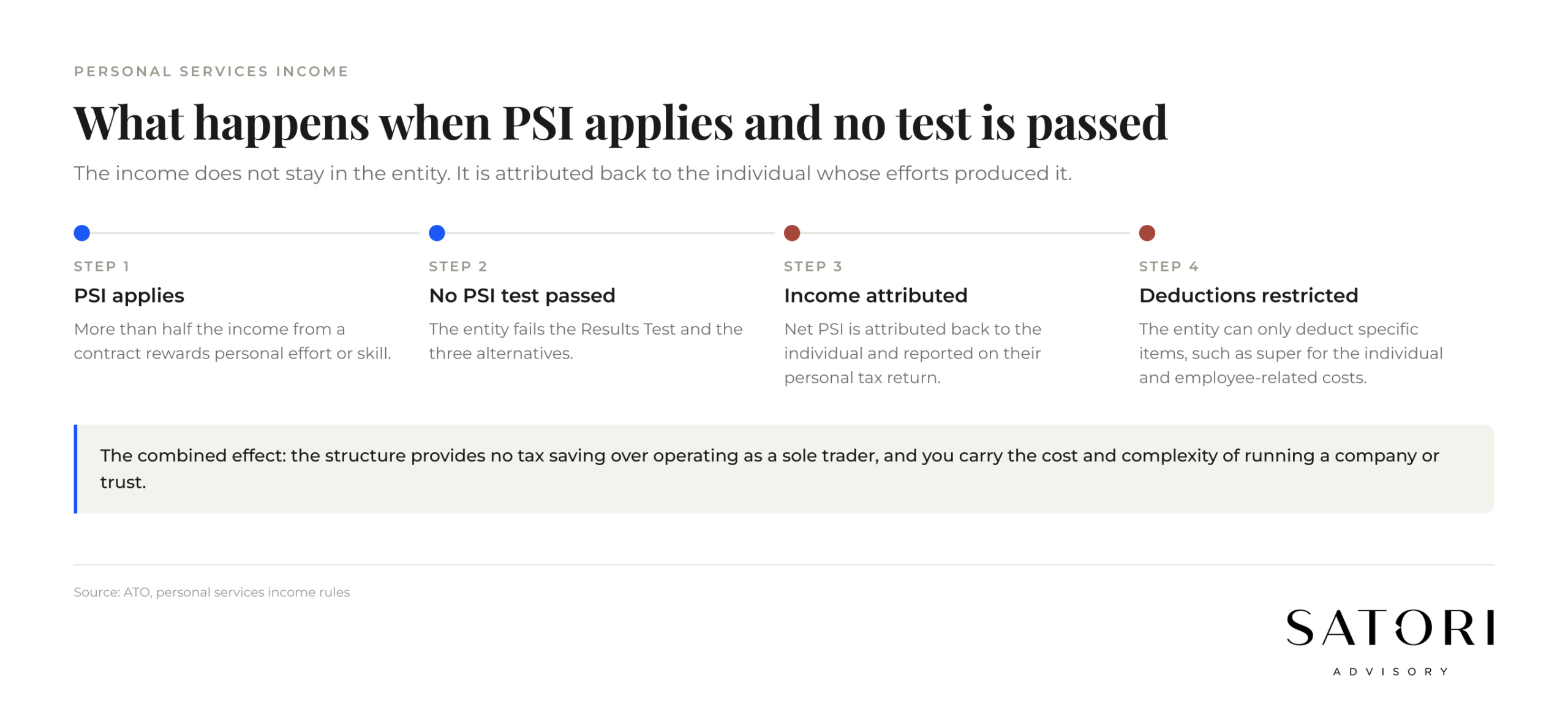
When PSI applies and the entity does not pass one of the PSI tests, two things happen.
Income attribution. The net PSI is attributed back to the individual whose efforts produced it. The individual reports it on their personal tax return at marginal rates.
Restricted deductions. The interposed entity (Pty Ltd or trust) can only deduct specific things: contributions to super for the individual, employee-related expenses if the individual is properly employed, expenses you could deduct in your own name as an employee.
The combined effect: the structure provides no tax saving over operating as a sole trader, and you carry the cost and complexity of running a company or trust for no benefit.
The four PSI tests
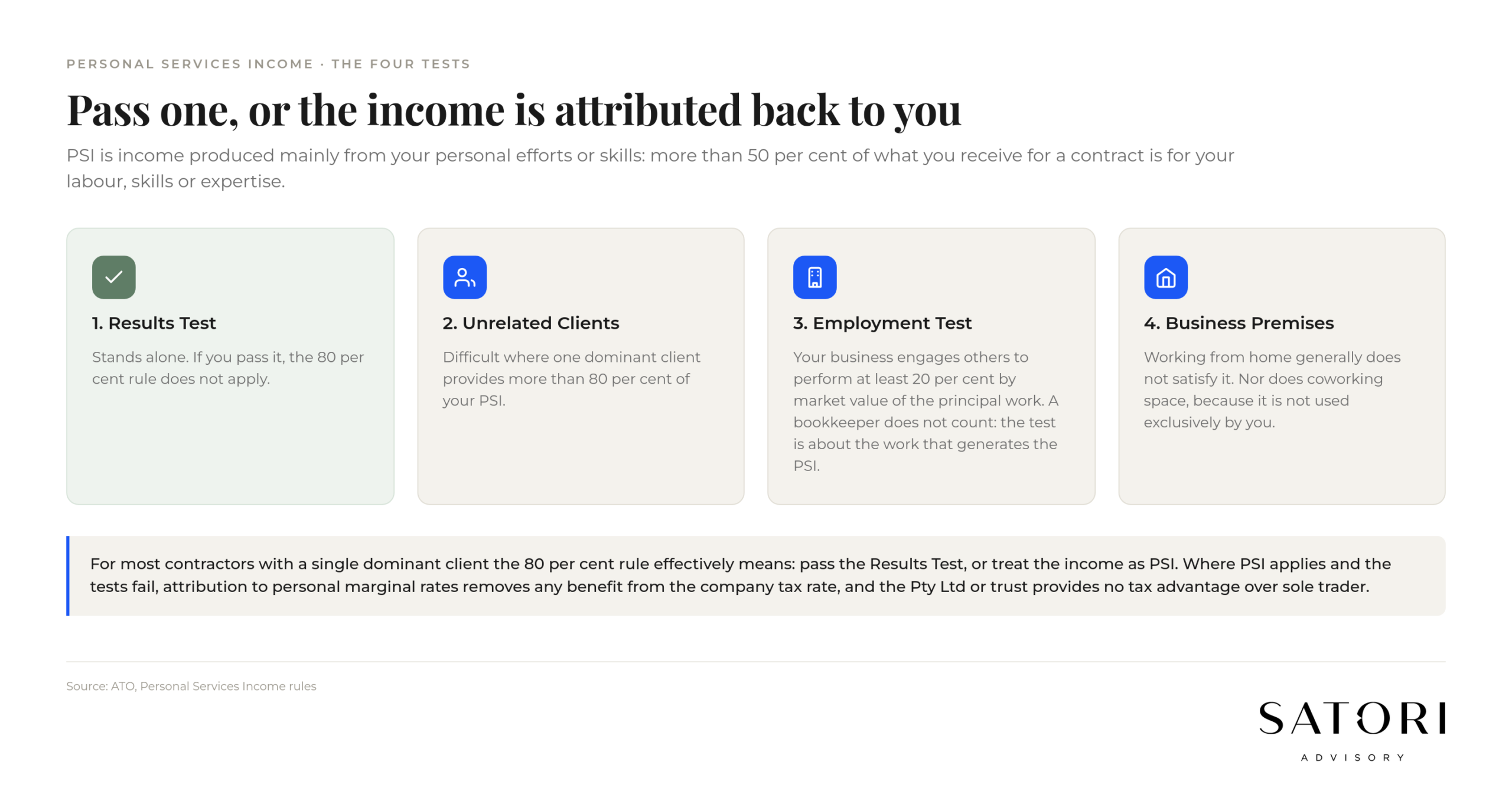
If PSI applies, you need to pass at least one of four tests. The first (Results Test) stands alone. The other three are alternatives if more than 80 per cent of your PSI in the income year comes from one client (the ’80 per cent rule’).
Test 1: Results Test
You pass if all three are true.
You are paid to produce a result (not to provide hours of work).
You provide the tools and equipment to do the work.
You are liable for the cost of fixing defects in the work.
The Results Test stands alone. If you pass it, the 80 per cent rule does not apply.
Most professional services contractors fail the Results Test because they are paid hourly, use the client’s systems, and are not personally liable for defects.
Test 2: Unrelated Clients Test
You pass if you receive PSI from two or more unrelated clients in the income year, and you obtained the work through public offers (advertising, public tender, professional listing).
Word-of-mouth referrals through existing contacts do not count as public offers. The unrelated clients also cannot be associates of each other or of you.
Many contractors have one dominant client and a small secondary engagement. The 80 per cent rule then applies (because more than 80 per cent of PSI comes from one client), and the Unrelated Clients Test is not available.
Test 3: Employment Test
You pass if your business engages other entities (employees or contractors) to perform at least 20 per cent (by market value) of the principal work that generates the PSI.
Apprentices and trainees count for the full year if engaged for at least half of it.
Hiring a bookkeeper or administrative support does not count: the test is about the principal work that generates the PSI.
Test 4: Business Premises Test
You pass if you maintain and use business premises that meet all of the following: physically separate from the client’s premises and from your private residence, used exclusively by you, used to conduct the activities producing PSI, the premises are used for more than half the income year.
Working from home generally does not satisfy this test. Coworking space generally does not satisfy this test (because it is not used exclusively by you).
The 80 per cent rule
If more than 80 per cent of your PSI in the income year comes from a single client (and their associates), you can only rely on the Results Test or apply to the ATO for a Personal Services Business Determination (PSBD).
A PSBD is a written determination from the ATO that you are a Personal Services Business despite failing the standard tests. The application process is detailed and the success rate depends on the substance of your business.
For most contractors with a single dominant client, the 80 per cent rule effectively means: pass the Results Test or treat the income as PSI (attributed back to you at marginal rates).
How the company tax rate interacts
When the PSI rules apply and the entity fails the tests, attribution to personal marginal rates removes any benefit from the company tax rate.
When the PSI rules do not apply (the entity is conducting a Personal Services Business, or the income is not PSI), the company tax rate applies in 2025-26 at:
25 per cent for a base-rate entity (aggregated turnover under $50M and no more than 80 per cent of assessable income being base-rate-entity passive income).
30 per cent for other companies.
The interaction is that some structures (e.g. heavy passive income from licensed IP or asset rental) can push the passive income above 80 per cent, moving the company out of base-rate entity status and into 30 per cent. Worth modelling carefully if the company holds material passive income.
How to actually decide structure
For Australian contractors, three questions.
Does PSI apply to your income? In most professional services contractor situations, yes.
If PSI applies, can you pass one of the four tests? In most contractor situations, no for Results, no for Unrelated Clients (single dominant client), no for Employment (not engaging others to do principal work), no for Business Premises (working from home or client’s site).
Given the answer, what structure makes sense? Sole trader is often the simplest answer when PSI applies and tests fail. The Pty Ltd or trust provides no tax benefit and adds compliance cost.
Counter-examples exist (income above the top marginal threshold where the company rate is still relevant in narrow circumstances, business that is genuinely productising and moving away from labour-based revenue), but most pure contractor situations end up where they started.
How Satori works with contractors
Most of our contractor clients face the PSI question at some point. We work through the four tests with each client’s specific facts, model the structure options against actual numbers, and recommend the structure that produces the best after-tax position with the lowest compliance burden.
Where a structure does add value (genuinely productised revenue, multiple unrelated clients, significant employment of others), we set it up properly. Where it does not, we advise the simpler sole trader path and focus the tax planning on what actually works (concessional super contributions, work-related deductions, salary structures, asset positioning).
What to do next
If you currently trade through a Pty Ltd or trust as a contractor, run the PSI tests against your current year facts.
If you are considering setting up a Pty Ltd or trust, model whether PSI applies and whether you can pass a test, before incurring the setup cost.
If PSI applies and tests fail, talk to your tax adviser about whether the simpler sole trader path is the right move.
How Satori Advisory works
At Satori Advisory we integrate your tax, business, wealth and lending as a prosperity engine, aligned with what matters most to you. With a clear roadmap, informed by data and backed by decades of strategic experience, we simplify the complex. We don’t offer pre-packaged solutions. We deliver tailored, end-to-end advice that reflects your reality and ambitions. You’ll work directly with senior advisers who listen deeply, think boldly and act with purpose. Feel cared for by our trusted team and curated network of financial and business specialists, as we empower you to make smart decisions and realise your potential, powered by numbers.
Frequently asked questions
What is Personal Services Income (PSI) in Australia?
Income produced mainly from your personal efforts or skills. The legal test: more than 50% of the amount you receive for a contract is for your labour, skills, or expertise rather than for the supply or sale of goods, the use of an asset, or a granted right.
Why do PSI rules matter for contractors?
When PSI applies and the entity fails the PSI tests, the income is attributed back to the individual at marginal tax rates (up to 47% with Medicare). The interposed Pty Ltd or trust provides no tax saving. Deductions are also restricted.
What are the four PSI tests?
Results Test (paid for a result, supply your own tools, liable for defects). Unrelated Clients Test (two or more unrelated clients obtained through public offers). Employment Test (others doing 20%+ of principal work). Business Premises Test (separate, exclusive business premises).
What is the 80 per cent PSI rule?
If more than 80% of your PSI in the income year comes from a single client (and associates), you can only rely on the Results Test or apply for a Personal Services Business Determination from the ATO. The Unrelated Clients, Employment, and Business Premises tests are not available.
Does the company tax rate apply if PSI rules attribute my income?
No. When income is attributed back to you personally under the PSI rules, it is taxed at your marginal rate, not the company rate. The Pty Ltd structure provides no benefit.
What is a base-rate entity for company tax?
A company with aggregated turnover under $50 million and no more than 80% of assessable income being passive (interest, dividends, rent, royalties, net capital gains). Base-rate entities pay 25% company tax in 2025-26. Other companies pay 30%.
Should I be a sole trader or set up a Pty Ltd as a contractor?
For most professional services contractors where PSI applies and tests fail, sole trader is simpler and produces the same after-tax outcome. The Pty Ltd adds compliance cost without tax benefit. Counter-examples exist (genuinely productised revenue, multiple unrelated clients, significant employment of others).
Ready to talk?
If you would like a calm, no-pressure conversation about how this applies to your specific situation, we are here to help.
Please feel free to get in touch on 1300 925 081 or send an email to [email protected] if you’d like to book in a chat on the above or on other matters.
Disclaimer
This article contains general information only and has been prepared without considering your objectives, financial situation or needs. It is not personal financial advice, taxation advice or legal advice and should not be relied upon when making financial decisions. Before acting on any information, consider its appropriateness to your circumstances and seek professional advice where appropriate.