
Table of Contents
Lenders Mortgage Insurance is one of the bigger one-off costs in Australian property buying, and it is structurally misunderstood. The ‘insurance’ you pay does not protect you. It protects the lender. You pay it because the lender wants the cover before they will lend you more than 80% of the property’s value.
It can still be a good decision to pay it. The 2026 landscape has changed enough, especially for first home buyers, that the right question is not ‘is LMI worth it?’ but ‘is LMI the cheapest way into the right property for me, or is there a better path?’
What LMI actually is
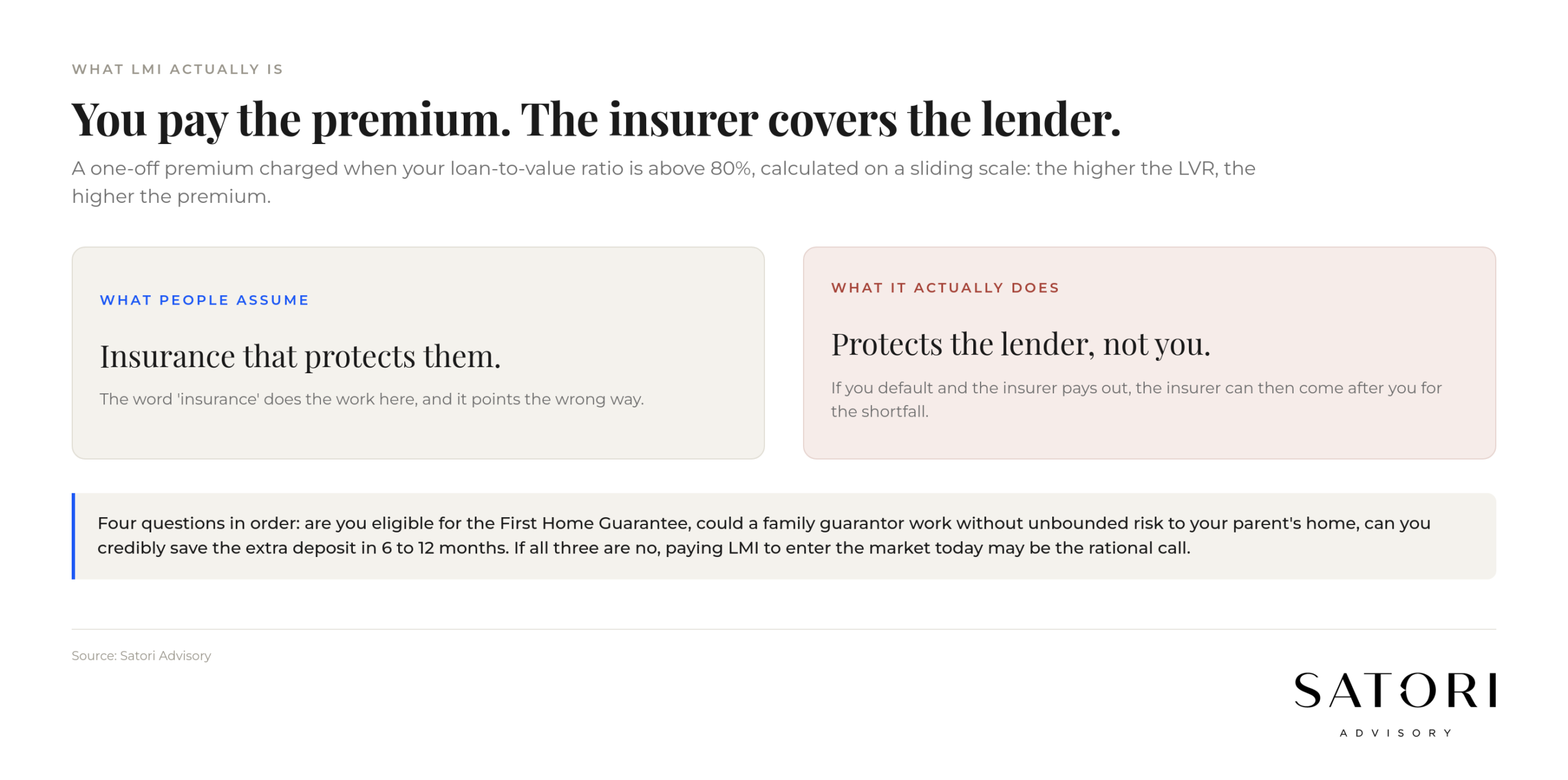
LMI is a one-off insurance premium charged when your loan-to-value ratio (LVR) is above 80%. The premium goes to a mortgage insurer (such as Helia or QBE LMI), which agrees to cover the lender for any shortfall if you default and the eventual sale of the property does not clear the loan balance.
You pay the premium. The insurer covers the lender. If you default and the insurer pays out, the insurer can then come after you for the shortfall. The protection is genuinely one-way.
LMI is calculated on a sliding scale. The higher your LVR, the higher the premium. On a $700,000 purchase with a 10% deposit ($70,000 down, $630,000 loan), LMI commonly lands $18,000 to $25,000. On the same purchase with a 5% deposit, the LMI can be over $40,000.
When LMI is worth paying
Three situations where paying LMI is rationally the right call.
When the property market is rising faster than your savings rate. If you can save $25,000 in a year but the property you want is appreciating $40,000 in the same year, the LMI is the cheaper way to lock in the purchase price.
When you have a clear, time-bound reason to enter the market now (a baby on the way, a school zone, a move-in lease ending, a partner’s job).
When you have already maximised the alternatives. You have explored a family guarantor, you have checked the First Home Guarantee, you have considered a slightly cheaper property in a comparable area. None of those work for your situation.
When LMI is the wrong call
Several situations argue against paying LMI.
When you qualify for the federal First Home Guarantee. From 1 October 2025, the scheme dropped its income caps and place limits and now waives LMI on deposits as low as 5%. For eligible first home buyers, the scheme is structurally cheaper than paying LMI on the same property.
When you can credibly save the additional deposit in 6 to 12 months. The market is unlikely to outrun a focused savings push that fast.
When you have a family member willing and able to act as a limited guarantor. A guarantor pledge of 10 to 20% of the property’s value, secured against their property, can remove the LMI trigger without anyone having to pay upfront.
When the property is in a flat or declining market. LMI plus a falling LVR means you can end up owing more than the property is worth (negative equity).
The First Home Guarantee (5% Deposit Scheme) in 2026
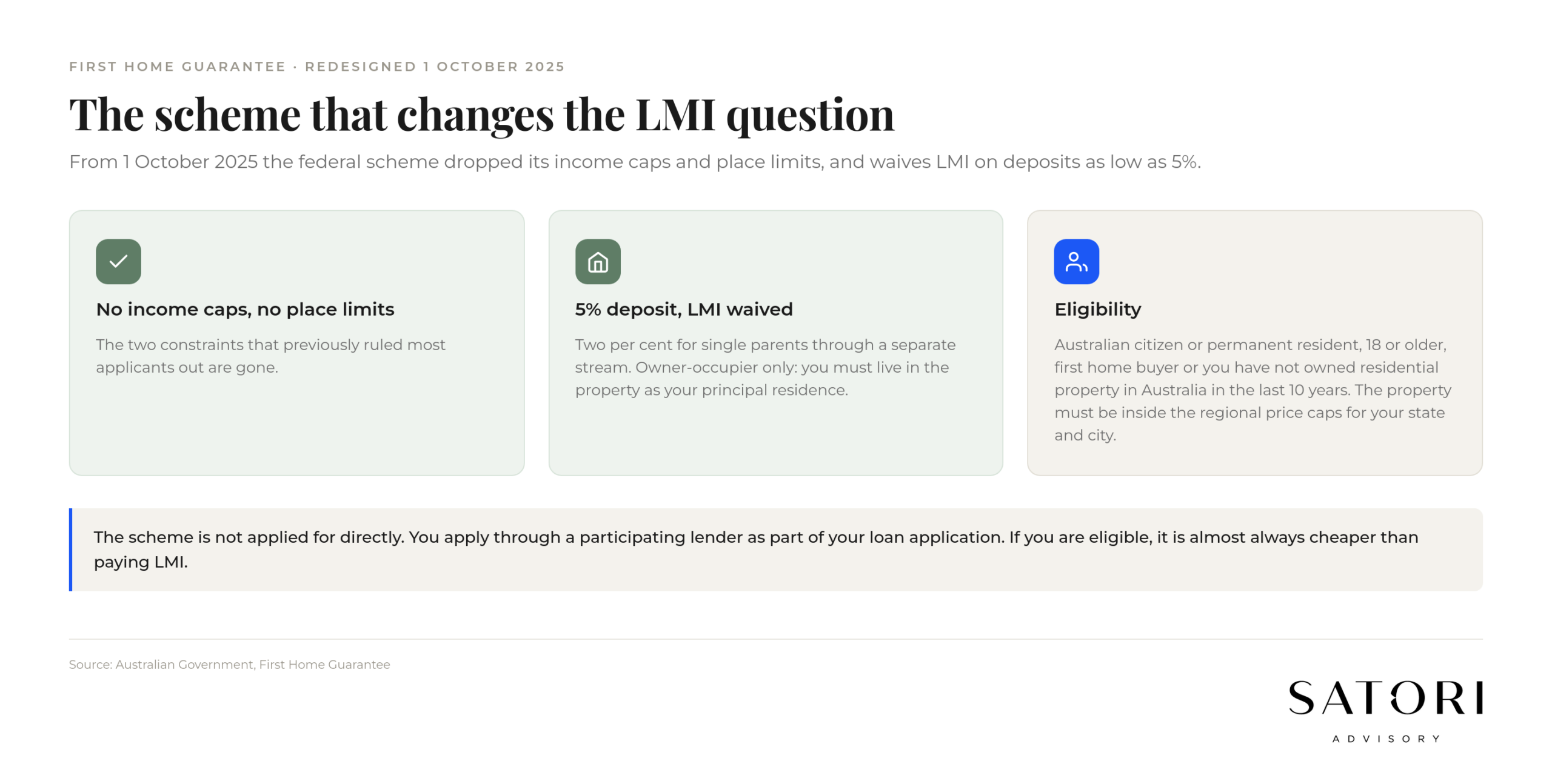
The federal First Home Guarantee was redesigned from 1 October 2025. The key change: no income caps, no place limits, and LMI is waived on deposits as low as 5%.
Eligibility in 2026:
Australian citizen or permanent resident, 18 or older.
First home buyer (or you have not owned residential property in Australia in the last 10 years).
Minimum 5% deposit (2% for single parents through a separate stream).
Owner-occupier (you must live in the property as your principal residence).
Property must be inside the regional price caps for your state and city.
The scheme is not applied for directly. You apply through a participating lender as part of your loan application.
The family guarantor alternative
If you do not qualify for the First Home Guarantee, a family guarantor can remove the LMI trigger another way.
How it works: a family member (usually a parent) pledges a portion of their property as additional security against your loan. The combined security brings your effective LVR under 80% in the lender’s eyes, even though your actual cash deposit is below 20%.
Two important rules for the guarantor.
Prefer a limited guarantee. A guarantor’s exposure should be bounded to a specific dollar amount or percentage of the loan, not unlimited. This caps the worst-case for the parent if you default.
Treat it as a formal arrangement. A loan agreement, not a verbal pledge, including how the guarantor will be released once your LVR drops under 80% from repayments and price growth.
How to actually decide
Four questions, in this order.
Are you eligible for the First Home Guarantee? If yes, the scheme is almost always cheaper than LMI.
Could a family guarantor work, without putting your parent’s home at unbounded risk? If yes, that is usually cheaper than LMI.
Can you credibly save the extra deposit in 6 to 12 months? If yes, hold.
If the answer to all three is no, paying LMI to enter the market today may be the rational call. Run the numbers with a broker before committing.
How Satori Advisory works
At Satori Advisory we integrate your tax, business, wealth and lending as a prosperity engine, aligned with what matters most to you. With a clear roadmap, informed by data and backed by decades of strategic experience, we simplify the complex. We don’t offer pre-packaged solutions. We deliver tailored, end-to-end advice that reflects your reality and ambitions. You’ll work directly with senior advisers who listen deeply, think boldly and act with purpose. Feel cared for by our trusted team and curated network of financial and business specialists, as we empower you to make smart decisions and realise your potential, powered by numbers.
Frequently asked questions
What is Lenders Mortgage Insurance?
An insurance premium charged when you borrow more than 80% of a property’s value in Australia. You pay it. The lender (or its mortgage insurer) is the one protected if you default and the property sale does not cover the loan balance.
How is LMI calculated in Australia?
On a sliding scale based on your loan-to-value ratio (LVR) and loan amount. The higher the LVR, the higher the premium. A 10% deposit ($630,000 loan on a $700,000 property) commonly lands $18,000 to $25,000. A 5% deposit on the same property can be over $40,000.
How can I avoid LMI in Australia?
Three common ways. Save a 20% deposit (LVR 80% or lower). Use the federal First Home Guarantee scheme (5% deposit, no LMI, expanded 1 October 2025). Or use a family guarantor pledging additional security from their own property.
How much is LMI on a 10% deposit?
On a typical $700,000 property with a 10% deposit, LMI commonly lands $18,000 to $25,000 payable upfront. The exact figure depends on the lender, the insurer, and the precise LVR.
What is the First Home Guarantee in 2026?
A federal scheme that waives LMI for eligible first home buyers with a deposit as low as 5%. From 1 October 2025 it has no income caps, no place limits, and is available through participating lenders. Owner-occupier only, 10-year lookback for first home buyer status.
Can I capitalise LMI into the loan?
Most lenders allow you to add LMI to the loan amount instead of paying upfront. The trade-off is you pay interest on the LMI over the life of the loan, which usually adds 30 to 60% to the total cost of the premium.
Does LMI protect me as the borrower?
No. LMI protects the lender. If you default and the insurer pays out the shortfall, the insurer can pursue you for that amount. The premium does not give you any cover.
Ready to talk?
If you would like a calm, no-pressure conversation about how this applies to your specific situation, we are here to help.
Please feel free to get in touch on 1300 925 081 or send an email to [email protected] if you’d like to book in a chat on the above or on other matters.
Disclaimer
This article contains general information only and has been prepared without considering your objectives, financial situation or needs. It is not personal financial advice, taxation advice or legal advice and should not be relied upon when making financial decisions. Before acting on any information, consider its appropriateness to your circumstances and seek professional advice where appropriate.