
Table of Contents
Australia has close to 600,000+ SMSFs holding roughly 30 per cent of the country’s $4 trillion-plus super assets. The flexibility for members is real. The trustee responsibility is also real.
Many SMSF trustees set up the fund with enthusiasm and then quietly let obligations drift over the years. The repercussions of neglect are often hidden until they are not: a contested audit, an ATO query, an underperforming portfolio that compounds the underperformance because nobody looked at it.
Below is a 2026 lens on the four most common neglect patterns and the simple systems to prevent each one.
Pattern 1: drifting from the documented investment strategy
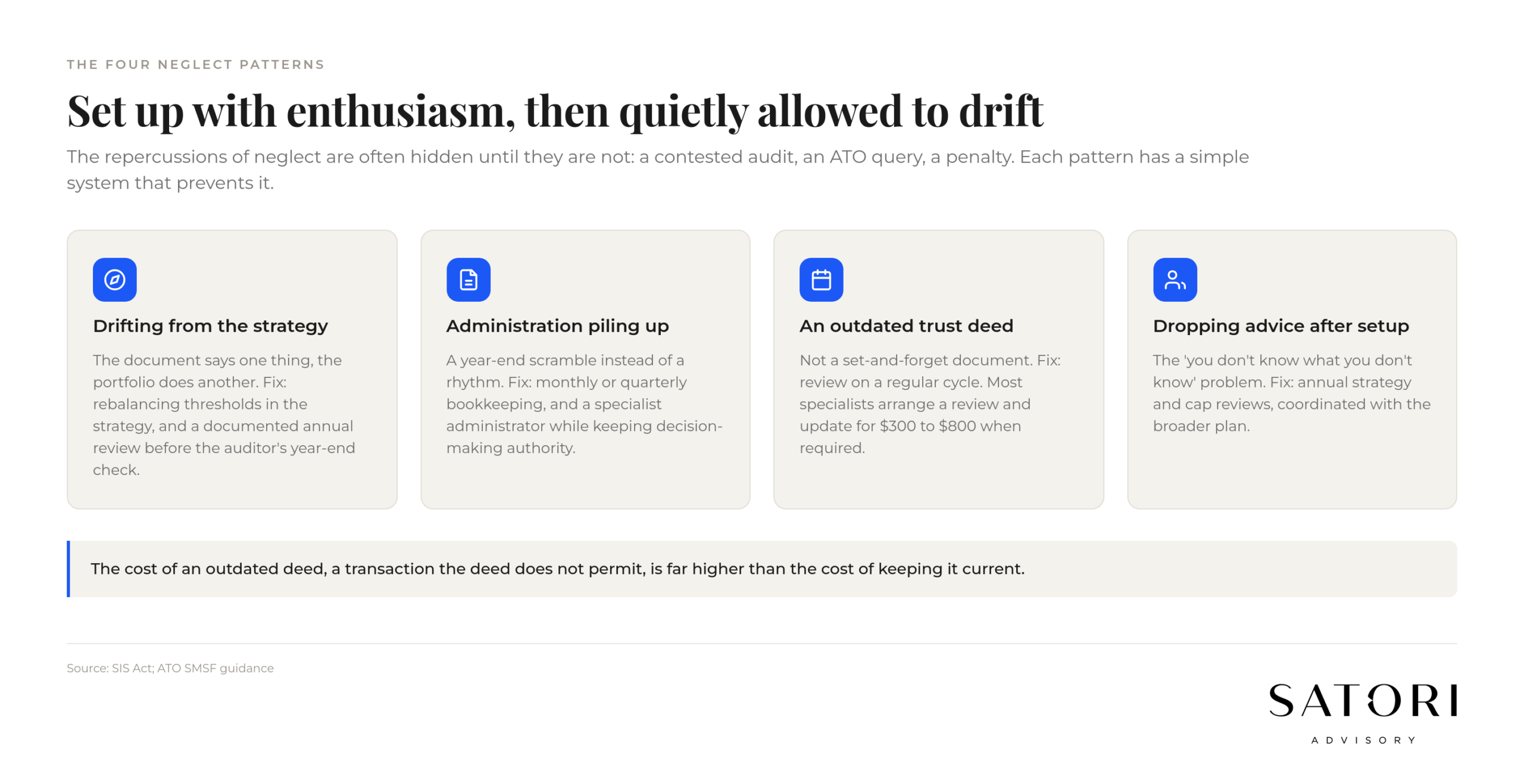
This is the most common neglect pattern. Members take control of the fund’s assets at setup, then show progressively less interest in managing the portfolio as the years roll on.
Three obligations a trustee must meet on the investment strategy.
Have a documented investment strategy. The SIS Act requires it. The strategy must address risk, return, composition (including diversification), liquidity, the fund’s ability to meet liabilities, and insurance.
Review the strategy regularly. Annually is the working standard, before the auditor’s year-end check. The review should be documented through trustee minutes.
Give effect to the strategy. The actual portfolio must reflect what the document says. If the strategy says Australian shares 20-30 per cent and the actual holding is 55 per cent, either rebalance or update the strategy with a documented reason.
Investment strategy disciplines that prevent drift
Three practical disciplines.
Start with the end in mind. Document how much the members need to retire (current spending or estimated retirement budget). The retirement savings goal dictates the decisions leading up to it.
Asset allocation rebalancing. Set rebalancing thresholds in the strategy (e.g. rebalance when any class drifts more than 5 percentage points from target). Action when triggered.
Quarterly cash review. The portfolio should be paying regular income through dividends, distributions, rent, or interest. Cash should be re-invested in accordance with the strategy, not allowed to accumulate as unintended cash drag.
Pattern 2: letting administration pile up
SMSF administration should be straightforward, not a year-end scramble. Three moves keep it that way.
Use technology. Most accountants now use smart SMSF technology that provides clarity, tools, and insights to make the right decisions. The right platform reduces day-to-day admin meaningfully.
Set up a monthly or quarterly bookkeeping rhythm. Capturing transactions, dividends, contributions, and pension payments as they happen beats reconstructing a year of activity at audit time.
Engage an SMSF specialist accountant or administrator. The cost is justified by the time saved and the compliance risk avoided.
Many trustees discover that the best ongoing SMSF experience involves outsourcing the administration to a specialist while retaining decision-making authority. This is not the same as outsourcing the trustee role (which cannot be done).
Pattern 3: outdated trust deed
The SMSF trust deed is not a set-and-forget document. There has been (and will continue to be) a steady stream of legislative changes, tax determinations, rulings, ATO guidance, and court cases that affect how SMSFs can operate.
Examples of recent changes that may require deed updates:
Concessional contribution cap moves (now $32,500 for 2026-27).
Carry-forward concessional contribution rules.
Division 296, in force since 1 July 2026.
Transfer Balance Cap indexation (currently $2.1 million for 2026-27).
Downsizer Contribution age threshold (lowered to 55 in 2023).
Updating a trust deed need not be expensive. Most SMSF specialist accountants can arrange a deed review and update for $300-$800 when required. The cost of an outdated deed (a transaction the deed does not authorise, an investment strategy the deed does not permit) can be much higher.
Pattern 4: dropping professional advice after setup
Many SMSF trustees engage a financial planner or accountant at setup, then drift away from the relationship once the fund is operating.
The ‘you don’t know what you don’t know’ problem is real. SMSF rules, super contribution caps, transfer balance rules, and tax treatment all evolve. The trustee who is not connected to ongoing advice often misses opportunities (carry-forward contributions, pension phase transitions, asset positioning for Division 296) and sometimes drifts into compliance breaches without realising.
Ongoing advice in the SMSF context typically includes:
Annual investment strategy review.
Annual review of contributions across all members against caps.
Coordinating contributions, withdrawals, and pension phase transitions with the broader financial plan.
Updating the strategy and the trust deed as legislation changes.
Reviewing trustee documentation before the annual audit.
The cost is meaningful but the value is usually meaningfully higher.
The penalties when neglect is caught
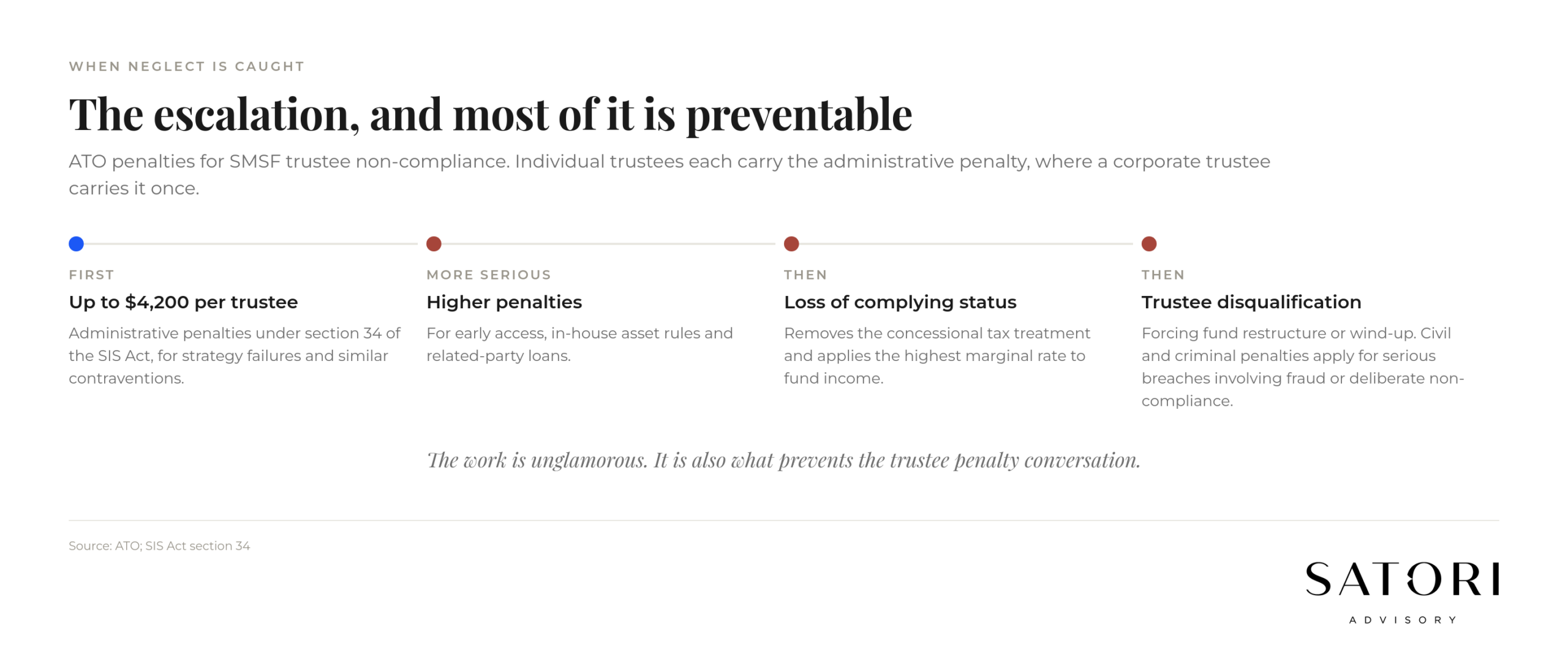
ATO penalties for SMSF trustee non-compliance include:
Administrative penalties under section 34 of the SIS Act, up to $4,200 per trustee, for strategy failures and similar contraventions. Individual trustees each carry the penalty; corporate trustee carries it once.
Higher penalties for more serious contraventions (early access, in-house asset rules, related-party loans).
Loss of complying fund status, which removes the concessional tax treatment and applies the highest marginal rate to fund income.
Disqualification of trustees, forcing fund restructure or wind-up.
Civil and criminal penalties for serious breaches involving fraud or deliberate non-compliance.
Most penalties are preventable with the simple systems above.
How Satori works with SMSF clients on obligations
For our SMSF clients, the trustee obligations are part of the ongoing engagement, not a once-a-year scramble.
Annual investment strategy review timed before the auditor’s year-end check.
Trust deed review on a regular cycle, with update where required.
Documentation of trustee decisions and the reasoning behind them.
Coordination of contributions, withdrawals, pension transitions and Division 296 planning with the broader financial picture.
The work is unglamorous. It is also what prevents the trustee penalty conversation.
What to do next
Pull your SMSF investment strategy. Check the date of the last documented review. If more than 12 months old, schedule a trustee meeting to review it now.
Check when the trust deed was last updated. If more than 3-5 years, consider a review.
If your fund administration is currently a year-end scramble, set up a monthly or quarterly bookkeeping rhythm or engage a specialist administrator.
If you have been operating without ongoing advice, get a one-off check-in to review the current position against current rules.
How Satori Advisory works
At Satori Advisory we integrate your tax, business, wealth and lending as a prosperity engine, aligned with what matters most to you. With a clear roadmap, informed by data and backed by decades of strategic experience, we simplify the complex. We don’t offer pre-packaged solutions. We deliver tailored, end-to-end advice that reflects your reality and ambitions. You’ll work directly with senior advisers who listen deeply, think boldly and act with purpose. Feel cared for by our trusted team and curated network of financial and business specialists, as we empower you to make smart decisions and realise your potential, powered by numbers.
Frequently asked questions
What are the legal obligations of an SMSF trustee in Australia?
Under the SIS Act: formulate, review and give effect to an investment strategy; sole purpose test; arm’s-length transactions; no early access; member benefit rules; annual independent audit; annual ATO return. Plus trust deed compliance and ongoing documentation of trustee decisions.
How often should I review my SMSF investment strategy?
Annually is the working standard, timed before the auditor’s year-end check. The review should be documented through trustee minutes. Update the strategy if the portfolio has drifted or member circumstances have changed.
What happens if I do not review my SMSF investment strategy?
The ATO can impose an administrative penalty of up to $4,200 per trustee under SIS Act section 34. Auditors actively flag strategy failures, and the ATO acts on auditor reports. Beyond the penalty, the trustee is exposed to claims that investment decisions were made without a documented strategy.
Does my SMSF trust deed need regular updating?
Yes. The trust deed is not a set-and-forget document. Legislative changes (concessional caps, contribution rules, TBC, Division 296) regularly require deed updates. Review every 3-5 years or whenever a major legislative change affects the fund.
Can I run my SMSF without an accountant?
Technically yes, but practically no for most trustees. The annual independent audit is mandatory and must be done by an approved SMSF auditor (separate from the trustees). Ongoing compliance, contribution cap tracking, pension phase administration, and Division 296 planning typically need specialist accounting support.
What is the cost of getting SMSF compliance wrong?
Administrative penalties start at $4,200 per trustee. Serious breaches can attract loss of complying fund status (removing concessional tax treatment), trustee disqualification, and civil or criminal penalties. The cost of getting it right (a few thousand dollars per year of professional support) is much smaller than the cost of getting it wrong.
Ready to talk?
If you would like a calm, no-pressure conversation about how this applies to your specific situation, we are here to help.
Please feel free to get in touch on 1300 925 081 or send an email to [email protected] if you’d like to book in a chat on the above or on other matters.
Disclaimer
This article contains general information only and has been prepared without considering your objectives, financial situation or needs. It is not personal financial advice, taxation advice or legal advice and should not be relied upon when making financial decisions. Before acting on any information, consider its appropriateness to your circumstances and seek professional advice where appropriate.