
Table of Contents
A formal pre-approval remains an essential step in purchasing property in Australia in 2026. The lender has run a full assessment of your financial situation and committed to a maximum amount they will lend, subject to the property meeting their criteria when you find it.
The value is in two directions. You and the selling agent both know your real borrowing capacity. And you get a chance to fix anything in your application before it becomes a real obstacle.
What pre-approval actually is
A pre-approval is a conditional commitment from a lender that they will lend you up to a specified amount, subject to verification of the property and to your situation not materially changing before settlement.
It is not the same as a final loan approval. The final approval comes after you find the specific property, the lender values it, and the lender confirms the loan terms against the contract.
But pre-approval gives you the confidence to make an offer with a clear ceiling. It also signals to the agent and vendor that you are a serious buyer who has done the financial work.
Why pre-approval matters more in 2026
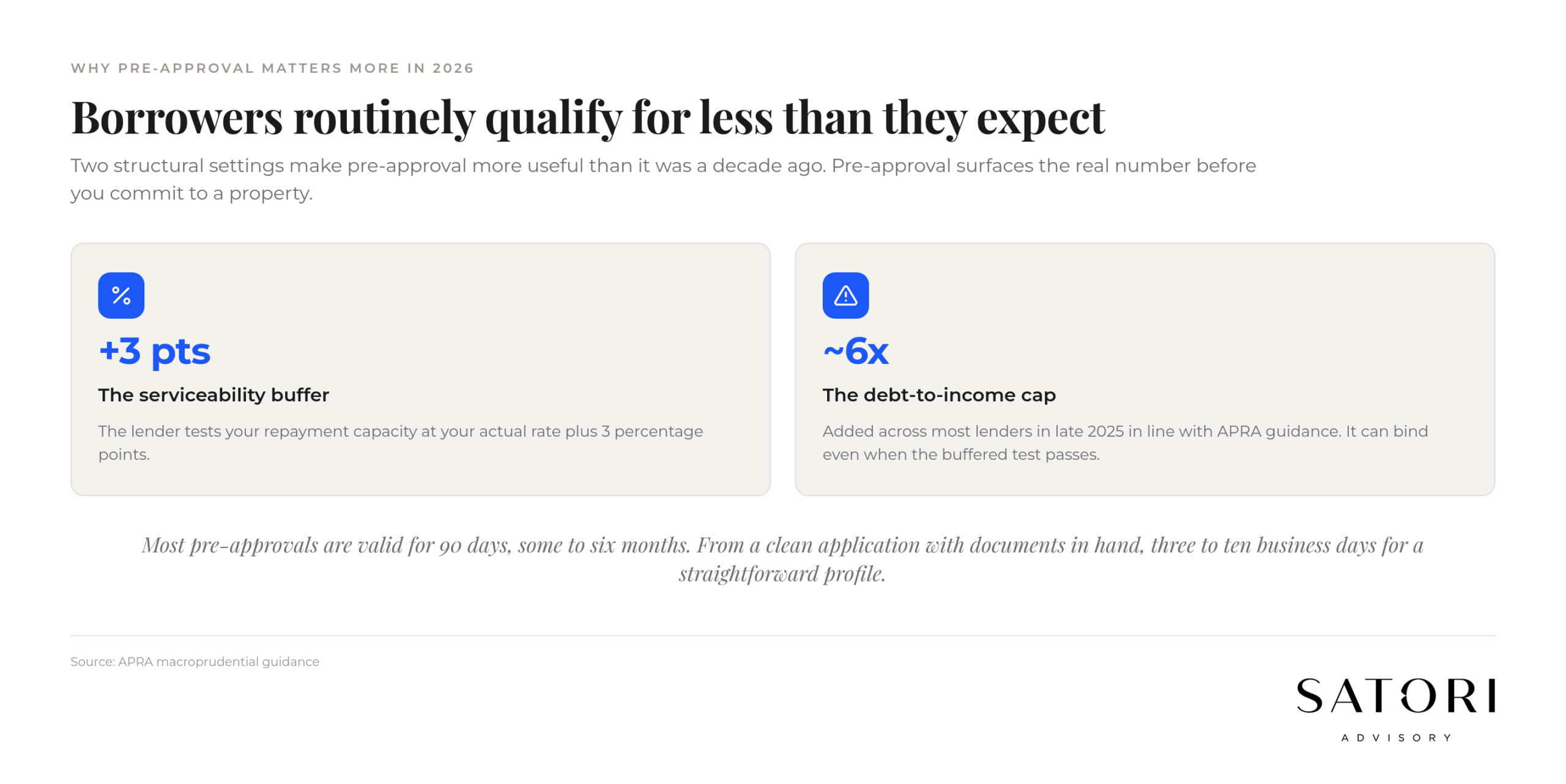
Two structural settings make pre-approval more useful than it was a decade ago.
APRA serviceability buffer of 3 percentage points. The lender tests your repayment capacity at your actual rate plus 3 percentage points. So if your headline rate would be 6.0%, the lender assesses your serviceability at 9.0%. Your real borrowing capacity is meaningfully lower than the headline rate would suggest.
Lender DTI policies commonly sit around 6x gross annual income. APRA also limits banks to no more than 20% of new mortgage lending at a DTI of 6 or more, since 1 February 2026. Applied across most lenders in line with APRA macroprudential guidance, this can bind even when the buffer-adjusted serviceability test passes.
Both settings mean borrowers routinely qualify for less than they expect. Pre-approval surfaces the real number before you commit to a property.
Why pre-approval matters operationally
Beyond knowing the ceiling, pre-approval lets you fix the application BEFORE it matters.
You can identify and close unused credit cards (their limit counts as debt against you).
You can pay down small personal loans or BNPL balances (each reduces your borrowing capacity).
You can adjust discretionary spending visible on bank statements before the lender pulls them (lifestyle expenses are scrutinised closely in 2026).
You can line up guarantor documentation if a family guarantor is in the picture.
You can correct any credit file errors before they affect a real application.
All of these take time. Doing them before you find a property is much easier than scrambling under contract.
How long does pre-approval last in Australia?
Most lenders issue pre-approvals valid for 90 days. Some go to 6 months.
If your pre-approval expires before you find a property, the lender re-runs the assessment. If your circumstances (income, expenses, credit) have not materially changed, the renewal is usually straightforward.
If your circumstances have changed (job change, new debt, change in deposit), the renewed pre-approval may differ.
How long does pre-approval take?
From a clean application with all supporting documents in hand: typically 3 to 10 business days for a straightforward profile, longer for self-employed applicants or applicants with complex income.
The bottleneck is usually documentation gathering, not lender processing time. Have the payslips, statements, ID, and recent tax returns ready before you start.
Pre-approval for investment property buyers
Pre-approval is particularly useful when you are buying an investment property.
It lets you run cashflow scenarios at the buffer rate (your actual rate plus 3%) with a reasonable rental income assumption before you fall in love with a specific property.
If the cashflow at the buffer rate stacks up, the property is a serviceable investment. If it does not, walking away early is a lot cheaper than walking away under contract.
Three things to do before you apply for pre-approval
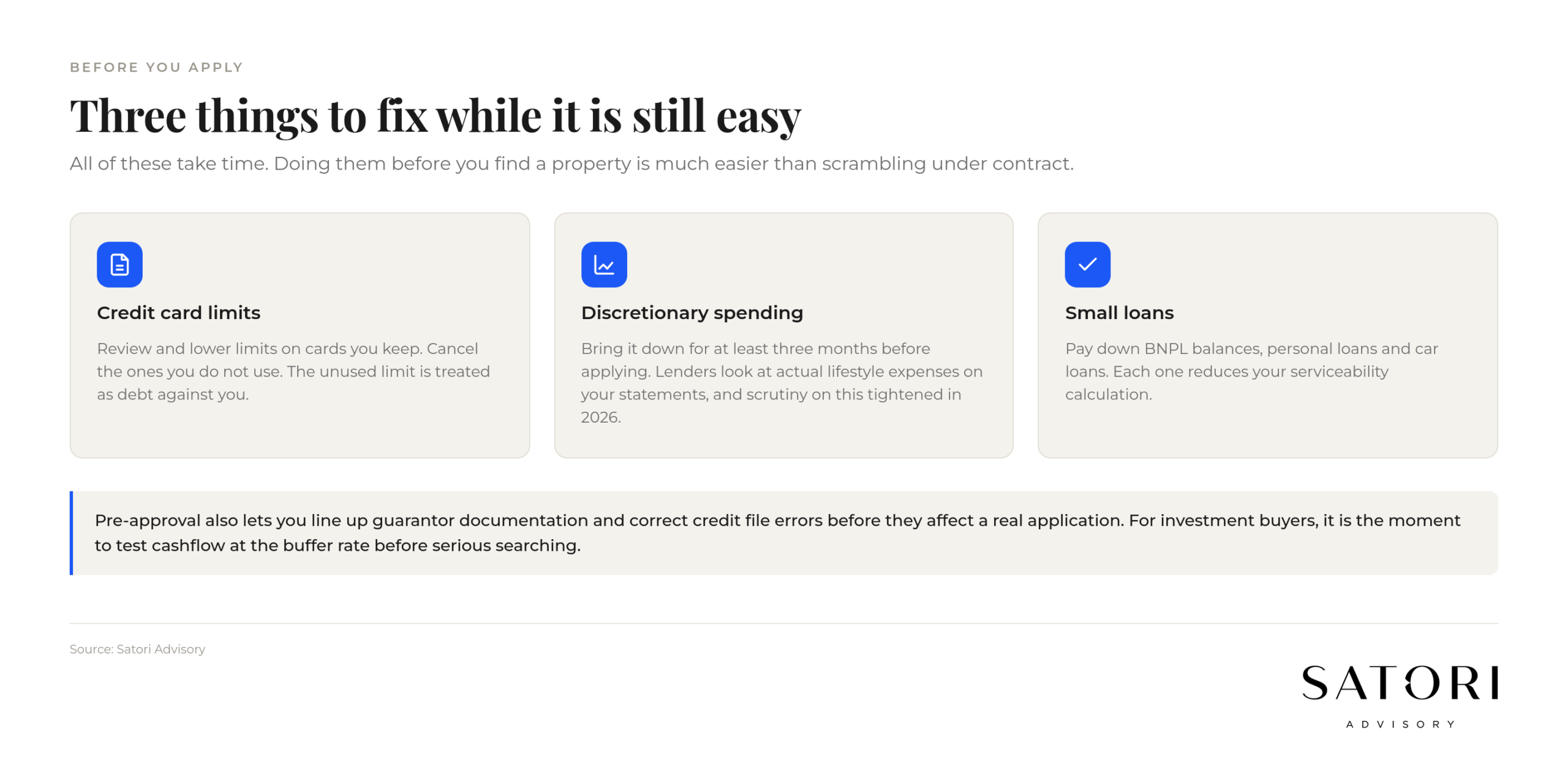
Review and lower credit card limits on cards you keep. Cancel cards you do not use. The unused limit is treated as debt.
Clean up the bank statements that will be reviewed. Bring discretionary spending down for at least three months before applying. Lenders look at actual lifestyle expenses, not your self-declared figure.
Pay down small loans (BNPL, personal loans, car loans). Each loan reduces your serviceability calculation.
How Satori works with buyers on pre-approval
Through our lending team, we coordinate pre-approval as part of the integrated planning conversation. We do not just chase a number from one lender. We look at which lender’s policy best fits your income profile, your deposit structure, and your broader financial plan.
For first-time investors, the pre-approval conversation is the moment to set the strategy: which structure, which type of property, what cashflow profile, what timeline. We would rather get that right before the property contract than after.
What to do next
If you are 6 months or less from house hunting, get pre-approved now. The lead time on the personal preparation alone is worth the early start.
If you have an existing pre-approval that is more than 60 days old, check the remaining validity and whether you should renew.
If you are considering an investment property, use the pre-approval process to test cashflow at the buffer rate before serious property searching.
How Satori Advisory works
At Satori Advisory we integrate your tax, business, wealth and lending as a prosperity engine, aligned with what matters most to you. With a clear roadmap, informed by data and backed by decades of strategic experience, we simplify the complex. We don’t offer pre-packaged solutions. We deliver tailored, end-to-end advice that reflects your reality and ambitions. You’ll work directly with senior advisers who listen deeply, think boldly and act with purpose. Feel cared for by our trusted team and curated network of financial and business specialists, as we empower you to make smart decisions and realise your potential, powered by numbers.
Frequently asked questions
How long does home loan pre-approval last in Australia?
Most lenders’ pre-approvals are valid for 90 days. Some lenders extend to 6 months. If your pre-approval expires, the lender will re-run the assessment, which is usually straightforward if your circumstances have not materially changed.
How long does it take to get pre-approval for a home loan?
From a clean application with all supporting documents in hand, typically 3 to 10 business days for a straightforward profile. Self-employed applicants and applicants with complex income profiles can take longer. Gathering documentation is usually the bottleneck.
Is pre-approval a guarantee of the loan?
No. Pre-approval is conditional. The final approval comes after you find the property, the lender values it, and the lender confirms the loan terms against the contract. Pre-approval is the lender’s commitment subject to those conditions and to your circumstances not materially changing.
What is the APRA serviceability buffer in 2026?
3 percentage points. Lenders test your repayment capacity at your actual rate plus 3 percentage points. So if your rate would be 6.0%, the lender assesses you at 9.0%. The buffer has been at this level since late 2021.
How can I improve my chances of getting pre-approved?
Three moves: lower or cancel credit card limits you do not need, reduce discretionary spending visible on bank statements for at least three months before applying, and pay down small loans (BNPL, personal loans, car loans).
Does pre-approval affect my credit score?
Yes. Each pre-approval enquiry leaves a credit footprint. Multiple pre-approvals from different lenders in a short period can flag to subsequent lenders and may slightly affect the score. Stick to one or two carefully chosen lenders rather than scattergun applications.
Ready to talk?
If you would like a calm, no-pressure conversation about how this applies to your specific situation, we are here to help.
Please feel free to get in touch on 1300 925 081 or send an email to [email protected] if you’d like to book in a chat on the above or on other matters.
Disclaimer
This article contains general information only and has been prepared without considering your objectives, financial situation or needs. It is not personal financial advice, taxation advice or legal advice and should not be relied upon when making financial decisions. Before acting on any information, consider its appropriateness to your circumstances and seek professional advice where appropriate.