
Table of Contents
Fixed or variable. The one decision that causes more borrower stress than any other.
You spend months analysing the current market, then you have to make a choice based on the future market. With multiple variables in play and economic factors out of your control, even the experts get this wrong regularly.
Below is a 2026 lens on how to think about it, what the RBA picture looks like as of May 2026, and the split loan option that gives you both.
The 2026 RBA picture
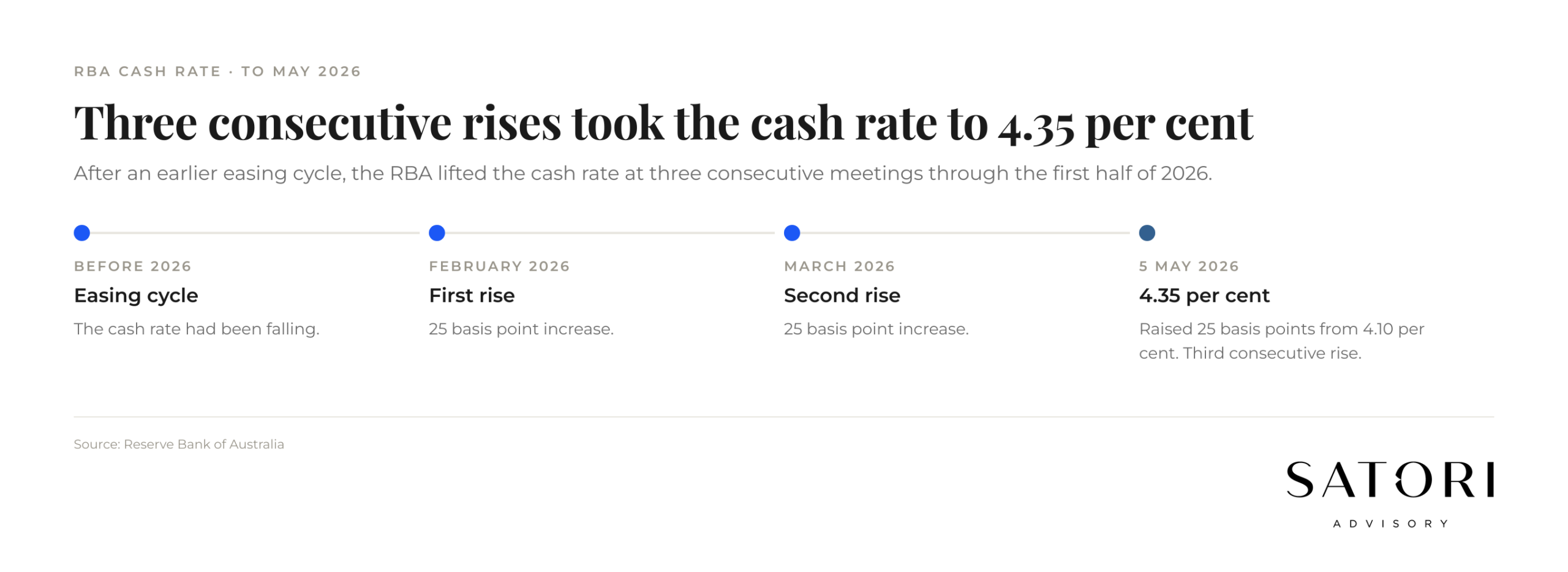
As of May 2026, the RBA cash rate sits at 4.35 per cent, raised 25 basis points from 4.10 per cent on 5 May 2026.
The May 2026 move was the third consecutive rate rise (February, March, May), after an earlier easing cycle.
Fixed rate searches surged more than 250 per cent in early 2026 as borrowers weighed certainty against flexibility, according to CommBank research. The conversation is live.
What this means for borrowers: the rate environment is uncertain enough that the fix-vs-variable decision is now a real one rather than a formality. The right answer depends on your situation rather than a market prediction.
When to fix
Fixing makes sense in three scenarios.
Certainty matters more than flexibility. The first two years of a new home loan are often the hardest financially. Fixing for that period gives you a known repayment to budget against, which can be valuable for cashflow discipline.
Single-income or tight-budget households where a rate rise would create real stress. The cost of certainty is a small premium over variable; the value of avoiding a $300+ per month rate-rise surprise is real.
When you believe (and are willing to bet) that rates will rise meaningfully during the fixed period. The higher rates rise after you fix, the more you save.
What you give up: flexibility on extra repayments (most fixed loans cap or prohibit them), offset account access (most fixed loans do not have offset), and break costs if you want to exit early.
When to stay variable
Variable suits three scenarios.
You want offset account access. The offset is one of the most useful features of an Australian variable home loan, and it is rarely available on fixed loans.
You want to make extra repayments without limits or fees. Variable loans allow unlimited extra repayments; fixed loans cap them.
You believe (and are willing to bet) that rates will fall during the period. The lower rates fall after you choose variable, the more you save vs the equivalent fixed.
What you give up: certainty. Each RBA decision affects your repayment immediately or within a month or two.
The split loan: have both
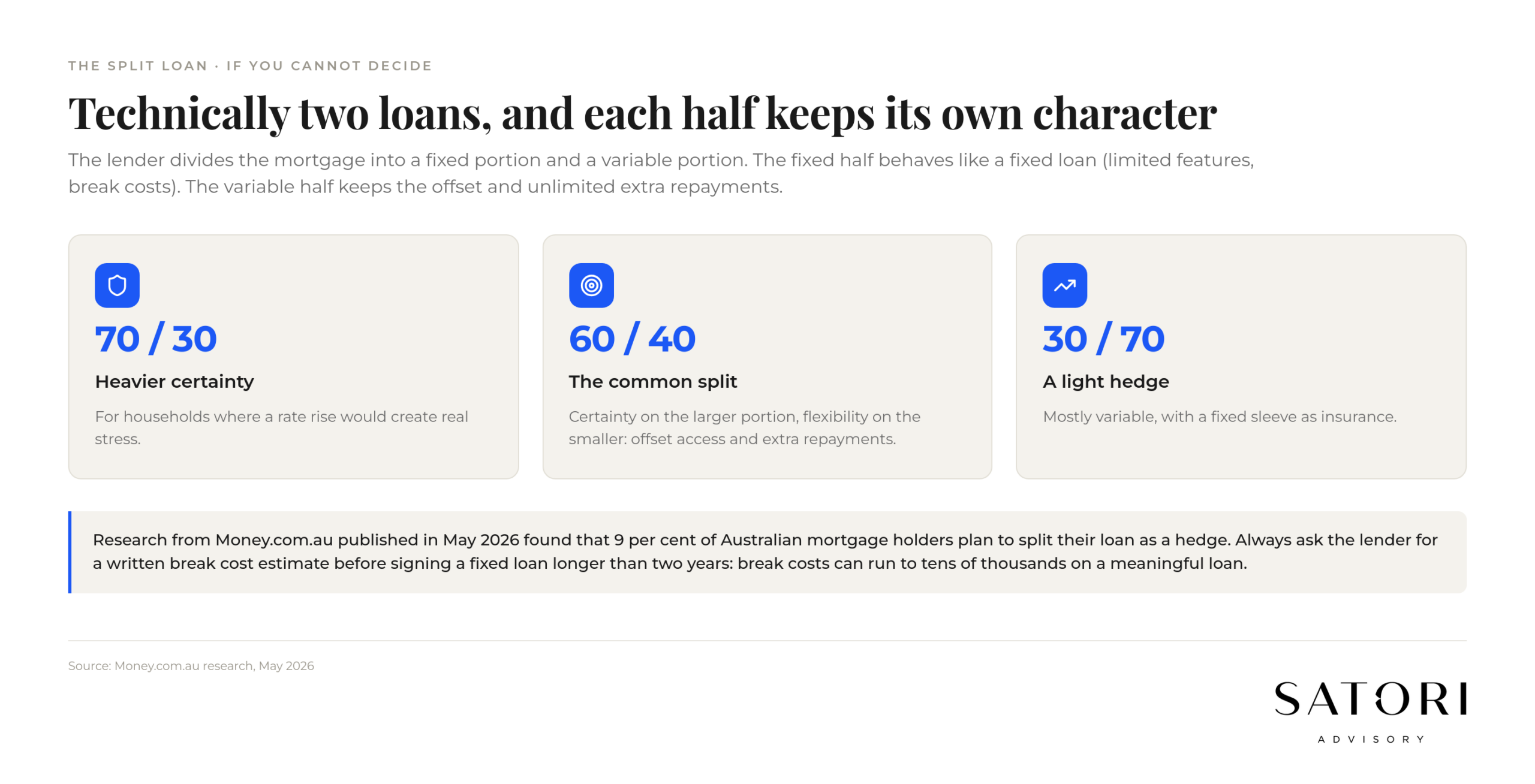
If you cannot decide, a split loan gives you both. The lender divides your mortgage into two portions: one fixed, one variable. Most lenders allow at least a 2-way split, with the proportions customisable.
Common split structures:
60% fixed, 40% variable. Certainty on the larger portion; flexibility (offset, extra repayments) on the smaller portion.
70% fixed, 30% variable. Heavier certainty.
30% fixed, 70% variable. Light certainty hedge.
Technically you are taking out two loans. The fixed portion behaves like a fixed loan (limited features, break costs). The variable portion behaves like a variable loan (offset, extra repayments).
Research from Money.com.au published in May 2026 found that 9 per cent of Australian mortgage holders plan to split their loan as a hedge.
Break costs on a fixed loan
If you exit a fixed loan before the term ends (e.g. by refinancing or selling), the lender charges break costs.
Break costs reflect the lender’s economic loss from the early termination. The bigger the gap between your fixed rate and current market rates (in the wrong direction), and the longer remaining on your fix, the bigger the break cost.
Break costs can be tens of thousands of dollars on a meaningful loan with several years remaining at a meaningfully different rate. Always get a written break cost estimate before deciding to refinance during a fixed period.
A worked example for thinking about the decision
Consider a $600,000 mortgage with 25 years remaining.
Variable rate today: 6.00%. Monthly repayment approximately $3,866.
Fixed rate (3-year) today: 5.75%. Monthly repayment approximately $3,770.
The fixed rate is slightly lower in this example, which is common when the market expects further rate moves up. Over the 3-year fixed period, the saving vs variable at today’s rate is roughly $3,500.
If variable rises 0.50% over the period (average), the cumulative saving of being fixed grows to roughly $7,000 to $10,000.
If variable falls 0.50% over the period (average), being variable would have been roughly $5,000 to $8,000 better off.
The decision is not principally a math problem. It is principally a question of whether the certainty premium (or the flexibility value) matches your specific situation.
A complicated decision: take professional advice
A mortgage broker who works with multiple lenders sees the spread of fixed and variable rates across the market, has visibility into the lender-specific policies, and can model your situation against the choice.
We strongly recommend taking professional advice before signing a new fixed loan, especially if it is for longer than 2 years. The decision is not just about today’s rate; it is about the next 2-5 years minimum.
How Satori thinks about fixed vs variable
For our lending clients, the fix-vs-variable decision is part of the broader plan: cashflow tolerance, financial buffers, time in the home, planned changes in income, and the loan’s role in any wider tax or wealth strategy.
We do not have a default answer that applies to every client. The answer that fits your plan today may not be the answer that fits your neighbour’s. The discipline is to make the decision deliberately and revisit it before the fixed term expires.
What to do next
Confirm your real monthly repayment cushion. How much rate movement (in either direction) would you absorb without changing lifestyle?
Get current fixed and variable rate quotes from your existing lender and at least one other lender.
If you are leaning toward fixed, ask the lender for a written break cost estimate so you know the exit cost.
If you cannot decide, model a 60/40 or 70/30 split loan with your broker.
How Satori Advisory works
At Satori Advisory we integrate your tax, business, wealth and lending as a prosperity engine, aligned with what matters most to you. With a clear roadmap, informed by data and backed by decades of strategic experience, we simplify the complex. We don’t offer pre-packaged solutions. We deliver tailored, end-to-end advice that reflects your reality and ambitions. You’ll work directly with senior advisers who listen deeply, think boldly and act with purpose. Feel cared for by our trusted team and curated network of financial and business specialists, as we empower you to make smart decisions and realise your potential, powered by numbers.
Frequently asked questions
Should I fix my home loan in 2026?
It depends on your situation. Fix when certainty of repayment matters more than flexibility (early years of a loan, single income, tight budget). Stay variable when you want offset access, full flexibility on extra repayments, and the ability to benefit from future rate cuts. A split loan gives you both.
What is the RBA cash rate in 2026?
4.35 per cent as of May 2026, raised 25 basis points from 4.10 per cent on 5 May 2026. The May 2026 move was the third consecutive rise (February, March, May).
What is a split home loan?
A loan structure where the lender divides your mortgage into two portions, one fixed and one variable. The fixed portion gives you certainty; the variable portion gives you offset access and flexibility. Common splits are 60/40 fixed/variable or 70/30.
What are break costs on a fixed home loan?
Fees charged by the lender if you exit a fixed loan before the term ends. They reflect the lender’s economic loss from early termination and can be tens of thousands of dollars on a meaningful loan with several years remaining. Always get a written break cost estimate before refinancing during a fixed period.
Can I make extra repayments on a fixed loan?
Usually only limited extra repayments are allowed on a fixed loan, often capped at a few thousand dollars per year. Variable loans allow unlimited extra repayments. This is one of the main reasons borrowers who want to pay down the loan aggressively choose variable or a split with a meaningful variable portion.
Does a fixed loan have an offset account?
Rarely. Most fixed loans do not offer offset, or offer it only on a partial basis. Variable loans almost always include offset. This is one of the main reasons to keep at least a portion of the loan variable in a split structure.
How many Australians are fixing in 2026?
According to Money.com.au research published May 2026, 56 per cent of Australian mortgage holders intend to stay on variable and ride further volatility, while 9 per cent plan to split their loan as a hedge. Fixed rate searches surged more than 250 per cent in early 2026 as borrowers weighed certainty against flexibility.
Ready to talk?
If you would like a calm, no-pressure conversation about how this applies to your specific situation, we are here to help.
Please feel free to get in touch on 1300 925 081 or send an email to [email protected] if you’d like to book in a chat on the above or on other matters.
Disclaimer
This article contains general information only and has been prepared without considering your objectives, financial situation or needs. It is not personal financial advice, taxation advice or legal advice and should not be relied upon when making financial decisions. Before acting on any information, consider its appropriateness to your circumstances and seek professional advice where appropriate.