
Table of Contents
The ATO does not actually have inspectors looking through every return. The screen is automated. Data from banks, employers, super funds, share registries, crypto exchanges, sharing-economy platforms, state revenue offices, and other government agencies gets matched against your return. Where the numbers do not match, your return surfaces for review.
Most of the audit risk Australians face in 2026 comes from a small set of recurring patterns. Below is what the ATO is actively watching, and what to do about it.
Hot spot 1: Work-related deductions
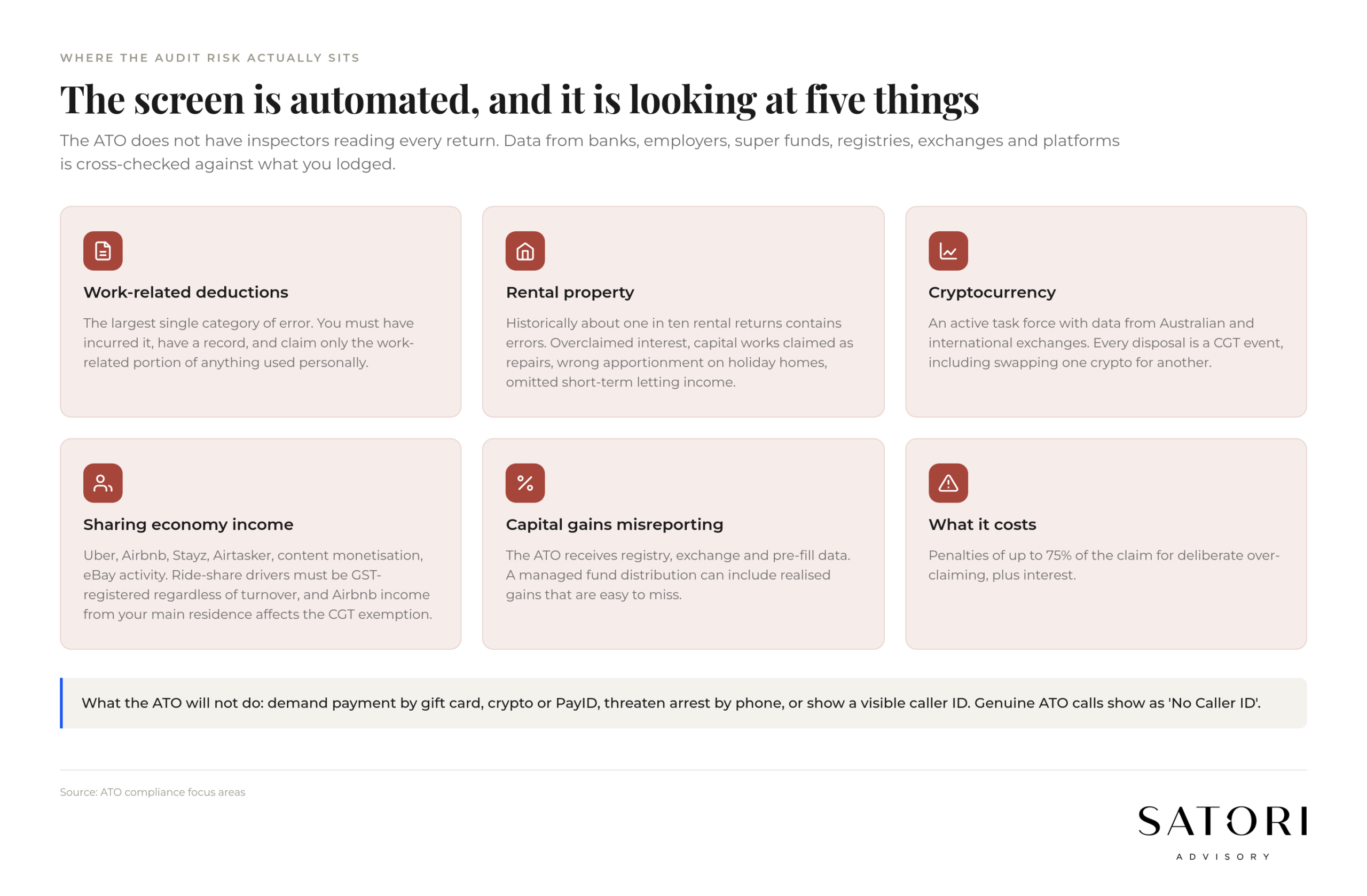
Work-related deductions are the largest single category of error the ATO sees. The rules are not complicated, but the application is where most claims drift.
Three requirements for any work-related deduction.
You incurred the expense yourself and were not reimbursed by your employer or business.
You have a record proving you incurred the expense (most claims).
The expense is directly related to how you earn your income.
Most importantly, you only claim the work-related portion of items used personally (mobile phone, internet, computer). Claiming 100% of a personal phone bill because you check email on it is the classic ATO red flag.
Working from home
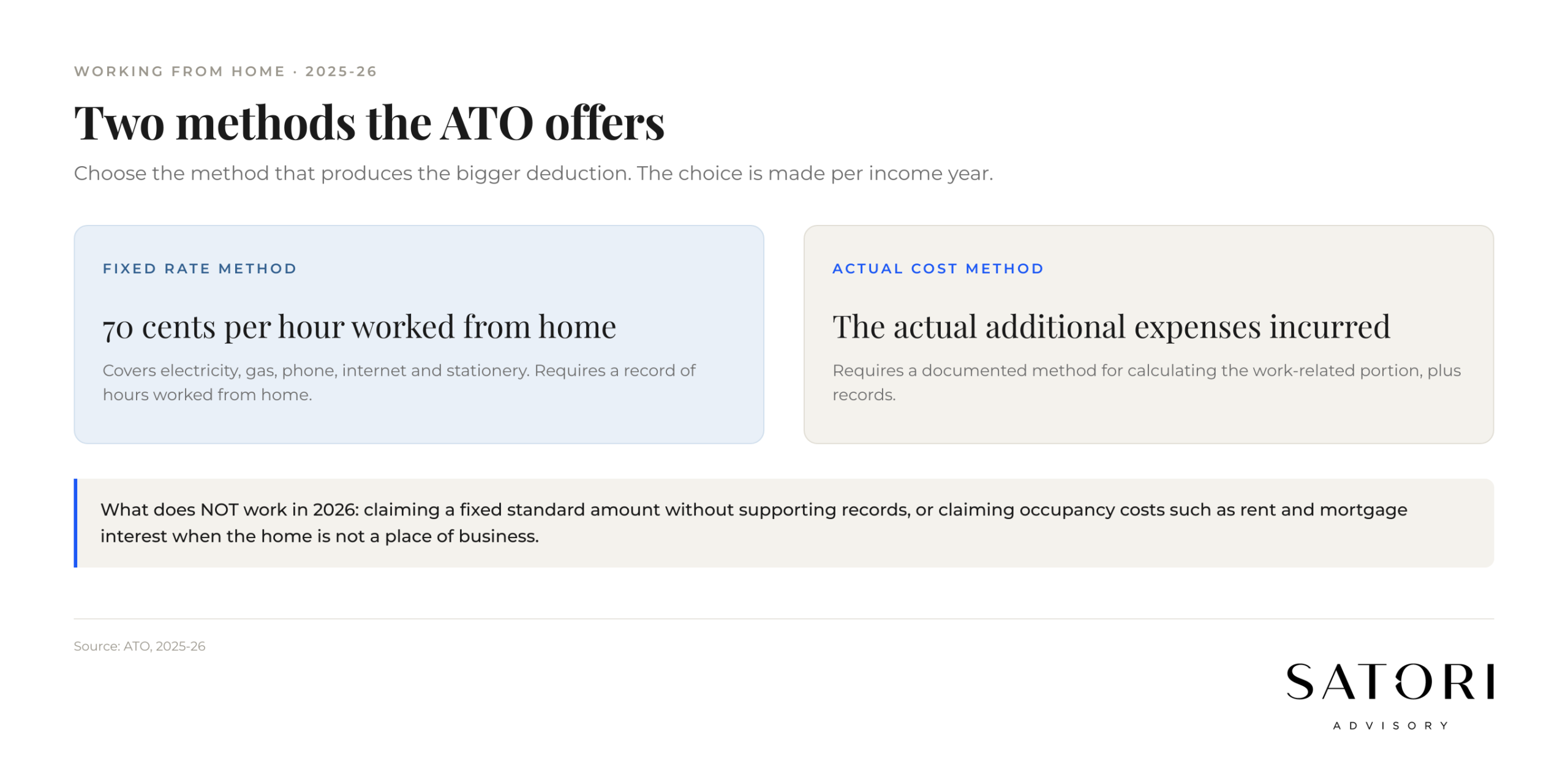
For 2025-26 the ATO offers two methods.
Fixed rate method: 70 cents per hour worked from home. Covers electricity, gas, phone, internet, and stationery. Requires a record of hours worked from home (timesheet, diary, time-tracking app).
Actual cost method: claim the actual additional expenses incurred from working at home. Requires a documented method for calculating the work-related portion, and receipts for each expense.
Choose the method that produces the bigger deduction. The choice is made per income year.
What does NOT work in 2026: claiming a fixed ‘standard’ WFH amount without supporting records, or claiming occupancy costs (rent, mortgage interest) when the home is not your principal place of business.
Work clothing
Generally not deductible. Exceptions: occupation-specific clothing (chef’s whites, hi-vis), uniforms with a clearly marked employer logo, or protective gear required by workplace hazards (steel-cap boots).
A suit you wear to the office is not deductible even if your employer requires you to wear one.
Below $150 of claimed laundry expense you do not need receipts, but the ATO can still ask how you calculated the figure.
Hot spot 2: Rental property deductions
Historically about one in ten rental property returns contains errors, and the ATO conducts thousands of focused rental audits each year.
Common errors in 2026:
Overclaimed interest (especially where the loan partly funds a private purpose).
Capital works claimed as repairs (replacing a damaged fence is a repair; building a new fence is capital).
Incorrect apportionment for holiday homes that are sometimes let.
Omitted income from short-term accommodation sharing.
Two rules tightened in earlier reforms: travel to inspect a residential rental property is no longer deductible for most landlords, and second-hand plant and equipment can no longer be depreciated when you buy a previously rented residential property.
Hot spot 3: Cryptocurrency
The ATO maintains an active crypto task force and receives data from Australian and international exchanges under data-matching arrangements.
Each crypto disposal is a CGT event for investors: selling crypto for AUD, swapping one crypto for another, spending crypto on goods or services, gifting crypto.
The 50% CGT discount applies for individuals, trusts and partnerships holding more than 12 months in 2025-26. From 1 July 2027 the discount is replaced under the reforms announced in the 2026 Federal Budget.
Records must be kept for five years from each transaction. Most Australian crypto investors use a tracking tool (Koinly, Crypto Tax Calculator, CoinTracker) that integrates with exchanges.
Hot spot 4: Sharing economy income
Income from Uber, Airbnb, Stayz, Airtasker, OnlyFans, content monetisation, eBay business activity, and other sharing-economy platforms must be declared.
Two specific rules worth knowing.
Uber and other ride-share drivers must be registered for GST regardless of turnover.
Airbnb income from your main residence affects your CGT main residence exemption when you eventually sell.
ATO data-matching with these platforms is now mature. Underreporting is high-risk.
Hot spot 5: Capital gains misreporting
The ATO receives share registry data, crypto exchange data, and ATO pre-fill data on most disposals. Disposals reported on your return are cross-checked against that data.
Common errors: forgetting that a managed fund distribution can include realised capital gains; misreporting the cost base on long-held shares; failing to apply the 50% discount where eligible; or applying the discount when you should not (e.g. trading activity classified as ordinary income).
Where you have large capital gains or losses in a year, double-check the calculation before lodging. The ATO scrutinises large numbers more closely.
What the ATO will and will not do
The ATO will:
Receive automated data from banks, employers, super funds, share registries, crypto exchanges, government agencies, and sharing-economy platforms.
Cross-check your return against that data.
Issue queries (and sometimes amended assessments) for returns where the data does not match.
Apply penalties of up to 75% of the claim for deliberate over-claiming, plus interest.
The ATO will NOT:
Demand payment by gift card, cryptocurrency, or PayID to an unknown number.
Threaten you with arrest by phone (see our piece on ATO scams: those calls are scams, not the ATO).
Show a visible caller ID on a phone call. Genuine ATO calls show as ‘No Caller ID’ in 2026.
How to stay on the right side of the line
Claim only what you can substantiate. The substantiation needs to exist at the time you lodge, not after the ATO asks.
Declare every income source. Sharing economy, crypto, freelance work, monetised content, side businesses.
Apportion personal-use items correctly. Phones, internet, vehicles. Methodology must be documented.
Get specialised advice for material crypto, rental property, or capital gains activity.
Lodge through a tax agent if your situation has complexity. The cost is deductible the following year.
How Satori Advisory works
At Satori Advisory we integrate your tax, business, wealth and lending as a prosperity engine, aligned with what matters most to you. With a clear roadmap, informed by data and backed by decades of strategic experience, we simplify the complex. We don’t offer pre-packaged solutions. We deliver tailored, end-to-end advice that reflects your reality and ambitions. You’ll work directly with senior advisers who listen deeply, think boldly and act with purpose. Feel cared for by our trusted team and curated network of financial and business specialists, as we empower you to make smart decisions and realise your potential, powered by numbers.
Frequently asked questions
What triggers an ATO audit in Australia?
The ATO does not target individuals for audit randomly. They use data-matching to flag returns where reported numbers do not match data received from banks, employers, super funds, share registries, crypto exchanges, sharing-economy platforms, and government agencies. Common triggers: large or unusual deductions, missing income from data sources, repeated rental property losses, large unexplained capital gains or losses.
What is the work from home fixed rate for 2025-26?
70 cents per hour worked from home. Covers electricity, gas, phone, internet, and stationery in a single rate. You can still claim depreciation on assets like computers and office furniture separately. The alternative is the actual cost method.
Can I claim my work suit on tax in Australia?
No. Conventional work clothing (suits, dresses, business attire) is not deductible even if your employer requires you to wear one. Exceptions are occupation-specific clothing (chef’s whites, hi-vis), uniforms with a clear employer logo, and protective gear.
Do I have to declare Airbnb income on my tax return?
Yes. All income from short-term accommodation sharing (Airbnb, Stayz, etc.) must be declared. If you let part of your main residence, the income will also affect your CGT main residence exemption when you eventually sell.
Does the ATO match crypto data?
Yes. The ATO has a dedicated crypto task force and receives data from Australian and international exchanges. If you have crypto activity not reported on your return, the ATO can see it and will issue an amended assessment.
What is the penalty for over-claiming tax deductions in Australia?
Penalties depend on the conduct. For careless mistakes the penalty is typically 25% of the shortfall. For recklessness it is 50%. For intentional disregard of the law, up to 75% of the shortfall. Plus interest on the unpaid amount.
Can the ATO check my bank account?
The ATO receives data from Australian banks on interest paid and account holders. They do not access individual transactions routinely, but can request transaction-level data through formal information requests if an audit is opened.
Ready to talk?
If you would like a calm, no-pressure conversation about how this applies to your specific situation, we are here to help.
Please feel free to get in touch on 1300 925 081 or send an email to [email protected] if you’d like to book in a chat on the above or on other matters.
Disclaimer
This article contains general information only and has been prepared without considering your objectives, financial situation or needs. It is not personal financial advice, taxation advice or legal advice and should not be relied upon when making financial decisions. Before acting on any information, consider its appropriateness to your circumstances and seek professional advice where appropriate.