
Table of Contents
Interest only loans were once the default for many Australian investors. Then APRA tightened the rules, lenders priced IO higher than P&I, and the conversation changed.
Below is a 2026 framework for thinking about when an IO loan earns its place, when it costs you money, and what to plan for when the IO period ends.
How an interest only loan actually works
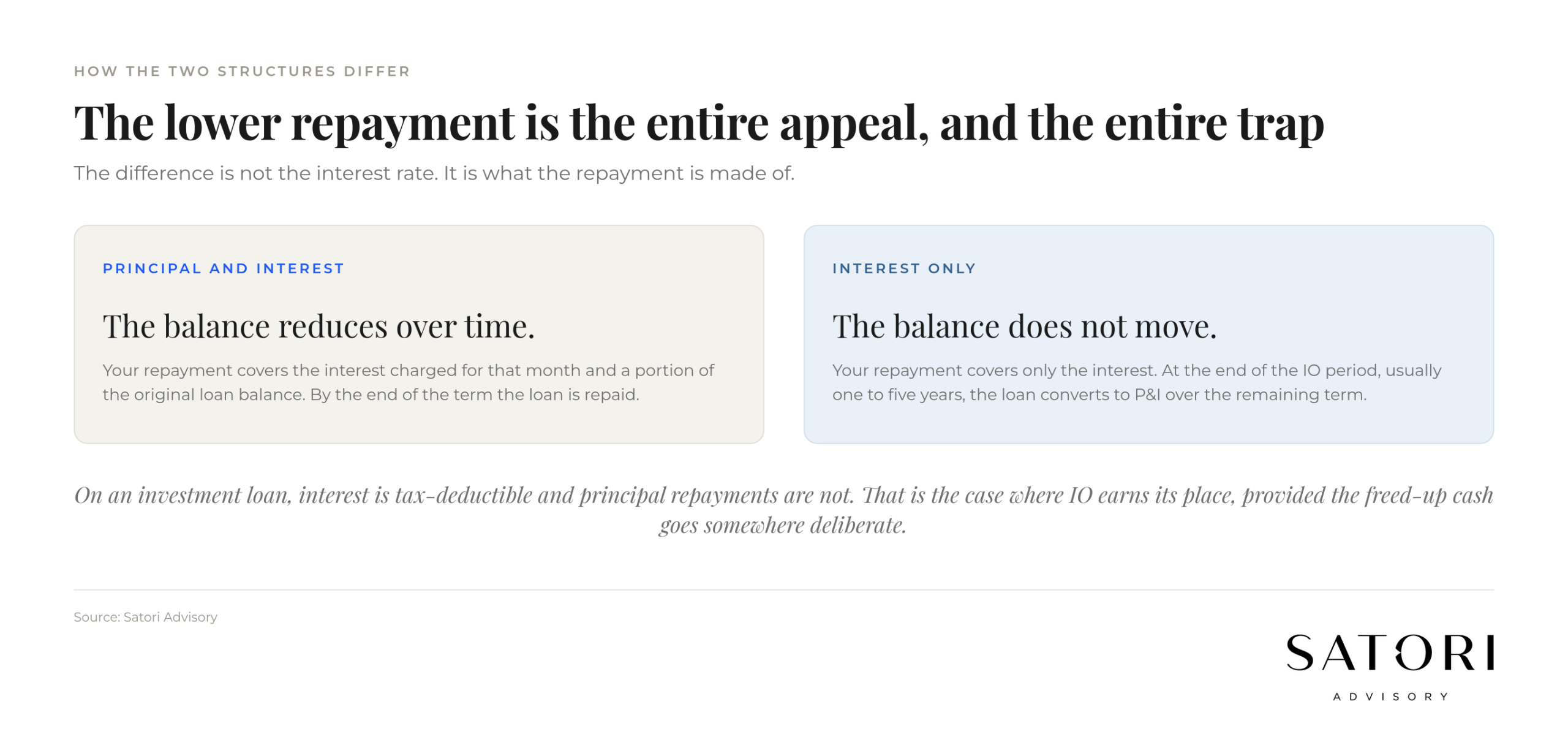
On a P&I loan, your monthly repayment covers both the interest charged for that month and a portion of the original loan balance. The balance reduces over time. By the end of the loan term, the balance is zero.
On an IO loan, your monthly repayment covers only the interest. The loan balance does not reduce during the IO period. At the end of the IO period (usually one to five years, sometimes longer for investment loans), the loan either converts to P&I or you need to refinance.
The IO repayment is lower than the P&I repayment on the same loan, because you are not paying down principal. That is the entire appeal. It is also the entire trap.
When IO makes sense
Two scenarios where IO earns its place.
Investment property cashflow
Interest on an investment loan is tax-deductible. Principal repayments are not. Keeping the loan on IO means more of your repayment is tax-deductible, and your out-of-pocket cashflow is lower while the property generates rent.
This works well when the rest of your financial plan uses the freed-up cash productively, such as paying down a non-deductible owner-occupied loan or making concessional super contributions (up to the $32,500 cap).
Bounded transition periods
If you have a short, clearly bounded period of constrained cashflow (parental leave, a planned career break, a renovation that will lift the property’s value), IO can take pressure off the monthly budget without permanently changing the loan structure.
The key word is bounded. IO works for two years to get through a planned period. IO does not work as a default for ten years.
When IO costs you money
On an owner-occupied home loan by default. If you are not using the lower repayment to do something specific and intentional, you are paying more for the loan over its life and you are not building equity in your home.
When the rate premium on IO loans is large. Many lenders charge a higher rate on IO than on P&I (a regulatory response to APRA serviceability concerns), which can erase the cashflow benefit.
When the IO period is long and there is no plan for what happens at the end. If your loan term is 30 years and you take 5 years of IO followed by 25 years of P&I on the original balance, you are paying off the same amount over a shorter remaining period. The P&I repayment when the IO ends can be a meaningful step up.
What happens when the IO period ends
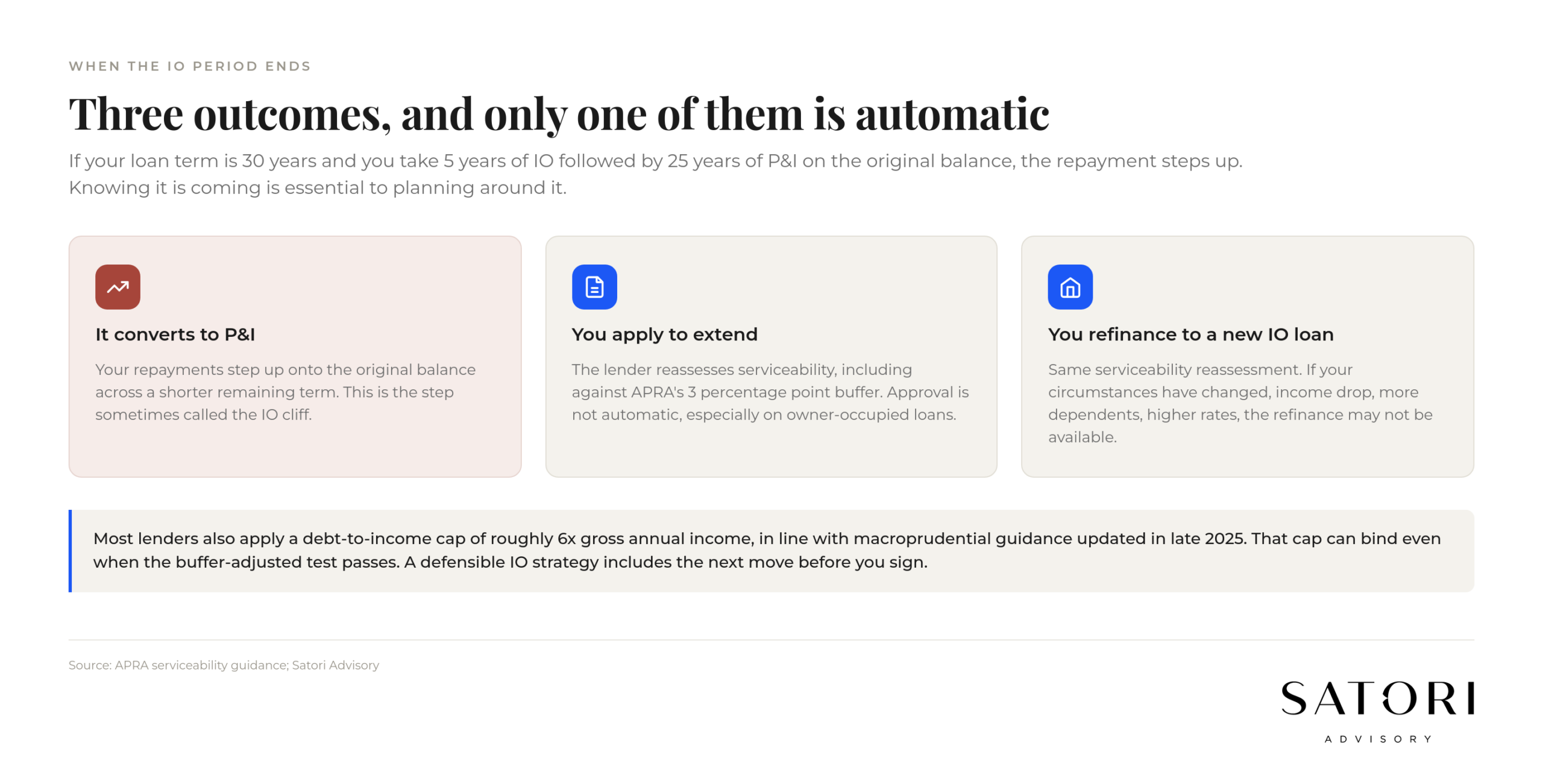
Three outcomes are common.
The loan automatically converts to P&I. Your repayments step up. If the increase is meaningful, this is sometimes called the IO cliff. Knowing it is coming is essential to planning around it.
You apply to extend the IO period. The lender reassesses serviceability, including against APRA’s 3 percentage point buffer. Approval is not automatic, especially on owner-occupied loans where the IO regulatory stance has hardened.
You refinance to a new IO loan. Same serviceability reassessment applies. If your circumstances have changed (income drop, more dependents, higher general interest rates), the refinance may not approve at the same loan amount.
The APRA serviceability landscape in 2026
APRA has maintained the serviceability buffer at 3 percentage points since late 2021. Lenders must add this buffer to the actual rate when assessing whether a borrower can repay.
What this means in practice: when you apply for or extend an IO loan, the lender is assessing whether you can afford the loan at a rate noticeably higher than the rate you will pay. If your rate is 6.0%, the lender tests serviceability at 9.0%.
Most lenders also apply a debt-to-income (DTI) cap of roughly 6x gross annual income, in line with macroprudential guidance updated in late 2025. That cap can bind even when the buffer-adjusted serviceability test passes.
Both settings affect IO applications and extensions. APRA has signalled no change to either through 2026.
How to decide between IO and P&I
Three questions.
Is the loan on an investment property or your owner-occupied home? If investment, IO has a credible case. If owner-occupied, the default should be P&I unless you have a specific bounded reason to deviate.
What will you do with the cashflow difference? If the answer is ‘pay down non-deductible debt’ or ‘maximise concessional super contributions’ or ‘fund a clearly bounded transition’, IO is doing real work. If the answer is ‘have more spending money’, IO is costing you long-term wealth for short-term comfort.
What is the plan for when the IO period ends? If the answer is ‘we will figure it out then’, the plan is incomplete. A defensible IO strategy includes the next move before you sign.
What to do next
If you have an IO loan with the period ending in the next 12 months, run the P&I conversion math now. The step-up can be material.
If you have an investment property on P&I and are paying non-deductible debt down slowly, model switching to IO with the freed-up cashflow directed at the non-deductible debt.
If you are unsure which structure fits your specific situation, that is a conversation worth having with a broker who works inside an integrated advice picture.
How Satori Advisory works
At Satori Advisory we integrate your tax, business, wealth and lending as a prosperity engine, aligned with what matters most to you. With a clear roadmap, informed by data and backed by decades of strategic experience, we simplify the complex. We don’t offer pre-packaged solutions. We deliver tailored, end-to-end advice that reflects your reality and ambitions. You’ll work directly with senior advisers who listen deeply, think boldly and act with purpose. Feel cared for by our trusted team and curated network of financial and business specialists, as we empower you to make smart decisions and realise your potential, powered by numbers.
Frequently asked questions
What is an interest only loan?
A loan where your monthly repayment covers only the interest charged that month, not any of the loan balance. The balance does not reduce during the interest only period. At the end of that period the loan converts to principal and interest, or you refinance.
How do interest only loans work in Australia in 2026?
You agree to an interest only period (usually 1 to 5 years for owner-occupiers, sometimes longer for investment loans) during which you only pay interest. After that period the loan switches to principal and interest, and your repayments step up to cover the original loan balance over the remaining term.
Is interest only better than principal and interest?
Rarely for owner-occupied home loans. Often defensible for investment property loans, where interest is tax-deductible and the freed-up cashflow can be used productively elsewhere. The right answer depends on what you do with the cashflow difference.
What happens at the end of an interest only loan period?
The loan typically converts to principal and interest, with repayments stepping up to cover the original balance over the remaining term. You can also apply to extend the IO period or refinance, both subject to APRA serviceability reassessment at the new lender.
Why is the interest only rate higher than principal and interest?
Lenders charge a premium on interest only loans because APRA has tightened the regulatory treatment of IO lending. The premium discourages IO as a default and compensates for the higher risk profile.
Can I get an interest only loan on an owner-occupied property?
Sometimes. Lenders apply tighter assessment to IO loans on owner-occupied properties than on investment loans. Approval typically requires a clear stated purpose for the IO structure, and the loan amount may be capped lower than the equivalent P&I loan.
What is the APRA serviceability buffer for interest only loans in 2026?
3 percentage points. APRA has maintained the buffer at this level since late 2021, with no signalled change for 2026. The buffer applies to all new applications and extensions, including IO.
Ready to talk?
If you would like a calm, no-pressure conversation about how this applies to your specific situation, we are here to help.
Please feel free to get in touch on 1300 925 081 or send an email to [email protected] if you’d like to book in a chat on the above or on other matters.
Disclaimer
This article contains general information only and has been prepared without considering your objectives, financial situation or needs. It is not personal financial advice, taxation advice or legal advice and should not be relied upon when making financial decisions. Before acting on any information, consider its appropriateness to your circumstances and seek professional advice where appropriate.