
Table of Contents
This is a boring but necessary one, best treated like an explainer rather than a headline. The Stage 3 tax cuts were redesigned and legislated to apply from 1 July 2024, changing the resident income tax rates and thresholds. In simple terms, most taxpayers received some level of benefit, but the biggest reshuffle was that the changes were redistributed so lower and middle income earners received larger cuts than under the original Stage 3 plan, while higher income earners received a smaller cut than originally expected.
If you are unsure whether it has affected you, or how it flows into your cash flow and planning, the best place to start is understanding the brackets that apply now.
What changed from 1 July 2024
The redesigned Stage 3 changes that took effect from 1 July 2024 can be summarised in four moves:
- The 19 percent marginal rate was reduced to 16 percent.
- The 32.5 percent marginal rate was reduced to 30 percent.
- The threshold for the 37 percent bracket moved from $120,000 to $135,000.
- The threshold for the 45 percent bracket moved from $180,000 to $190,000.
Current Australian resident tax brackets (from 1 July 2024)
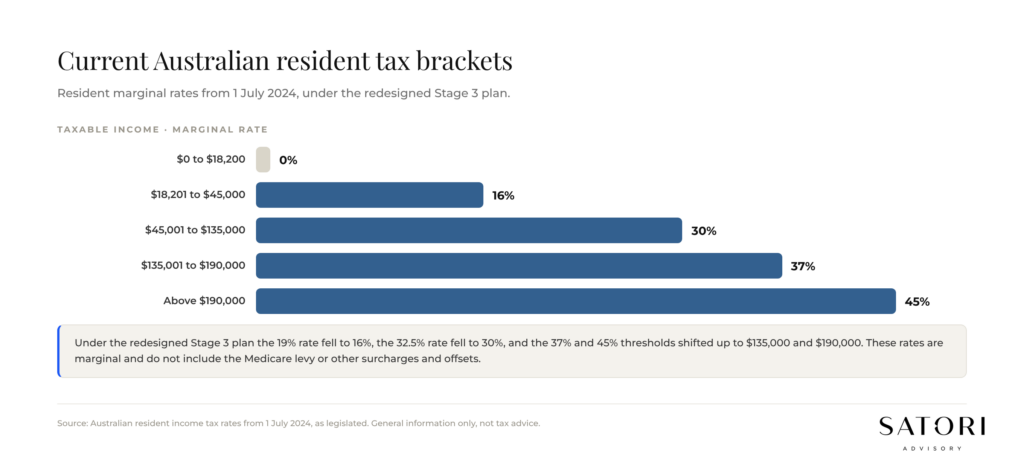
| Taxable income (AUD) | Marginal tax rate |
| $0 to $18,200 | 0% |
| $18,201 to $45,000 | 16% |
| $45,001 to $135,000 | 30% |
| $135,001 to $190,000 | 37% |
| $190,001 and over | 45% |
Important note. These rates are marginal rates and do not include the Medicare levy or any other levies, offsets, or surcharge impacts that can apply depending on your circumstances.
Further tax cuts from 1 July 2026 and 1 July 2027
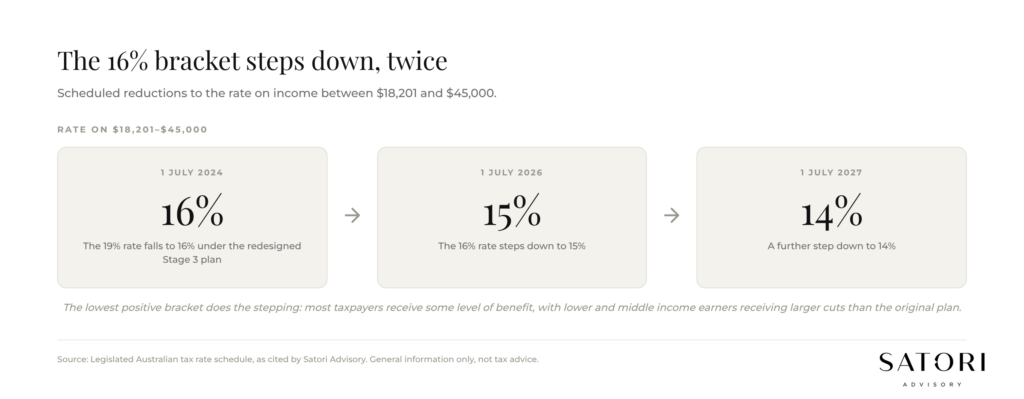
The current legislation also schedules further reductions to the 16 percent bracket rate.
| Date effective | Taxable income range (AUD) | Rate |
| From 1 July 2024 | $18,201 to $45,000 | 16% |
| From 1 July 2026 | $18,201 to $45,000 | 15% |
| From 1 July 2027 | $18,201 to $45,000 | 14% |
Who benefited most from the redesign
The intent of the redesign was to redistribute benefits so lower and middle income earners received larger tax cuts than they would have under the legislated Stage 3 plan that existed prior to the change.
What this means for planning
Most people treat tax cuts like a windfall. The smarter approach is to treat them like a planning input. A small shift in after-tax income can be a good opportunity to tighten systems, reduce expensive debt, build buffers, or increase consistent investing, without relying on motivation.
Tax is rarely a single number. It is a system, and timing, structure, and thresholds matter.
What to do next
If you want a simple next step, identify your expected taxable income range, then confirm which bracket changes apply to you now, and what may change again from 1 July 2026 and 1 July 2027.
If you have concerns about how these rates affect your cash flow, or you want to make sure you are not missing simple planning opportunities, give us a call and we can sense check it with you.
How Satori Advisory works
At Satori Advisory we energise every part of your financial world. We integrate your tax, business, wealth and lending as a prosperity engine, aligned with what matters most to you. With a clear roadmap, informed by data and backed by decades of strategic experience, we simplify the complex. Tax brackets are an input, not a strategy. The work is connecting them to your cash flow, debt, super, and structure so a small change in after-tax income compounds. We do not offer pre-packaged solutions. We deliver tailored, end-to-end advice that reflects your reality and ambitions. You work directly with senior advisers who listen deeply, think boldly and act with purpose, supported by our trusted team and curated network of financial and business specialists, so you can realise your potential, powered by numbers.
Frequently asked questions
What are the current Stage 3 tax brackets in Australia?
From 1 July 2024, resident tax rates include 16 percent for $18,201 to $45,000, 30 percent for $45,001 to $135,000, 37 percent for $135,001 to $190,000, and 45 percent for $190,001 and over.
What changes are coming to tax rates in 2026 and 2027?
The legislated step down of the 16 percent rate to 15 percent applies from 1 July 2026, and a further reduction to 14 percent is legislated from 1 July 2027. The ATO had not yet published its 2026-27 resident rates table at the time of review, so confirm the current-year rate at ato.gov.au before acting.
Do these tax rates include the Medicare levy?
No. The marginal tax rates and thresholds are separate from the Medicare levy and other possible levies, offsets, or surcharges that may apply.
Who benefited most from the redesigned Stage 3?
The intent of the redesign was to redistribute benefits so lower and middle income earners received larger cuts than under the original Stage 3 plan. Higher income earners received a smaller cut than originally expected.
How should I use a tax cut in my plan?
Treat it as a planning input, not a windfall. A small shift in after-tax income is a good moment to reduce expensive debt, build buffers, or increase consistent investing without relying on motivation.
Ready to talk?
If you would like a calm, no-pressure conversation about how the current and scheduled tax brackets affect your plan, we would be glad to set one up.
Please feel free to get in touch on 1300 925 081 or send an email to [email protected] if you’d like to book in a chat on the above or on other matters.
Disclaimer
This article contains general information only and has been prepared without considering your objectives, financial situation or needs. It is not personal financial advice, taxation advice or legal advice and should not be relied upon when making financial decisions. Before acting on any information, consider its appropriateness to your circumstances and seek professional advice where appropriate.